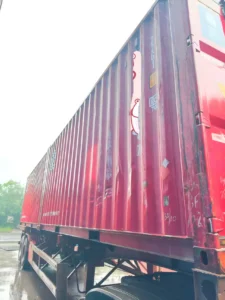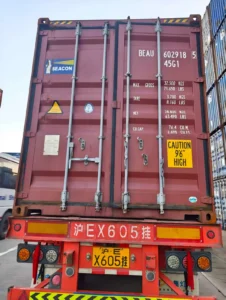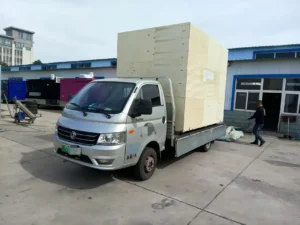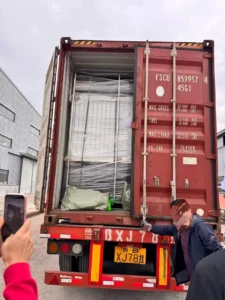
The LCL shipping cost from China to Canada depends on cargo volume, chargeable weight, China origin, Canadian destination, consolidation charges, ocean freight, customs clearance and final delivery requirements.
LCL — Less than Container Load — allows multiple shippers to share space inside one container. Instead of paying for an entire 20ft or 40ft container, an importer pays for the space used by the shipment.
This makes LCL particularly useful for smaller commercial shipments that do not require a complete container.
However, the ocean freight rate per CBM is only one part of the total cost.
A complete LCL shipment may include China factory pickup, warehouse receiving, CFS handling, export customs clearance, consolidation, ocean freight, Canadian deconsolidation, destination charges, customs brokerage and truck delivery.
For a complete overview of FCL, LCL, 20GP and 40HQ costs, see our China to Canada Shipping Cost guide.
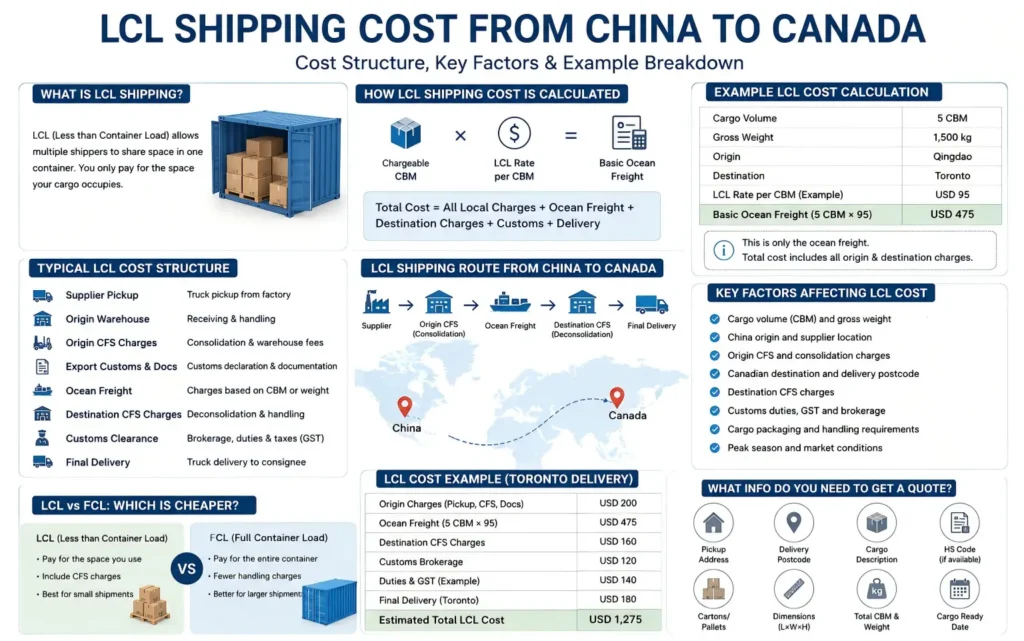
How Much Does LCL Shipping from China to Canada Cost?
There is no permanent fixed LCL shipping cost from China to Canada.
Unlike FCL, where the carrier usually quotes the freight per container, LCL pricing is generally based on the amount of container space occupied by the cargo.
A simple ocean-freight calculation can be expressed as:
Chargeable CBM × LCL Rate per CBM = Basic Ocean Freight
But the final logistics cost can include substantially more than this basic freight calculation.
For example, a shipment of 5 CBM may also require China pickup, origin CFS charges, documentation, customs declaration, destination CFS charges, customs brokerage and final truck delivery.
Therefore, importers should compare the total LCL transportation cost, not only the advertised rate per CBM.
How Is LCL Shipping Cost Calculated?
LCL freight is normally calculated according to chargeable volume or weight.
Cargo volume is calculated using:
Length × Width × Height = CBM
For multiple cartons or pallets:
CBM per package × number of packages = total CBM
Freight providers then apply the relevant LCL charging rule based on the cargo’s volume and weight.
BRF SHIPPING’s existing LCL service explains that LCL shipments share container space and are generally charged according to volume, with weight also affecting the calculation in some cases.
Example LCL Cost Calculation
Consider a commercial shipment with the following profile:
| Cargo Detail | Example |
|---|---|
| Packages | 10 pallets |
| Total Volume | 5 CBM |
| Gross Weight | 1,500 kg |
| Origin | Qingdao |
| Destination | Toronto |
| Shipping Method | LCL |
The basic ocean freight might begin with:
5 CBM × current LCL freight rate
But this is only the international freight component.
The complete quotation should also consider:
China Pickup + Origin CFS + Export Customs + Ocean Freight + Canada CFS + Customs + Inland Delivery
This is why two freight forwarders quoting the same ocean rate may still produce very different total shipment costs.
What Charges Are Included in LCL Shipping?
The cost structure of an LCL shipment is different from an FCL container.
| Shipping Stage | Typical LCL Cost |
|---|---|
| Supplier Pickup | Truck pickup from factory |
| China Warehouse | Receiving and handling |
| Origin CFS | Consolidation and warehouse charges |
| Export Customs | Customs declaration |
| Documentation | Shipping documents and handling |
| Ocean Freight | Rate based on chargeable volume/weight |
| Canada CFS | Deconsolidation and handling |
| Customs | Brokerage, duties and tax |
| Final Delivery | Truck delivery to consignee |
Understanding these individual cost components is essential when comparing the LCL shipping cost from China to Canada.
China Origin LCL Charges
Before cargo can be loaded into the shared container, it normally has to move through an export warehouse or Container Freight Station.
The China-side process may look like:
Supplier → Pickup Truck → CFS Warehouse → Cargo Receiving → Consolidation → Export Container
Origin costs can include warehouse receiving, forklift handling, documentation, export declaration and consolidation.
If goods are purchased from several suppliers, BRF SHIPPING can also coordinate supplier pickup and consolidate the cargo before export.
Multi-Supplier Consolidation
LCL can be particularly useful when an importer buys smaller quantities from multiple Chinese factories.
For example:
Supplier A: 1.5 CBM
Supplier B: 2 CBM
Supplier C: 1.5 CBM
can potentially be combined into:
5 CBM LCL shipment
instead of arranging three separate international shipments.
Consolidation can reduce duplicated international shipping and destination handling, although the actual savings depend on supplier locations and warehouse costs.
LCL Shipping Cost from Shanghai to Canada
Shanghai is an important consolidation gateway for cargo originating in Eastern China.
Factories in Shanghai, Jiangsu, Zhejiang and surrounding manufacturing areas may route LCL cargo through an appropriate Shanghai-area CFS depending on the actual supplier location and sailing schedule.
A typical shipment can move:
Supplier → Shanghai CFS → Consolidation → Canada → Deconsolidation → Delivery
The final cost depends on both China origin handling and the Canadian destination.
LCL Shipping Cost from Ningbo to Canada
Ningbo is another major LCL export gateway for factories located in Zhejiang and nearby regions.
For smaller commercial shipments, Ningbo can be compared with Shanghai according to:
supplier location, pickup cost, consolidation schedule, sailing frequency and destination charges.
The lowest ocean freight per CBM does not necessarily produce the lowest total logistics cost.
LCL Shipping Cost from Qingdao to Canada
Qingdao is a practical consolidation gateway for cargo produced in Shandong and Northern China.
BRF SHIPPING can coordinate:
Factory Pickup → Qingdao Warehouse → LCL Consolidation → Export Customs → Ocean Freight → Canada
This can be suitable for smaller shipments of industrial products, machinery parts, fitness equipment, aluminum products, hardware and general commercial cargo.
LCL Shipping Cost from Shenzhen to Canada
For factories located in Shenzhen, Dongguan, Guangzhou, Foshan and surrounding parts of South China, LCL cargo can be consolidated through South China export warehouses.
Important cost factors include the distance between the factory and CFS, warehouse handling, cargo volume and the destination service available in Canada.
LCL Shipping Cost to Vancouver
Vancouver is one of BRF SHIPPING’s major Canada gateways for China-origin ocean freight. The company’s China-to-Canada sea-freight service also covers LCL cargo alongside FCL and inland delivery.
For cargo whose final destination is Vancouver or nearby British Columbia, the routing may be:
China CFS
↓
Ocean Freight
↓
Vancouver CFS
↓
Customs Clearance
↓
Local Truck Delivery
The final cost should include both destination CFS charges and local delivery.
LCL Shipping Cost to Toronto
For a Toronto importer, the total cost can be more complex because Toronto is an inland market.
Depending on the selected consolidation service, cargo may enter through an appropriate Canadian gateway before moving inland.
The shipment may involve:
China CFS → Canadian Gateway → Inland Transportation → Toronto Warehouse
Therefore, when requesting an LCL shipping cost from China to Canada, provide the Toronto delivery postcode rather than requesting only a generic Canada rate.
This allows the forwarder to calculate the complete destination cost.
LCL Shipping Cost to Montreal
Montreal can be an important destination for businesses importing smaller commercial cargo into Quebec and Eastern Canada.
The total quotation can include international LCL freight, Canadian CFS handling, customs clearance and final delivery.
The correct routing depends on the origin consolidation service and final destination.
LCL Shipping Cost to Calgary and Edmonton
For cargo destined for Alberta, inland transportation becomes an important part of the total cost.
A low port-to-port LCL rate may not be the most economical route once inland handling and final delivery are added.
For this reason, BRF SHIPPING recommends quoting LCL shipments using the complete Canadian delivery address.
What Are CFS Charges?
CFS stands for Container Freight Station.
Because LCL cargo shares a container with other shipments, the goods must be consolidated before departure and separated after arrival.
A typical flow is:
Factory → Origin CFS → Consolidation → Container → Vessel → Destination CFS → Deconsolidation → Delivery
This creates handling charges that do not apply in exactly the same way to a full-container shipment.
CFS charges are therefore one of the key reasons that LCL should be compared on a total-cost basis instead of ocean freight alone.
Origin CFS vs Destination CFS Charges
Origin CFS
The origin warehouse receives the cargo, checks shipment details and prepares goods for consolidation.
Typical costs may include warehouse handling, pallet handling, documentation and consolidation.
Destination CFS
After the container arrives in Canada, the consolidated cargo must be separated so each consignee’s shipment can be released.
Destination costs may include deconsolidation, warehouse handling, documentation and release-related charges.
For small shipments, these fixed destination charges can represent a meaningful percentage of the total transportation cost.
Port-to-Port LCL Shipping Cost
A port-to-port LCL quotation generally does not represent the complete logistics budget.
For example:
Shanghai CFS → Vancouver CFS
may exclude:
China supplier pickup, Canadian customs brokerage, duties, GST and final truck delivery.
Port-to-port pricing is most useful when the importer already controls destination logistics.
Door-to-Door LCL Shipping Cost
For many Canadian importers, door-to-door LCL pricing provides a clearer view of the actual shipment budget.
A complete shipment can be:
China Supplier
↓
Factory Pickup
↓
China CFS
↓
LCL Consolidation
↓
Ocean Freight
↓
Canada CFS
↓
Customs Clearance
↓
Truck Delivery
↓
Customer Warehouse
BRF SHIPPING already provides China-origin pickup, LCL, customs coordination and final-delivery services as part of its broader logistics network.
For the broader route and destination overview, see Shipping from China to Canada.
LCL vs FCL: Which Is Cheaper?
LCL is normally attractive when the shipment does not require a full container.
FCL becomes increasingly competitive as cargo volume increases.
The comparison should not be based only on:
LCL rate per CBM vs FCL ocean freight
Instead, compare:
| LCL | FCL |
|---|---|
| Origin CFS | Container positioning |
| LCL consolidation | Container trucking |
| Freight by CBM | Freight per container |
| Destination CFS | Destination container charges |
| Deconsolidation | Container drayage |
| Final delivery | Final delivery |
As volume increases, LCL warehouse and destination charges can make a dedicated container more competitive.
When Should You Compare LCL with a 20GP?
This is one of the most important cost decisions for importers.
A shipment does not need to physically fill every cubic meter of a 20GP before FCL becomes worth comparing.
When LCL volume becomes substantial, request two quotations:
Option A — Total LCL Cost
and
Option B — Total 20GP FCL Cost
Then compare the complete origin-to-destination amount.
If your cargo is approaching a size where FCL may be practical, read:
20ft Container Shipping Cost from China to Canada
LCL vs 40ft Container
For much larger shipments, a 40GP or 40HQ can provide considerably more cargo capacity and typically shifts the pricing structure from per-CBM LCL charges to full-container pricing.
If the cargo is already large enough to require a substantial share of a container, compare the LCL total against both 20GP and 40ft options.
For larger commercial loads, see:
40ft Container Shipping Cost from China to Canada
Is LCL Always Cheaper for Small Shipments?
Not necessarily.
LCL avoids paying for a complete container, which makes it practical for many smaller shipments.
However, the shipment also passes through consolidation and deconsolidation warehouses.
This introduces origin and destination charges.
For very small cargo, the minimum charge and destination handling can make the cost per CBM relatively high.
The correct approach is to calculate the complete door-to-door cost.
Weight vs Volume in LCL Shipping
LCL cargo is not always priced only by physical cubic meters.
Dense cargo can be affected by its weight.
For example, two shipments may each occupy 3 CBM, but one may weigh substantially more than the other.
The freight provider therefore needs both:
Total CBM
and
Gross Weight
before confirming the chargeable quantity.
This is especially important for machinery, metal products, stone products and other dense cargo.
Palletized vs Loose Carton LCL Cargo
Packaging can affect LCL cost.
Pallets can improve handling and cargo protection but may increase total cubic volume.
Loose cartons may use space more efficiently but may involve additional handling considerations depending on the cargo.
Before palletizing, importers should compare:
cargo protection
versus
additional CBM
because LCL cost can increase when packaging increases the shipment volume.
Canada Customs Costs for LCL Cargo
LCL cargo entering Canada is still subject to normal commercial import requirements.
Customs-related costs are separate from ocean freight and can include customs brokerage, applicable customs duty and GST.
The CBSA states that 5% GST is payable on most imported goods, while the applicable duty depends on the product classification, origin and tariff treatment.
Canada’s CARM system is the official system of record for commercial import accounting and payment of duties and taxes.
Importers should therefore confirm the HS code, customs value, product origin and importer setup before shipment.
Does LCL Freight Include Duty and GST?
Not automatically.
A basic LCL freight quotation may include only origin handling and international freight.
Another quotation may include:
Pickup + Freight + Customs + Delivery
Always confirm whether the quotation includes or excludes Canadian duties and taxes.
This is particularly important when comparing DAP, DDP, FOB or EXW shipping arrangements.
What Factors Increase LCL Shipping Cost?
The most important cost factors are:
- Cargo CBM and gross weight
- China factory location
- Origin CFS
- Canadian gateway
- Destination CFS charges
- Final delivery postcode
- Cargo packaging
- Special handling requirements
- Customs requirements
- Peak shipping periods
- Shipment frequency
The total route should be optimized as one logistics chain rather than pricing each stage independently.
How to Reduce LCL Shipping Cost from China to Canada
Consolidate Multiple Purchase Orders
Instead of sending several small shipments separately, consider combining them into one larger LCL shipment.
This can reduce repeated minimum charges and documentation costs.
Reduce Unnecessary Packaging Volume
Because volume directly affects LCL pricing, oversized cartons or inefficient palletization can increase cost.
Choose the Correct Export Warehouse
The cheapest consolidation rate may not be economical if the supplier must truck cargo a long distance to reach the CFS.
Compare LCL and FCL
As cargo volume increases, compare the total LCL cost against a 20GP.
Provide the Final Canadian Postcode
This allows the forwarder to calculate inland delivery rather than providing only an incomplete port rate.
Prepare Cargo Early
Allowing more time before the cargo-ready date gives the logistics provider more routing and consolidation options.
Example Total LCL Cost Structure
A complete shipment calculation can be expressed as:
China Factory Pickup
Origin Warehouse / CFS
Export Customs
Documentation
LCL Ocean Freight
Canada Destination CFS
Customs Brokerage
Duty and GST
Final Truck Delivery
=
Total LCL Shipping Cost from China to Canada
This total is more useful for purchasing and logistics budgeting than the ocean rate per CBM alone.
What Information Is Needed for an LCL Quote?
To calculate an accurate quotation, send BRF SHIPPING:
- China supplier or pickup address
- Canadian delivery address/postcode
- Product description
- HS code if available
- Number of cartons or pallets
- Dimensions of each package
- Total CBM
- Gross weight
- Cargo-ready date
- Incoterm
- Any dangerous or special cargo information
These details allow the logistics team to determine the chargeable quantity, appropriate consolidation warehouse and Canadian delivery route.
LCL Shipping Cost from China to Canada FAQ
What is the LCL shipping cost from China to Canada?
There is no permanent fixed rate.
The cost depends on cargo CBM, weight, China origin, Canadian destination, consolidation charges, customs and delivery requirements.
A current quotation should be based on the actual shipment details.
How is LCL freight calculated?
LCL freight is generally calculated according to chargeable volume or weight.
The freight provider needs cargo dimensions, total CBM and gross weight before confirming the final chargeable quantity.
Is LCL cheaper than a 20ft container?
For smaller shipments, LCL is often more practical because the importer does not pay for a complete container.
As cargo volume increases, a 20GP may become more competitive after LCL origin and destination charges are included.
How many CBM should I ship by LCL?
There is no universal cutoff.
The point where FCL becomes more economical depends on the current LCL rate, container rate, destination charges, cargo weight and delivery location.
Compare both LCL and 20GP quotations when the shipment becomes larger.
Can BRF SHIPPING pick up LCL cargo from my supplier?
Yes.
BRF SHIPPING can coordinate China factory pickup and move cargo to the appropriate export warehouse or consolidation facility.
Can goods from multiple Chinese suppliers be combined?
Yes, where practical.
Multiple supplier shipments can be received at a warehouse and consolidated before international transportation.
Can LCL cargo be shipped to Vancouver?
Yes.
Vancouver is one of the Canadian gateways covered by BRF SHIPPING’s China-to-Canada sea freight services.
Can LCL cargo be delivered to Toronto?
Yes, subject to the selected route and delivery arrangement.
Provide the Toronto postcode when requesting a quotation so inland transportation can be included.
Does LCL shipping include customs clearance?
Only if customs clearance is specifically included in the quotation.
Always check the exact service scope.
Does an LCL quotation include Canadian GST?
Not automatically.
GST, customs duty and customs brokerage should be confirmed separately unless they are explicitly included in the quotation.
Get an LCL Shipping Quote from China to Canada
Need the current LCL shipping cost from China to Canada?
Send BRF SHIPPING your supplier location, Canadian delivery postcode, cargo dimensions, total CBM, gross weight and cargo-ready date.
We can evaluate the complete route:
China Pickup → CFS Consolidation → Export Customs → LCL Sea Freight → Canada CFS → Customs → Truck Delivery
and compare LCL with FCL when your cargo volume is large enough to justify both options.
Continue Reading
20ft Container Shipping Cost from China to Canada
40ft Container Shipping Cost from China to Canada
Sea Freight from China to Canada
Request Your China-to-Canada LCL Quote