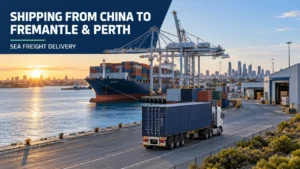
Shipping from China to Fremantle and Perth can be arranged by full container load (FCL), less than container load (LCL), air freight or a complete door-to-door service. Fremantle is the sea-freight gateway, while Perth and the surrounding industrial areas are the main final-delivery market. Importers therefore need to plan the port arrival and the inland delivery as one connected route.
BRF Shipping can coordinate supplier pickup in China, export customs declaration, FCL or LCL ocean freight, Australian customs and biosecurity processing, and final delivery to a warehouse, commercial address or approved project site in Western Australia.
This guide explains shipping methods, transit times, cost components, Fremantle arrival procedures and delivery options across Perth. It also includes a real 1.12 CBM LCL shipment of artificial fishing bait from Yantai to Fremantle via Qingdao Port.
Request a quote: Send the pickup city, cargo description, packing list, total weight and volume, Incoterm, cargo-ready date and Western Australia delivery postcode to BRF Shipping.
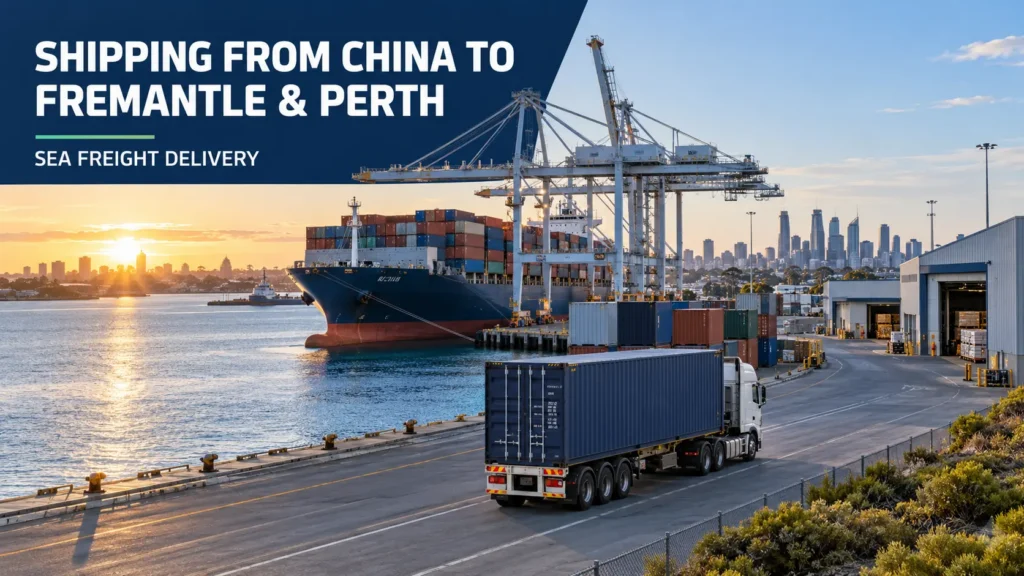
How Fremantle Port Connects to Perth Deliveries
Fremantle and Perth usually describe different parts of the same shipment.
- Fremantle is the port destination for containerised sea freight.
- Perth is the metropolitan delivery market for warehouses, distributors, factories, retailers and project sites.
- A door-to-door shipment normally arrives through Fremantle and continues by road to a Perth-area address.
The complete transport route is therefore: China supplier → Chinese port → Fremantle Port → Perth or Western Australia delivery address.
Fremantle Ports states that the Inner Harbour handles almost all of Western Australia’s container trade. Official port information is available from Fremantle Ports.
China to Fremantle and Perth Shipping Options
| Shipping method | Best suited to | Typical freight time* | Western Australia delivery |
|---|---|---|---|
| FCL sea freight | Large, heavy or high-volume shipments using a dedicated container | About 16–30 days port to port | Container delivery, side-loader or depot unpack |
| LCL sea freight | Commercial cargo that does not fill a full container | About 22–40+ days port to port | Pallet, crate or carton delivery |
| Air freight | Urgent, lightweight or high-value cargo | About 3–8 days airport to airport | Perth warehouse or business delivery |
| Door-to-door sea freight | Importers needing one coordinated route from supplier to WA destination | Commonly 25–48+ days | Perth metro and regional WA by quotation |
*Transit times are planning ranges, not guaranteed schedules. Chinese origin, vessel routing, transshipment, consolidation, customs and biosecurity intervention, terminal or depot release and final-delivery availability can all affect the total timeline.
For a national service overview, visit shipping from China to Australia. For a complete cost comparison, see shipping cost from China to Australia.
Sea Freight from China to Fremantle
Sea freight is normally the most practical method for heavy, bulky or non-urgent commercial cargo moving to Western Australia. Importers can reserve a complete container through FCL or share space with other shippers through an LCL consolidation service.
BRF Shipping can coordinate:
- Pickup from a factory or supplier in China
- China warehouse receiving and multi-supplier consolidation
- Export customs declaration and origin documentation
- FCL or LCL ocean freight to Fremantle
- Pre-arrival customs and biosecurity document coordination
- Terminal or unpack-depot release
- Container, pallet, crate or loose-cargo delivery in Western Australia
- Empty-container return for FCL shipments
For detailed ocean-service information, read sea freight from China to Australia.
Major Shipping Routes from China to Fremantle
Cargo can be shipped from China’s main container ports. The best origin gateway depends on the supplier address, inland pickup cost, sailing schedule, consolidation availability and total transit time.
Common routes include:
- Shanghai to Fremantle: Suitable for cargo from Shanghai, Jiangsu, Zhejiang and nearby manufacturing regions.
- Ningbo to Fremantle: Often used for suppliers in Zhejiang and the Yangtze River Delta.
- Shenzhen or Yantian to Fremantle: Common for goods from Shenzhen, Dongguan, Huizhou and the Pearl River Delta.
- Guangzhou or Nansha to Fremantle: Suitable for factories in Guangzhou, Foshan, Zhongshan and nearby cities.
- Qingdao to Fremantle: A practical gateway for cargo from Shandong, including suppliers in Yantai, Weifang, Linyi and Qingdao.
- Tianjin to Fremantle: Used for cargo from Tianjin, Beijing, Hebei and northern China.
- Xiamen to Fremantle: Common for cargo manufactured in Fujian and surrounding areas.
Some routes use direct sailings, while others involve transshipment. The lowest ocean rate is not always the lowest total cost if the routing creates a long transshipment delay or requires expensive inland transport in China.
FCL Shipping from China to Fremantle
FCL shipping gives one shipper the use of a full container. It is normally suitable for larger orders, heavy cargo, machinery, construction products, furniture or shipments that benefit from fewer handling points.
20ft container shipping to Fremantle
A 20ft general-purpose container is often used for dense cargo such as machinery, tiles, stone products, metal components and building materials. Weight distribution and road-transport limits must be reviewed before loading, even when the container still has available internal space.
See 20ft container shipping cost from China to Australia for cost factors and planning considerations.
40ft and 40HQ shipping to Fremantle
A 40ft general-purpose or 40HQ container is commonly used for furniture, fencing, panels, packaging, retail inventory, light machinery and other high-volume cargo. A 40HQ provides additional internal height, but the correct equipment must be selected using actual package dimensions, volume and weight.
See 40ft container shipping cost from China to Australia for a detailed comparison.
When FCL is usually the better choice
FCL may be suitable when:
- The cargo occupies a substantial part of a container
- The goods are heavy, long, fragile or difficult to consolidate
- Several Chinese supplier orders can be combined
- The importer wants a sealed-container movement
- The receiving site can accept and unload a container
- Reducing handling points is more important than booking the smallest freight allocation
The final container selection should be based on the packing list and loading plan—not only product quantity or estimated cubic volume.
LCL Shipping from China to Fremantle
LCL shipping allows multiple shippers to share a container. It is often the most economical method for smaller commercial shipments that do not justify a dedicated 20ft container.
LCL freight is usually charged on a weight-or-measure basis. The chargeable quantity is commonly expressed as revenue tons, subject to the consolidator’s tariff, minimum charges and verified warehouse measurements.
The complete cost may include:
- Supplier pickup in China
- Origin CFS or consolidation warehouse receiving
- Measurement, labeling and export documentation
- China export customs declaration
- Ocean freight to Fremantle
- Destination deconsolidation and depot charges
- Customs and biosecurity processing
- Pallet, crate or carton delivery to the Perth area
LCL cargo is handled more frequently than FCL cargo. Strong export packaging, waterproof protection where required, clear shipping marks and accurate dimensions reduce the risk of damage, loss and billing adjustments.
For a full cost guide, see LCL shipping cost from China to Australia.
Real LCL Case: Yantai to Fremantle via Qingdao
BRF Logistics coordinated a door-to-door LCL shipment of artificial fishing bait from a supplier in Yantai, Shandong, to the Fremantle area of Western Australia.
Shipment details
| Item | Details |
|---|---|
| Commodity | Artificial fishing bait |
| Origin | Yantai, Shandong, China |
| Port of loading | Qingdao Port |
| Destination | Fremantle, Western Australia |
| Volume | 1.12 CBM |
| Gross weight | 500 kg |
| Shipping method | LCL sea freight |
| Service scope | Pickup, Qingdao consolidation, export handling, ocean freight, destination coordination and final delivery |
The cargo was too small to justify a full container. BRF collected it from the Yantai supplier and transported it to the Qingdao consolidation warehouse. The packages were measured, labeled and prepared for shared-container loading before export to Fremantle.
The route was:
Yantai supplier → Qingdao CFS → Qingdao Port → Fremantle → consignee
The 1.12 CBM volume was greater than the shipment’s 0.50 metric-ton weight under a common 1 CBM versus 1,000 kg comparison, so the shipment would typically be rated at approximately 1.12 revenue tons, subject to the consolidator’s tariff and final remeasurement.
View the complete Yantai to Fremantle LCL shipping case on BRF Logistics.
Artificial Fishing Bait Import Considerations
Artificial bait may be made from soft plastic, silicone, rubber, metal, textile fibres or mixed materials. The material composition matters because products containing feathers, hair, untreated timber, plant material, animal-derived ingredients, liquids or natural attractants can have additional Australian biosecurity conditions.
For artificial fishing products, provide:
- A specific commercial invoice description
- Material or product-composition information
- Packing list with package count, dimensions and weight
- Confirmation of any liquids, scents or natural ingredients
- Timber-packaging treatment evidence where applicable
- Importer and customs-broker instructions
Descriptions such as “fishing products” may be too general for efficient assessment. The invoice should distinguish artificial lures or bait from natural bait and accurately describe the materials.
Air Freight from China to Perth
Air freight is suitable for urgent spare parts, samples, electronics, technical products and other cargo with a high value relative to its weight. Cargo can move through Perth Airport or another suitable Australian gateway depending on the airline service and delivery plan.
Air freight is charged according to chargeable weight—the higher of the actual gross weight and the calculated volumetric weight under the applicable carrier rules. An accurate quote therefore requires the dimensions and weight of every package.
Pickup in China, export handling, Australian clearance and delivery to a Perth-area warehouse can be arranged as one service. Visit air freight from China for general service information.
China to Fremantle Transit Times
The ocean transit is only one part of the total lead time. A realistic shipment plan should include supplier preparation, pickup, export clearance, origin cut-off, consolidation, international transport, destination clearance and final delivery.
| Shipment stage or method | Typical planning range* |
|---|---|
| China pickup and export preparation | 1–5 business days |
| FCL sea freight to Fremantle | About 16–30 days port to port |
| LCL sea freight to Fremantle | About 22–40+ days port to port |
| Air freight to Perth | About 3–8 days airport to airport |
| Sea freight door-to-door | Commonly 25–48+ days |
| Customs, biosecurity and local delivery | Varies by documents, cargo and availability |
*These ranges are indicative. Vessel routing, transshipment, blank sailings, peak demand, weather, examinations, treatment and delivery capacity can extend the timeline.
Shipping Cost from China to Fremantle and Perth
There is no fixed permanent rate for China-to-Fremantle freight. Carrier capacity, fuel, equipment availability, season, origin port, cargo characteristics and the destination-delivery scope all affect pricing.
A complete quotation may include:
- Factory pickup or inland transport in China
- Origin warehouse, loading or consolidation charges
- China export customs declaration
- Ocean or air freight
- Carrier documentation and handling charges
- Fremantle terminal or unpack-depot charges
- Customs brokerage and biosecurity processing
- Import duty, GST and government charges where applicable
- Delivery to Perth or another Western Australia destination
- Empty-container return for FCL shipments
- Waiting time or special delivery equipment where required
For FCL cargo, container size, weight, loading port and delivery method strongly affect the final cost. For LCL, the chargeable revenue tons and Fremantle destination charges are important. For Perth door delivery, the postcode, shipment format, vehicle and unloading requirements must be confirmed.
Quotes should be compared using the same Incoterm and scope. A low port-to-port freight rate may exclude origin handling, Australian charges, clearance or final delivery.
Fremantle Arrival and Release Process
FCL containers arrive at a container terminal in Fremantle’s Inner Harbour. LCL containers are normally transferred to a nominated unpack depot before each consignment becomes available.
A typical destination process includes:
- The carrier or agent issues arrival information.
- Customs and biosecurity documents are assessed.
- Duty, GST and destination charges are handled as applicable.
- The shipping line, terminal or unpack depot confirms cargo availability.
- Delivery is booked using an appropriate vehicle.
- Cargo is delivered to the Perth or Western Australia destination.
- The empty container is returned after FCL unloading.
Terminal discharge does not mean the cargo is immediately ready for collection. Customs status, biosecurity status, carrier release, terminal or depot release and payment requirements must all be completed.
Australian Customs Clearance
Commercial shipments require accurate valuation, tariff classification, origin information and supporting documents. Imported goods are cleared through declarations lodged by the importer or a licensed customs broker acting on the importer’s behalf.
Common documents include:
- Commercial invoice
- Packing list
- Bill of lading or air waybill
- Import Declaration information
- Accurate commodity description and tariff classification
- Evidence of origin when preferential treatment is claimed
- Permits, licences or certificates for regulated goods
Import GST is generally calculated at 10% of the value of the taxable importation. Customs duty depends on tariff classification, origin and any valid concession or free-trade preference. Importers should confirm the treatment of the actual goods rather than assuming that every China-origin product is duty free.
Official guidance:
For a process overview, see Australia customs clearance and door-to-door delivery.
Biosecurity and Packing Declaration Requirements
Australia applies strict biosecurity controls to containers, goods and packaging. Import conditions vary by commodity and material, so the importer should check the Biosecurity Import Conditions system before shipping.
For containerised sea freight, the packing declaration provides information about container cleanliness and packing materials. Missing or inaccurate documentation may cause inspection, treatment, delay and additional charges.
Before departure, confirm that:
- The container is clean internally and externally
- Cargo and packaging are free from soil, insects, seeds and plant or animal material
- Timber packaging is appropriately treated and free from bark
- Treatment certificates are available when required
- Straw or prohibited packing materials have not been used
- The commodity meets current BICON conditions
- Any required permit has been issued before shipment
Use the BICON import conditions search and the Department of Agriculture, Fisheries and Forestry’s preparing for import guidance.
For form guidance, read how to complete an Australia Packing Declaration form.
Container Delivery from Fremantle to Perth
The final-delivery method should be confirmed before the container becomes available. The correct vehicle depends on site access, cargo weight, unloading equipment and whether the receiver can accept a sealed container.
Standard trailer delivery
The container remains on the trailer while the receiver unloads it. The site needs suitable truck access, sufficient turning space and the labour or equipment required to complete unloading within the booked period.
Side-loader delivery
A side-loader may place the container on the ground beside the vehicle, subject to safe access, firm and level ground, overhead clearance, lateral space and carrier approval. Container collection or return must also be arranged.
Depot unpack and loose-cargo delivery
If the site cannot accept a full container, the container can be unpacked at a depot. Pallets, crates or individual pieces are then delivered using a suitable local truck.
LCL and pallet delivery
LCL cargo is normally delivered as pallets, crates or cartons after unpacking and release. A forklift, loading dock, tail-lift or hand-unload arrangement may be required depending on weight and package dimensions.
Perth Warehouse and Industrial-Area Delivery
Cargo can be delivered to commercial and industrial areas across metropolitan Perth, subject to carrier coverage and site suitability. Common destinations include:
- Kewdale and Perth Airport logistics areas
- Welshpool and Wattle Grove
- Canning Vale and Jandakot
- Bibra Lake and O’Connor
- Hazelmere and High Wycombe
- Malaga and Wangara
- Osborne Park
- Kwinana, Naval Base and Rockingham industrial areas
Every destination must be checked using the exact address. A warehouse postcode does not automatically confirm that the site can accept a container or unload heavy cargo.
Provide:
- Complete delivery address and postcode
- Receiving contact and operating hours
- Loading-dock or ground-level access
- Forklift capacity and available lifting equipment
- Gate width, turning space and height restrictions
- Delivery appointment or site-induction requirements
- Container placement requirements
- Weight and dimensions of heavy or long pieces
Regional Western Australia Delivery
Freight arriving in Fremantle can be delivered beyond Perth, but regional Western Australia requires additional planning. The final rate depends on distance, carrier coverage, cargo format, vehicle type and unloading requirements.
Regional delivery may be quoted to destinations such as:
- Mandurah and Peel
- Bunbury and the South West
- Geraldton and the Mid West
- Kalgoorlie and the Goldfields
- Albany and the Great Southern
- Other WA locations subject to service availability
For long-distance FCL delivery, the empty-container return plan can have a major effect on cost. In some cases, depot unpack in Perth followed by domestic road freight may be more practical than moving the sealed container to a distant destination.
Common Cargo Shipped from China to Perth
Subject to carrier acceptance and Australian import requirements, common commercial cargo includes:
- Machinery and industrial equipment
- Mining and construction components
- Building materials and architectural products
- Aluminium fencing, gates and metal products
- Furniture and homeware
- Automotive parts
- Solar and electrical equipment
- Fitness equipment
- Packaging and retail inventory
- Outdoor and marine products
- Artificial fishing equipment and accessories
Cargo containing batteries, chemicals, liquids, food, untreated timber, vehicles, medical products or natural animal or plant materials requires advance review.
Door-to-Door Shipping Process from China to Perth
A coordinated shipment normally follows these steps:
- Cargo review: Confirm product description, materials, dimensions, weight, value and WA destination.
- Service selection: Compare FCL, LCL and air freight based on volume, cost and deadline.
- Supplier pickup: Collect the goods or receive them at a China warehouse.
- Origin handling: Complete consolidation, container loading, documentation and export declaration.
- International freight: Ship the cargo to Fremantle or fly it to Perth.
- Pre-arrival preparation: Review customs, duty, GST and biosecurity requirements.
- Destination clearance: Complete the applicable Australian release procedures.
- Perth or WA delivery: Book the correct vehicle and unloading method.
- Empty return: Return the FCL container within the permitted period.
Early coordination helps reduce storage, detention, failed delivery and emergency handling costs.
EXW, FOB, DAP and DDP Terms
The Incoterm defines the division of transport obligations, costs and risks between buyer and seller.
- EXW (Ex Works): The buyer generally controls the shipment from the supplier’s premises, including pickup and origin handling, subject to the sales contract.
- FOB (Free on Board): The supplier generally handles export formalities and delivery to the named Chinese port; the buyer controls the main freight and destination process.
- DAP (Delivered at Place): The seller arranges transport to the named destination, while the buyer generally handles import clearance, duty and tax.
- DDP (Delivered Duty Paid): The seller assumes extensive delivery and import responsibilities. Importer, tax and compliance obligations must be structured carefully.
“Door to door” describes the transport scope. It does not automatically confirm that customs brokerage, duty, GST, inspection, treatment, storage, waiting time or unloading is included. The quotation must list the exact inclusions and exclusions.
Avoiding Demurrage, Detention and Storage Charges
Unexpected destination costs can arise when cargo is not cleared or collected within the available time.
- Demurrage generally applies when a container remains at the terminal beyond the permitted period.
- Detention generally applies when carrier equipment remains outside the terminal beyond the permitted period.
- Storage may apply at the terminal, unpack depot, warehouse or inspection facility.
- Waiting time may apply when the truck cannot access the destination or complete delivery on schedule.
Risk can be reduced by:
- Providing complete documents before arrival
- Checking biosecurity conditions before loading
- Confirming importer details and payment arrangements
- Planning delivery before cargo becomes available
- Checking unloading equipment and site access
- Returning empty equipment promptly
For further guidance, read why cargo problems still happen after arriving in Australia.
Information Needed for a Fremantle or Perth Quote
Provide:
- Supplier pickup address or nearest Chinese port
- Final WA delivery address and postcode
- Detailed product description and materials
- HS code, if known
- Number and type of packages
- Dimensions and weight of each package
- Total gross weight and cubic volume
- Cargo value and Incoterm
- Preferred shipping method
- Cargo-ready and required-delivery dates
- Battery, liquid, timber, dangerous-goods or regulated content
- Photos and drawings for machinery or unusual cargo
- Forklift, crane, side-loader or ground-placement requirements
Preliminary information can support an initial estimate, but the booking rate should be checked against the final packing list.
Why Choose BRF Shipping?
BRF Shipping can coordinate the main origin, international and destination stages through one logistics plan. Depending on the agreed scope, this may include supplier pickup, cargo consolidation, export declaration, FCL or LCL ocean freight, air freight, Australian clearance coordination and final delivery in Western Australia.
Related services:
- Pickup service in China
- China warehouse storage and consolidation
- China export customs declaration
- FCL shipping
- LCL shipping
- Door-to-door shipping from China
Frequently Asked Questions
Is Fremantle the port for shipping cargo to Perth?
Yes. Fremantle’s Inner Harbour is the main container gateway serving Perth and Western Australia. After port or depot release, cargo can be delivered to a Perth warehouse or another WA destination.
What is the difference between shipping to Fremantle and shipping to Perth?
Fremantle normally refers to the container port, while Perth refers to the metropolitan delivery destination. A door-to-door sea-freight shipment generally arrives through Fremantle and then moves by truck to the Perth-area consignee.
What is the cheapest way to ship from China to Perth?
Sea freight is generally the most economical option for heavy or bulky commercial cargo. LCL suits smaller shipments, while FCL often becomes more efficient as volume increases. Compare the complete cost to the Perth address, not only ocean freight.
How long does sea freight from China to Fremantle take?
FCL commonly takes about 16–30 days port to port. LCL may require about 22–40 days or longer because consolidation and destination unpacking add time. The full door-to-door timeline is longer.
Can you arrange LCL shipping to Fremantle?
Yes. LCL can include supplier pickup, China warehouse receiving, export declaration, ocean freight, Fremantle destination handling and delivery to the Perth area.
How was the 1.12 CBM Yantai shipment handled?
The 500 kg shipment of artificial fishing bait was collected in Yantai, moved to a Qingdao consolidation warehouse, exported as LCL cargo to Fremantle and coordinated for final delivery.
Can a full container be delivered to a Perth warehouse?
Yes, subject to safe truck access, site suitability, unloading equipment and carrier availability. Standard trailer, side-loader and depot-unpack options can be considered.
Can you deliver outside Perth?
Yes. Regional WA delivery can be quoted using the exact postcode, cargo format, weight and unloading requirements. For remote locations, unpacking in Perth and transferring the goods to domestic road freight may be more practical.
Do I need an Australian Packing Declaration?
Containerised sea-freight shipments commonly require packing information for biosecurity assessment. It must accurately address container cleanliness and packing materials and be prepared by an eligible party involved in or observing packing.
What causes delays after cargo arrives in Fremantle?
Common causes include incomplete documents, customs or biosecurity holds, inspection or treatment, unpaid charges, terminal or depot availability, delivery-capacity constraints and unsuitable receiving-site access.
Request a China to Fremantle and Perth Quote
Whether you are shipping 1 CBM of LCL cargo, a 20ft container, a 40HQ container, machinery or building materials, the quote should cover the complete route from the supplier in China to the final Western Australia destination.
Contact BRF Shipping with the packing list, pickup location, cargo description, delivery postcode and required shipping date. We will review the shipment and recommend an appropriate FCL, LCL, air-freight or door-delivery plan.