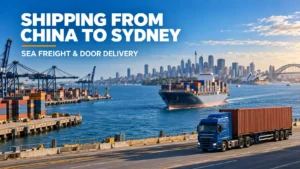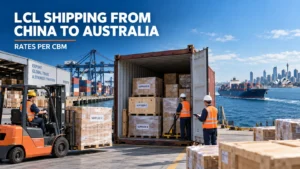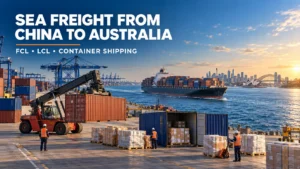
BRF SHIPPING provides reliable sea freight from China to Australia for full-container, less-than-container-load and door-to-door commercial shipments.
We arrange cargo pickup from Chinese factories, warehouse consolidation, container loading, export customs declaration, ocean freight booking, Australian customs and biosecurity coordination, port collection and delivery to warehouses, businesses and project sites.
Our China-to-Australia ocean freight network connects Qingdao, Shanghai, Ningbo, Shenzhen, Yantian, Guangzhou, Nansha, Tianjin, Xiamen and Dalian with Sydney, Melbourne, Brisbane, Fremantle and Adelaide.
Available services include:
- FCL container shipping
- LCL sea freight
- 20GP, 40GP and 40HQ containers
- Multi-supplier consolidation
- Factory and warehouse loading
- Port-to-port shipping
- Australian customs support
- Biosecurity-document coordination
- DAP and DDP options
- Final truck delivery
- Oversized and project cargo
For a complete comparison of ocean freight, air freight, customs, GST and door-delivery expenses, visit our Shipping Cost from China to Australia guide.
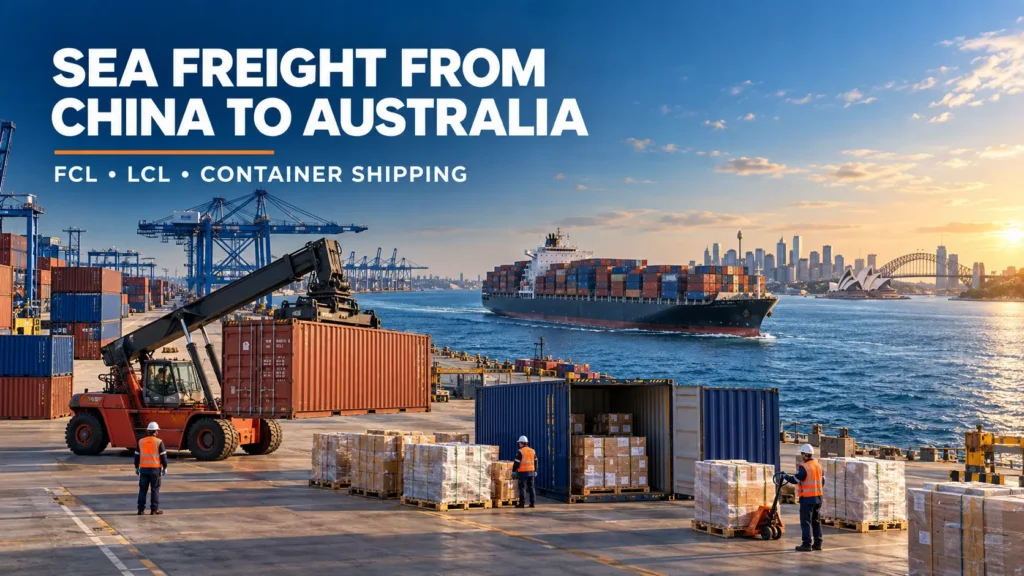
China-to-Australia Sea Freight Overview
| Service | Pricing Basis | Suitable Cargo | Indicative Port-to-Port Time |
|---|---|---|---|
| 20GP FCL | One complete container | Heavy or dense cargo | About 15–30 days |
| 40GP FCL | One complete container | General commercial cargo | About 15–30 days |
| 40HQ FCL | One high-cube container | Lightweight or bulky cargo | About 15–30 days |
| LCL Sea Freight | CBM or chargeable measurement | Smaller shipments | About 20–38+ days |
| Sea Freight Door to Door | Customized complete quotation | FCL and LCL cargo | About 22–45+ days |
| Special Container | Equipment and route quotation | Oversized or project cargo | Route-specific |
Transit times are estimates rather than guarantees. The final schedule depends on the Chinese port, Australian destination, carrier, vessel rotation, transshipment, port congestion, customs, biosecurity inspection and inland delivery.
What Is Sea Freight from China to Australia?
Sea freight moves commercial cargo from a Chinese seaport to an Australian port by container vessel or another suitable ocean-shipping service.
It is normally the most practical transportation method for cargo that is:
- Large
- Heavy
- Bulky
- Non-urgent
- Palletized
- Containerized
- Difficult to ship by air
- Part of a regular purchasing program
Importers can choose between FCL and LCL shipping.
FCL reserves a complete container for one shipper. LCL combines smaller consignments from several shippers inside one consolidated container.
The right choice depends on cargo volume, gross weight, dimensions, product characteristics, delivery schedule and the complete destination cost.
FCL Shipping from China to Australia
FCL shipping from China is suitable when the importer needs an entire container or wants more control over loading and cargo handling.
FCL means Full Container Load. The container is allocated to one shipper, although the container does not have to be completely full.
BRF SHIPPING can arrange:
- Empty-container release
- Factory container loading
- Warehouse container loading
- Loading supervision
- Cargo checking
- Palletizing and repacking
- Lashing and securing
- Container seal control
- China export declaration
- Shipping-line booking
- VGM submission
- Bill of lading preparation
- Arrival and delivery coordination
Advantages of FCL Shipping
FCL may provide:
- Lower cost per CBM for larger shipments
- Less cargo handling than LCL
- Better control over loading
- Reduced mixing with other consignments
- More suitable handling for long or fragile cargo
- Faster destination availability than LCL
- Easier planning for regular import programs
FCL is commonly used for aluminum fences, metal gates, scaffolding, machinery, furniture, acoustic barriers, building materials, WPC products and wholesale inventory.
20GP Container Shipping to Australia
A 20GP dry container has an approximate internal capacity of 33 CBM, although the practical loading quantity is lower for many shipments.
A 20GP is often suitable for:
- Dense metal products
- Heavy machinery
- Scaffolding
- Tiles
- Stone
- Hardware
- Industrial components
- Cargo with high weight and moderate volume
The maximum permitted cargo weight depends on the container, shipping line, port, road limits and loading distribution.
A 20GP should not be selected solely based on volume. For heavy cargo, the loading plan must also consider floor strength, axle limits, weight distribution and Australian inland-transport requirements.
40GP Container Shipping to Australia
A 40GP container provides approximately 67 CBM of internal volume.
It is commonly used for:
- General commercial cargo
- Furniture
- Machinery
- Retail products
- Building materials
- Multiple product categories
- Larger wholesale orders
A 40GP offers more floor space than a 20GP but has the same standard external height as a general-purpose container.
The choice between 40GP and 40HQ depends mainly on product height, package size, total volume and available carrier equipment.
40HQ Container Shipping to Australia
A 40HQ container provides approximately 76 CBM of nominal internal capacity and additional internal height.
It is commonly selected for:
- Aluminum fence panels
- Metal gates
- Acoustic barrier panels
- Outdoor products
- Lightweight furniture
- WPC products
- Bulky retail inventory
- High-volume, lower-density cargo
A 40HQ can offer a lower effective freight cost per product when the loading plan uses the additional height efficiently.
Actual loading capacity depends on package dimensions, pallets, product shape, weight distribution and safe loading requirements.
LCL Shipping from China to Australia
LCL shipping from China is designed for cargo that does not require a complete container.
It is suitable for:
- One pallet
- Several cartons
- Trial orders
- Spare parts
- Small wholesale shipments
- Cargo from one or multiple suppliers
- Shipments below a practical FCL volume
BRF SHIPPING can collect products from different suppliers and move them to a Chinese consolidation warehouse.
At the warehouse, we can coordinate:
- Receiving
- Package counting
- Cargo measurement
- Weight confirmation
- Label checking
- Repacking
- Palletizing
- Multi-supplier consolidation
- Export documentation
- Delivery to the export CFS
How LCL Shipping Works
A typical LCL process includes:
- Cargo pickup from the supplier
- Delivery to the consolidation warehouse
- Measurement and warehouse receiving
- Export customs declaration
- Consolidation into a shared container
- Ocean transportation
- Australian deconsolidation
- Customs and biosecurity release
- Collection or final delivery
Because LCL cargo must be consolidated and deconsolidated, it generally requires more handling and more destination processing than FCL.
How LCL Sea Freight Is Charged
LCL is normally charged according to the greater of:
- Actual cargo volume in CBM
- Applicable weight-to-measurement calculation
- Minimum shipment charge
One cubic metre is calculated as:
Length × Width × Height in metres
For example, a package measuring:
2.0 m × 1.2 m × 1.0 m
has a volume of:
2.4 CBM
However, the complete LCL cost can also include China warehouse charges, export handling, origin CFS, destination deconsolidation, Australian depot handling, customs clearance and final delivery.
For that reason, importers should compare the complete LCL quotation rather than only the advertised ocean rate per CBM.
FCL or LCL: Which Is Better?
| Factor | FCL | LCL |
|---|---|---|
| Cargo volume | Medium to large | Small to medium |
| Container use | Exclusive container | Shared container |
| Pricing | Per container | CBM or chargeable measurement |
| Cargo handling | Less handling | More handling |
| Destination process | Container collection | Deconsolidation first |
| Long cargo | Often more practical | Subject to CFS restrictions |
| Fragile cargo | Better loading control | More transfer points |
| Small trial orders | May be uneconomical | Usually practical |
| Transit planning | Generally simpler | Additional consolidation time |
There is no fixed CBM point at which FCL always becomes cheaper than LCL.
When cargo approaches approximately 12–15 CBM, it is sensible to compare:
- LCL total cost
- 20GP total cost
- China warehouse charges
- Australian destination charges
- Cargo-handling risk
- Delivery requirements
- Transit time
Long, heavy, non-stackable or fragile cargo may justify FCL at a lower volume.
Major Sea Freight Routes from China to Australia
Shanghai to Australia
Shanghai is a major export gateway for factories in:
- Shanghai
- Jiangsu
- Zhejiang
- Anhui
- Surrounding eastern China regions
Common routes include:
- Shanghai to Sydney
- Shanghai to Melbourne
- Shanghai to Brisbane
- Shanghai to Fremantle
- Shanghai to Adelaide
Shanghai offers a wide range of direct and transshipment services, depending on the carrier and Australian destination.
BRF SHIPPING recently arranged a 20GP metal fence and gate shipment from Shanghai to Sydney, including trucking, export declaration, ocean freight, Australian customs coordination, tax payment and final delivery.
Ningbo to Australia
Ningbo serves manufacturing regions across Zhejiang and nearby provinces.
Common cargo includes:
- Furniture
- Hardware
- Machinery
- Auto parts
- Electrical products
- Outdoor products
- Building materials
Available routes can connect Ningbo with Sydney, Melbourne, Brisbane and Fremantle.
Shenzhen and Yantian to Australia
Shenzhen and Yantian are important gateways for cargo from Guangdong and southern China.
Common routes include:
- Yantian to Sydney
- Yantian to Melbourne
- Yantian to Brisbane
- Shenzhen to Fremantle
Common cargo includes electronics, furniture, smart-home products, lighting, machinery and consumer goods.
Guangzhou and Nansha to Australia
Nansha is a practical loading port for factories in Guangzhou, Foshan, Zhongshan, Jiangmen and nearby Pearl River Delta manufacturing areas.
It can be particularly suitable for:
- Furniture
- Aluminum products
- Sanitary products
- Lighting
- Appliances
- Construction materials
Qingdao to Australia
Qingdao is one of the main gateways for cargo from Shandong and northern China.
Common export cargo includes:
- Aluminum fences
- Metal gates
- Tyres
- Machinery
- Building materials
- Industrial products
- Chemicals and powders
- Agricultural equipment
Available services connect Qingdao with Sydney, Melbourne, Brisbane and Fremantle, either directly or through transshipment.
Tianjin to Australia
Tianjin serves factories in Tianjin, Beijing, Hebei, Shanxi and surrounding northern regions.
It is commonly used for:
- Steel products
- Scaffolding
- Machinery
- Construction materials
- Industrial equipment
See our Tianjin-to-Sydney scaffolding shipping case involving 20GP and 40HQ equipment with customs and door-delivery coordination.
Xiamen to Australia
Xiamen supports cargo from Fujian and nearby manufacturing areas.
Common products include:
- Stone
- Building products
- Furniture
- Footwear
- Textiles
- Consumer goods
Dalian to Australia
Dalian is an option for manufacturers in Liaoning and Northeast China.
The best routing depends on cargo readiness, available equipment, carrier schedule and final Australian destination.
Main Australian Container Ports
Port Botany, Sydney
Port Botany is a major container gateway for New South Wales.
It supports delivery to:
- Sydney metropolitan area
- Newcastle
- Wollongong
- Canberra
- Regional New South Wales
Cargo can be delivered as a full container, unpacked loose cargo, palletized freight or specialized project shipment.
Port of Melbourne
Melbourne is a major gateway for Victoria and southern Australia.
It supports delivery to:
- Melbourne
- Geelong
- Dandenong
- Laverton
- Truganina
- Regional Victoria
- Interstate destinations
Melbourne is widely used for machinery, building materials, retail inventory, furniture and commercial products.
Port of Brisbane
Brisbane serves Queensland and South East Queensland.
Common delivery areas include:
- Brisbane
- Gold Coast
- Sunshine Coast
- Ipswich
- Toowoomba
- Regional Queensland
Heavy, oversized or long construction products require advance transport and unloading planning.
Fremantle Port
Fremantle is the principal container gateway for Perth and Western Australia.
It is suitable for:
- Industrial cargo
- Construction materials
- Mining-related equipment
- Machinery
- Building products
- Commercial inventory
Delivery costs should be calculated using the final Western Australia postcode rather than assuming Perth metropolitan transport.
Port Adelaide
Adelaide serves South Australia and selected inland destinations.
Depending on the carrier and schedule, cargo may move directly to Adelaide or through another Australian gateway.
The lowest port-to-port freight rate does not always produce the lowest total cost after inland delivery.
China-to-Australia Sea Freight Transit Time
| Origin | Sydney | Melbourne | Brisbane | Fremantle |
|---|---|---|---|---|
| Shanghai | About 15–25 days | About 16–26 days | About 17–28 days | About 18–30 days |
| Ningbo | About 15–26 days | About 16–27 days | About 17–29 days | About 18–31 days |
| Shenzhen/Yantian | About 12–23 days | About 14–25 days | About 14–26 days | About 17–29 days |
| Qingdao | About 18–28 days | About 19–30 days | About 20–31 days | About 21–32 days |
| Tianjin | About 19–30 days | About 20–31 days | About 21–32 days | About 22–34 days |
| Xiamen | About 14–25 days | About 15–26 days | About 16–27 days | About 18–30 days |
These are indicative port-to-port planning ranges.
Total door-to-door time also includes:
- Supplier pickup
- Warehouse receiving
- Export customs
- Vessel cut-off
- Port handling
- Customs clearance
- Biosecurity assessment
- Inspection when required
- Final delivery
A direct vessel is not automatically the best option. Sailing frequency, cargo-ready date, cut-off time, transshipment reliability and destination costs should be considered together.
Direct and Transshipment Services
Direct Service
A direct service carries the container from the Chinese loading port to the Australian discharge port without transferring it to another vessel.
Potential advantages include:
- Shorter transit
- Fewer handling stages
- Lower transshipment risk
- Easier schedule planning
Transshipment Service
A transshipment service transfers the container through an intermediate hub.
Potential advantages can include:
- More origin-port options
- Wider destination coverage
- Competitive freight rates
- Better schedule alignment
Potential disadvantages include:
- Longer transit time
- Connection delays
- Additional schedule uncertainty
- Higher risk during peak periods
BRF SHIPPING compares the total route rather than automatically selecting the lowest rate.
Shipping Lines from China to Australia
China-to-Australia services may be operated by or arranged through major carriers such as:
- COSCO SHIPPING
- OOCL
- CMA CGM
- ANL
- Maersk
- MSC
- ONE
- Hapag-Lloyd
- Evergreen
- PIL
- Yang Ming
Carrier availability depends on the origin port, Australian destination, equipment, commodity, cargo-ready date and current vessel schedule.
The most suitable carrier is not always the cheapest one.
Important comparison factors include:
- Direct or transshipment service
- Sailing frequency
- Transit time
- Equipment availability
- Blank-sailing risk
- Free time
- Destination charges
- Schedule reliability
- Special-cargo acceptance
Sea Freight Cost from China to Australia
Sea freight costs change according to:
- Chinese origin port
- Australian destination port
- Container type
- LCL cargo volume
- Cargo weight
- Shipping season
- Carrier capacity
- Fuel surcharge
- Direct or transshipment route
- Origin handling
- Australian destination charges
- Customs and biosecurity services
- Final delivery postcode
This sea freight page should not duplicate detailed container-rate content.
For current FCL, LCL, air freight and door-delivery comparisons, use the dedicated China-to-Australia Shipping Cost guide.
A complete sea freight quotation should clearly identify:
- China pickup
- Export handling
- Ocean freight
- Destination handling
- Customs-broker fees
- Government charges
- Duty and GST
- Inspection exclusions
- Port or depot storage
- Final delivery
- Container return
Port-to-Port Sea Freight
Port-to-port freight covers transportation between the agreed Chinese and Australian ports.
It may be suitable for importers that already have:
- An Australian customs broker
- A destination freight agent
- A container transport company
- A warehouse
- An established import process
Port-to-port quotations may exclude factory pickup, Chinese export handling, Australian destination charges, customs clearance, biosecurity services, duty, GST and final delivery.
Door-to-Door Sea Freight from China to Australia
Door-to-door sea freight connects the Chinese supplier with the final Australian delivery address.
The service can include:
- Factory pickup
- China warehouse receiving
- Multi-supplier consolidation
- FCL loading or LCL handling
- Export customs declaration
- Ocean freight booking
- Australian customs coordination
- Biosecurity-document support
- Port or depot collection
- Final truck delivery
- Empty-container return for FCL
BRF SHIPPING provides coordinated door-to-door shipping from China for warehouses, businesses, construction sites and other eligible delivery locations.
The precise scope must be confirmed in the written quotation.
DAP and DDP Sea Freight
DAP Shipping
Under DAP, transportation is arranged to the agreed destination, while the buyer normally handles import clearance and pays applicable customs duty and GST.
DDP Shipping
Under DDP, the seller assumes broader responsibility for import formalities, duty and tax under the confirmed arrangement.
Before offering DDP sea freight to Australia, the parties should confirm:
- Importer of Record
- Australian Business Number where relevant
- Customs-broker appointment
- HS classification
- Customs value
- Duty
- GST
- Product compliance
- Biosecurity conditions
- Delivery postcode
- Unloading arrangements
DDP availability depends on the product and importer structure. It should not be assumed for every shipment.
DDU is still used informally by some customers, but it is a legacy Incoterm. DAP is the current term normally used when the buyer remains responsible for import duty and taxes.
Australian Customs Clearance
Commercial sea freight must receive the necessary customs release before collection.
Documents can include:
- Commercial invoice
- Packing list
- Bill of lading
- Certificate of Origin
- Import permit
- Manufacturer’s declaration
- Treatment certificate
- Packing Declaration
- Product specifications
- Other commodity-specific records
For goods with a combined value over AUD 1,000 that are being entered for home consumption, an Import Declaration is generally required. Applicable duties, taxes and charges must be paid before release.
The importer or licensed customs broker remains responsible for the accuracy of the import declaration.
Read our complete Australia customs clearance and door-delivery guide.
Australian Biosecurity Requirements
Australian sea cargo may be assessed for risks associated with:
- Timber
- Bamboo
- Soil
- Seeds
- Insects
- Plant material
- Animal material
- Food
- Used machinery
- Outdoor equipment
- Container cleanliness
- Seasonal pests
The applicable requirements depend on the commodity, origin, packaging, treatment and delivery postcode.
Importers should check the official Biosecurity Import Conditions system before the cargo is loaded.
A shipment may require:
- Packing Declaration
- ISPM 15-compliant timber packaging
- Treatment certificate
- Import permit
- Manufacturer’s declaration
- Container inspection
- Commodity inspection
- Rural tailgate inspection
- Cleaning or treatment
Australia Packing Declaration
The packing entity may need to declare:
- Whether unacceptable packaging materials were used
- Whether timber or bamboo packaging was used
- How timber packaging was treated
- Whether an applicable FCL/X container was clean
- Which container or consignment the form covers
The declaration must be issued by the supplier, exporter or packer that packed the goods or observed the packing.
Use our guide on how to complete an Australia Packing Declaration Form before departure.
Why Cargo Can Be Delayed After Arrival
A container arriving at an Australian port is not automatically ready for delivery.
Possible delays include:
- Vessel berthing
- Container discharge
- Shipping-line release
- Customs examination
- Biosecurity inspection
- Treatment
- Terminal congestion
- Unpaid destination charges
- Truck appointment availability
- Warehouse receiving restrictions
- Rural delivery requirements
- Empty-depot changes
These delays can create terminal storage, demurrage, detention, inspection and redelivery costs.
Read our detailed guide to cargo inspections, storage and delivery delays after arrival in Australia.
Cargo Suitable for Sea Freight to Australia
BRF SHIPPING handles commercial and project cargo including:
- Aluminum fences
- Metal gates
- WPC fencing
- Acoustic panels
- Scaffolding
- Machinery
- Industrial equipment
- Furniture
- Outdoor products
- Fitness equipment
- Solar equipment
- Construction materials
- Packaging materials
- Retail inventory
- Spare parts
Cargo should be reviewed before booking if it is:
- Dangerous
- Oversized
- Overweight
- Temperature controlled
- Liquid
- Powder
- Magnetic
- Battery powered
- Food related
- Timber based
- Used machinery
- Subject to import permits
Oversized and Special Container Shipping
Cargo that does not fit safely into a standard dry container may require:
- Open-top container
- Flat-rack container
- Platform equipment
- Reefer container
- Special lifting
- Professional lashing
- Breakbulk service
A special-cargo quotation should include:
- Technical drawings
- Product photographs
- Package dimensions
- Gross weight
- Centre of gravity
- Lifting points
- Loading method
- Unloading method
- Final delivery conditions
Australian road restrictions and delivery-site access must also be checked before booking.
China-to-Australia Sea Freight Process
Step 1: Cargo Review
Confirm the product, HS code, supplier address, packaging, dimensions, gross weight, total CBM and Australian destination.
Step 2: FCL or LCL Comparison
Compare the complete cost, loading requirements, destination charges and delivery plan.
Step 3: Pickup or Container Loading
BRF SHIPPING arranges pickup in China or releases an empty container for factory loading.
Step 4: Export Documentation
Prepare the commercial invoice, packing list, booking details, shipping instructions and other required documents.
Step 5: China Export Customs
Complete the China export customs declaration and terminal procedures.
Step 6: Ocean Freight
Monitor gate-in, vessel departure, transshipment where applicable and estimated arrival.
Step 7: Pre-Arrival Preparation
Send the bill of lading, commercial documents, Packing Declaration and treatment records to the Australian customs broker.
Step 8: Customs and Biosecurity Release
Coordinate import declaration, taxes, document assessment and inspection when required.
Step 9: Australian Delivery
Collect the FCL container or LCL cargo and deliver it to the agreed warehouse, commercial address or project site.
Step 10: Empty-Container Return
For FCL cargo, monitor unloading time, free time and return to the nominated empty-container depot.
Why Choose BRF SHIPPING?
BRF SHIPPING manages more than the international ocean leg.
Our China-to-Australia service can include:
- Pickup from one or multiple suppliers
- China warehouse receiving
- Cargo consolidation
- Loading checks
- Container planning
- FCL and LCL booking
- Export customs declaration
- Document coordination
- Australian customs support
- Biosecurity communication
- Port collection
- Tailgate delivery
- Project-site delivery
- Empty-container return monitoring
We focus on the complete route from the Chinese supplier to the Australian destination.
Frequently Asked Questions
How long does sea freight from China to Australia take?
Port-to-port sea freight commonly takes approximately 12–32 days, depending on the origin, destination, carrier and routing. LCL and door-to-door shipments require additional handling and delivery time.
Is FCL or LCL cheaper?
LCL is normally more practical for smaller shipments. FCL may become more economical as cargo volume increases. Long, heavy, fragile or non-stackable cargo may justify FCL at a lower CBM.
Which Chinese ports ship to Australia?
Common origins include Shanghai, Ningbo, Qingdao, Shenzhen, Yantian, Guangzhou, Nansha, Tianjin, Xiamen and Dalian.
Which Australian ports receive cargo from China?
Major container destinations include Sydney, Melbourne, Brisbane, Fremantle and Adelaide.
Can BRF SHIPPING collect from several Chinese suppliers?
Yes. We can collect products from multiple factories, receive them at a China warehouse and consolidate them into one LCL or FCL shipment.
Can you ship a 20GP or 40HQ to Australia?
Yes. We arrange 20GP, 40GP and 40HQ containers, subject to cargo, weight, equipment and carrier availability.
Can you arrange Australian customs clearance?
BRF SHIPPING can coordinate with the appointed Australian customs broker and destination partners. The importer structure, cargo and exact service scope must be confirmed.
Does Australia require a Packing Declaration?
Containerized sea cargo commonly requires applicable packaging information. The required form depends on FCL/X or LCL cargo and the relevant biosecurity conditions.
Can you deliver the container to the customer’s warehouse?
Yes. We can arrange port collection and delivery to eligible Australian warehouses, businesses and project sites after customs and biosecurity release.
Is DDP sea freight available?
DDP may be available after checking the product, importer arrangement, HS code, customs duty, GST, biosecurity requirements and delivery address.
Request a Sea Freight Quote from China to Australia
Send BRF SHIPPING:
- Chinese supplier address
- Australian port or delivery postcode
- Cargo description
- HS code if available
- Number of packages
- Package dimensions
- Gross weight
- Total CBM
- Required container type
- Cargo-ready date
- Commercial value
- Incoterm
- Delivery requirements
- Cargo photographs
BRF SHIPPING will compare FCL, LCL, port-to-port and door-delivery options and recommend a practical ocean freight solution.
Contact BRF SHIPPING for sea freight from China to Sydney, Melbourne, Brisbane, Fremantle, Perth, Adelaide and other Australian destinations.
Ocean freight rates, schedules and transit times change according to carrier, season, equipment, port conditions, customs and biosecurity requirements. Confirm the current written quotation and vessel schedule before booking.