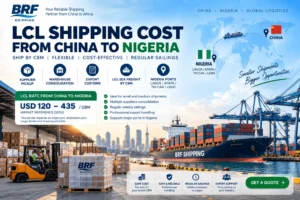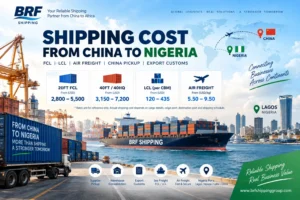
If your cargo is too small to fill a complete container, LCL shipping from China to Nigeria can provide a practical way to move commercial goods by sea without paying for an entire 20ft or 40ft container.
LCL means Less than Container Load. Your goods are consolidated with cargo from other exporters in China, loaded into a shared container and shipped to Nigeria, where the container is deconsolidated before individual shipments are released.
For importers shipping several pallets or a few cubic meters of machinery parts, building materials, furniture, consumer products, auto parts, electronics or wholesale inventory, LCL can be significantly more economical than booking a full container.
However, the LCL shipping cost from China to Nigeria cannot be understood from the ocean freight rate per CBM alone. China pickup, warehouse receiving, CFS charges, export customs, consolidation, ocean freight, Lagos deconsolidation and destination charges can all affect the final amount.
As of September 2026, published China-to-Nigeria LCL references vary considerably. Some market sources quote approximately USD 120–200 per CBM for freight-only services, specific China-to-Nigeria port pairs are publicly quoted around USD 260–395 per CBM, while another September market benchmark places Lagos LCL at approximately USD 435 per CBM. The differences reflect origin, routing, carrier, consolidation service and what is included in the quotation.
For this reason, BRF SHIPPING recommends comparing the total shipment cost and service scope, not simply choosing the lowest advertised CBM rate.
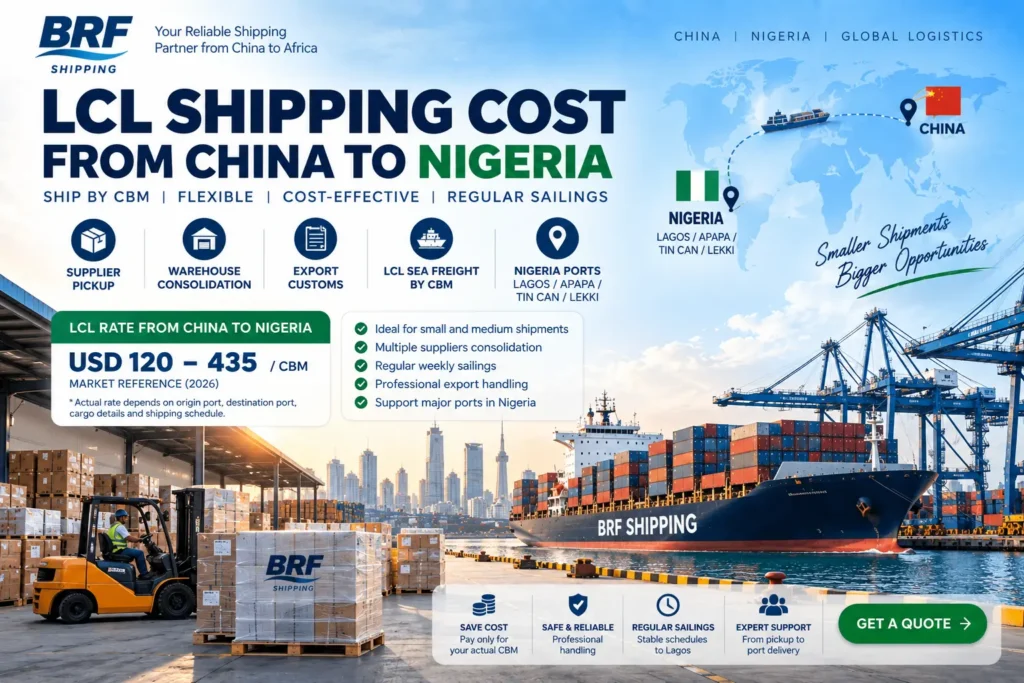
How Much Is LCL Shipping from China to Nigeria?
For budgeting, current public September 2026 references can be summarized as follows:
| LCL Service Reference | Indicative Market Rate |
|---|---|
| General freight-only China → Lagos reference | USD 120–200 / CBM |
| Ningbo → Apapa reference | USD 260–320 / CBM |
| Shanghai → Tin Can Island reference | USD 300–380 / CBM |
| Guangzhou → Onne reference | USD 280–350 / CBM |
| Qingdao → Lagos reference | USD 310–395 / CBM |
| Other published September Lagos benchmark | Around USD 435 / CBM |
These figures are market references, not guaranteed BRF SHIPPING rates. Public quotations currently differ substantially, which shows why importers need to check whether a price covers only ocean freight or also includes origin CFS, documentation, consolidation or destination handling.
A current BRF SHIPPING quotation should therefore be based on your actual cargo dimensions, weight, China pickup point, destination and cargo-ready date.
How Is LCL Freight Calculated?
LCL sea freight is normally calculated using W/M — Weight or Measurement.
For many general-cargo consolidation tariffs, the chargeable unit is based on either cargo volume or weight, whichever produces the higher chargeable revenue ton under the applicable tariff.
For example, consider a shipment with:
4.5 CBM and 620 kg
For ordinary lightweight commercial cargo, the shipment may be charged mainly according to the 4.5 CBM volume.
Now consider:
2 CBM and 3,000 kg
Because the shipment is unusually dense and heavy, the applicable weight rule may produce a higher chargeable quantity.
The exact W/M conversion and minimum charge should always be confirmed with the consolidator before booking.
Example: LCL Shipping Cost for 5 CBM from China to Lagos
Suppose an importer has 5 CBM of general cargo.
If the ocean-freight component were quoted at USD 180 per CBM:
5 CBM × USD 180 = USD 900
But USD 900 should not automatically be treated as the total shipment cost.
Additional charges may include China factory pickup, China warehouse receiving, CFS handling, export customs, documentation, pallet handling, consolidation fees, destination CFS charges, delivery order and Nigeria-side clearance costs.
This is one of the most common misunderstandings when comparing China to Nigeria LCL freight rates.
A forwarder quoting:
USD 150 / CBM
may ultimately be more expensive than another quotation showing:
USD 200 / CBM
if the first quotation excludes more origin and destination charges.
China to Lagos LCL Shipping
Lagos is the primary destination market for many China-origin LCL shipments.
Nigeria’s official port network includes Lagos Port Complex at Apapa, Tin Can Island Port Complex and Lekki Deep Sea Port in Lagos State. The Nigerian Ports Authority also lists Onne, Rivers, Delta and Calabar among the country’s other major port complexes.
For LCL cargo, the actual destination may be described in the consolidation schedule as Lagos, Apapa or another designated Lagos-area CFS arrangement.
The destination on your quotation should therefore be confirmed before booking.
A quotation that simply says:
China → Nigeria
is not precise enough for serious cost comparison.
It is better to confirm:
China CFS → Lagos CFS
together with the specific service scope.
LCL Shipping to Apapa, Lagos
Lagos Port Complex is located in Apapa and remains one of Nigeria’s principal commercial cargo gateways. The Nigerian Ports Authority identifies dedicated container-handling operations at the port, including container terminals and terminals handling both containers and general cargo.
For an LCL shipment, cargo does not usually move exactly like an FCL container.
A typical process is:
China Supplier → China Warehouse/CFS → Consolidation → Export Container → Lagos → Destination CFS → Deconsolidation → Cargo Release
Because of the additional consolidation and deconsolidation steps, LCL cargo can involve more handling than a dedicated FCL shipment.
Importers of fragile machinery, glass products or easily damaged goods should therefore pay particular attention to export packaging.
Tin Can Island LCL Shipping
Tin Can Island Port Complex is another important Lagos container gateway.
The Nigerian Ports Authority lists several Tin Can terminals handling containers and general cargo, including dedicated container terminal operations.
Whether your LCL service routes through Apapa, Tin Can or another Lagos-area facility depends on the consolidator, carrier and destination agent.
The lowest ocean rate is not automatically the best option.
Importers should also consider deconsolidation time, destination handling charges, local agent arrangements and cargo-release procedures.
China Origin Ports for Nigeria LCL Cargo
BRF SHIPPING can organize LCL shipments from major Chinese manufacturing regions and export gateways.
Qingdao to Lagos LCL
Qingdao is particularly convenient for cargo sourced from Shandong.
Products frequently exported from the region include machinery, aluminum products, fencing, building materials, industrial equipment, tyres, hardware and metal components.
Current public 2026 market references place selected Qingdao-to-Lagos LCL services around USD 310–395 per CBM, although other consolidation schedules can quote considerably lower freight-only rates depending on routing and service scope.
For factories in Qingdao, Weifang, Linyi, Zibo, Jinan and surrounding areas, using a Qingdao consolidation point can also reduce China domestic transportation.
Ningbo to Apapa LCL
Ningbo is an important export gateway for Zhejiang manufacturers.
Typical cargo origins include Yiwu, Ningbo, Hangzhou, Shaoxing, Jinhua and Taizhou.
Current public route references place Ningbo-to-Apapa LCL around USD 260–320 per CBM under selected 2026 market conditions.
Shanghai to Nigeria LCL
Shanghai serves factories throughout Shanghai, Jiangsu and the wider Yangtze River Delta.
Public 2026 route references place selected Shanghai-to-Tin Can LCL services at approximately USD 300–380 per CBM.
Guangzhou and Shenzhen to Nigeria LCL
South China is one of the most important sourcing regions for Nigerian buyers.
Cargo sourced from Guangzhou, Foshan, Shenzhen, Dongguan, Zhongshan and Huizhou can be collected and consolidated before export.
Typical products include lighting, electronics, furniture, aluminum products, household goods, machinery, hardware and retail merchandise.
Multi-Supplier Consolidation for Nigerian Importers
LCL is particularly useful when one buyer purchases from several Chinese suppliers.
Imagine a Nigerian importer purchasing:
2 CBM from Guangzhou
1.5 CBM from Foshan
2 CBM from Dongguan
1 CBM from Yiwu
Shipping every supplier separately can create repeated pickup, handling and export costs.
Instead, BRF SHIPPING can coordinate the goods into a China warehouse and combine them into one export plan.
BRF SHIPPING’s current warehouse service supports supplier coordination, warehouse consolidation, cargo sorting, measurements, labeling, repacking, palletizing and preparation for international export.
This gives the importer one consolidated shipment rather than several disconnected cargo movements.
What Does an LCL Quote Include?
This is one of the most important questions to ask.
An LCL quotation can contain several separate cost layers.
China Origin
This can include factory pickup, warehouse receiving, CFS handling, export documentation, export customs declaration and consolidation.
Ocean Freight
This is the international LCL transportation charge, generally calculated according to chargeable CBM or W/M.
Nigeria Destination
This can include destination CFS, deconsolidation, handling, delivery-order or local-agent charges.
Import Clearance
Customs duty, taxes, regulatory fees, customs-broker costs and inspections are separate unless explicitly included.
Inland Delivery
Transportation from the Lagos cargo-release facility to the buyer’s warehouse is also a separate service unless specifically quoted.
Therefore, when you see:
USD XXX / CBM
always ask:
What exactly does this rate include?
Freight-Only LCL vs Door-to-Door Pricing
These two quotation types should not be compared directly.
A port-to-port LCL quotation might show a much lower cost per CBM because it covers only the international freight component.
A door-delivery quotation may include substantially more:
China pickup, consolidation, export handling, international shipping, destination handling and inland transportation.
Some public September 2026 Nigeria references place freight-only LCL around USD 120–200 per CBM, while broader door-to-door or scope-expanded sea services can reach several hundred dollars per CBM.
The scope—not simply the headline rate—must therefore be compared.
For BRF SHIPPING’s Nigeria route, the default focus remains China pickup, China warehouse, export customs and international transportation. Nigeria import clearance or local delivery should only be treated as included when specifically confirmed in writing.
How Long Does LCL Shipping from China to Nigeria Take?
Current September 2026 public market references generally place China-to-Lagos LCL transit at approximately 36–48 days, depending on origin, sailing schedule, transshipment and destination deconsolidation. One current market source reports around 36–42 days, while other August–September references use a broader 38–48-day planning range.
However, LCL transit time should not be confused with the entire door-to-release timeline.
The shipment may also require time for China supplier pickup, CFS receiving, export consolidation, vessel cutoff, destination deconsolidation and customs release.
For this reason, a realistic logistics plan should look at:
Cargo Ready Date → China CFS → ETD → ETA Lagos → Deconsolidation → Cargo Release
rather than only the vessel transit.
LCL vs FCL: When Should You Book a Full Container?
LCL works best for relatively small shipments.
For example, 2 CBM, 4 CBM or 6 CBM normally does not justify paying for an entire 20GP container.
As cargo volume increases, however, the calculation changes.
BRF SHIPPING’s existing Nigeria shipping guide recommends comparing LCL and FCL once cargo reaches approximately 12–18 CBM, because the total LCL cost can begin approaching a dedicated 20GP rate after CFS and destination charges are considered.
Your published 20ft Nigeria cost page also highlights the 12–15 CBM range as a useful point to start comparing the total cost of LCL with a 20GP.
There is no universal cutoff because rates change.
The correct decision is:
Total LCL Cost vs Total 20GP Cost
not simply:
CBM × Ocean Freight Rate.
Example: 12 CBM LCL vs 20GP
Assume a shipment is 12 CBM.
At a hypothetical ocean rate of USD 200 per CBM:
12 × USD 200 = USD 2,400
Then add origin CFS and destination charges.
If a current 20GP FCL quotation is close to this total, a dedicated container may become attractive.
FCL can also reduce cargo handling because the goods stay inside one dedicated container instead of passing through multiple consolidation facilities.
This can be especially valuable for fragile goods, machinery, high-value products and irregularly packaged cargo.
Minimum LCL Charges
Many LCL services apply a minimum charge.
A shipment measuring only 0.4 CBM may still be billed at a minimum such as 1 CBM, depending on the consolidation tariff.
This means very small sea shipments are not always as cheap as importers expect.
For tiny urgent cargo, air freight or courier can sometimes be worth comparing despite the higher per-kilogram transportation rate.
Before booking, confirm the consolidator’s:
Minimum CBM + W/M Rule + Origin Charges + Destination Charges
so there are no surprises after cargo reaches the warehouse.
China Factory Pickup for LCL Cargo
If your supplier sells under EXW terms, the cargo still needs to move from the factory to the consolidation warehouse.
For example:
Yiwu Supplier → Ningbo CFS
or:
Linyi Supplier → Qingdao CFS
BRF SHIPPING can arrange supplier pickup and connect it with China warehouse receiving and export consolidation.
This is particularly useful when buyers work with factories that do not have their own export logistics team.
The pickup cost depends on supplier location, cargo dimensions, weight and truck requirement.
China Warehouse Services for Nigeria LCL Cargo
Warehouse handling is an important part of successful LCL shipping.
Cargo may need to be checked before it enters the export consolidation process.
BRF SHIPPING’s warehouse service can support cargo receiving, sorting, relabeling, repacking, palletizing and remeasurement before international shipment.
This is particularly important because LCL pricing depends heavily on cargo dimensions.
If a supplier reports:
3.0 CBM
but the warehouse measures:
3.8 CBM
the final freight calculation can change significantly.
Accurate measurement before booking therefore reduces later freight adjustments.
Should LCL Cargo Be Palletized?
It depends on the cargo.
Cartons containing general merchandise may sometimes ship without pallets.
Machinery parts, fragile products or higher-value cargo can benefit from palletizing or stronger export packaging because LCL cargo is handled more frequently than FCL cargo.
Additional packaging increases dimensions and may increase chargeable CBM, so the decision should balance freight cost against cargo protection.
For fragile or valuable products, saving a small amount of CBM is rarely worthwhile if packaging becomes unsafe.
Nigeria Customs Requirements for LCL Cargo
LCL cargo must still comply with normal Nigerian import procedures.
Nigeria Customs’ published import guidance identifies important steps including Form M, Pre-Arrival Assessment Report (PAAR) and submission of the Single Goods Declaration (SGD), together with supporting documents and duty/tax assessment.
Typical commercial shipment documentation includes the commercial invoice, packing list, transport document and accurate product/HS-code information.
Some commodities may require additional approvals or certificates.
Importers should confirm product-specific requirements before goods leave China rather than waiting until the cargo arrives in Lagos.
Is Nigeria Customs Clearance Included in the CBM Rate?
Normally, it should not be assumed to be included.
A port-to-port LCL rate may cover only international freight.
It may exclude Nigerian customs duty, taxes, customs broker charges, product certificates, inspections, destination CFS charges, storage and inland delivery.
For BRF SHIPPING’s Nigeria route, the standard logistics focus is:
China Supplier Pickup → China Warehouse/CFS → Export Customs → Consolidation → International LCL Freight → Nigeria Destination Facility
Nigeria customs clearance and local delivery can only be treated as included when they are specifically confirmed in the shipment quotation.
This distinction is especially important for African destinations because destination requirements vary significantly by commodity and importer.
What Products Can Ship LCL from China to Nigeria?
LCL can work well for a wide range of general commercial cargo, including machinery parts, aluminum products, hardware, building materials, furniture components, automotive parts, textiles, retail products, electronics and industrial components.
Cargo such as batteries, liquids, chemicals, powders, dangerous goods, oversized pieces or highly regulated products should be declared during quotation.
Never send sensitive or dangerous cargo to a consolidation warehouse under a generic product description.
The forwarder needs the real commodity information before accepting the shipment.
How to Reduce LCL Shipping Costs
The most effective way to lower LCL cost is not always finding a cheaper ocean freight rate.
Importers should optimize the complete shipment.
For example, combining several suppliers can reduce duplicated pickup and export handling, while using the most suitable China CFS can lower domestic transportation.
Accurate carton dimensions help avoid remeasurement adjustments.
Stronger but space-efficient packaging can reduce damage without unnecessarily increasing CBM.
As cargo becomes larger, comparing FCL before booking can prevent paying excessive LCL destination and handling charges.
In short:
Optimize the shipment structure first, then compare freight rates.
China to Nigeria LCL Cost Example
Consider a Nigerian importer buying products from three Chinese suppliers.
The cargo totals:
| Supplier | Cargo |
|---|---|
| Supplier A | 2.5 CBM |
| Supplier B | 3.0 CBM |
| Supplier C | 2.0 CBM |
| Total | 7.5 CBM |
Rather than shipping three separate consignments, BRF SHIPPING can coordinate the goods into one warehouse and prepare a single 7.5 CBM export shipment.
If the applicable freight component were USD 200 per CBM:
7.5 CBM × USD 200 = USD 1,500
The complete quotation would then add any applicable China pickup, warehouse/CFS, documentation and destination charges.
This example shows why buyers need a complete quotation rather than calculating the total budget from a web-published CBM rate alone.
Why Choose BRF SHIPPING for China to Nigeria LCL?
BRF SHIPPING can coordinate the China side of the shipment from supplier collection through international freight.
For buyers purchasing from several Chinese factories, our service can connect supplier communication, pickup, warehouse receiving, consolidation, cargo measurement, export documentation and LCL booking into one process.
Our current China to Nigeria service page covers FCL and LCL freight from major Chinese gateways to Lagos-area ports, while BRF’s warehouse operation supports multi-supplier consolidation before export.
The objective is not simply to provide a low CBM rate.
It is to build a shipping plan where the cargo, documents and costs are clear before export.
Frequently Asked Questions About China to Nigeria LCL Shipping
How much is LCL shipping from China to Nigeria per CBM?
Public September 2026 references vary significantly. Freight-only market references can be around USD 120–200 per CBM, specific published port-pair references range around USD 260–395 per CBM, and another current Lagos benchmark is approximately USD 435 per CBM. The actual quotation depends on origin, routing, carrier and included charges.
How much is LCL from China to Lagos?
There is no single Lagos rate. A Qingdao, Ningbo, Shanghai or South China consolidation can each have a different freight rate, CFS charge and transit route. Request a current quotation using your exact China origin and total CBM.
How long does LCL shipping from China to Lagos take?
Current September 2026 market references generally indicate approximately 36–48 days for LCL sea transport, depending on the origin, sailing, transshipment and consolidation schedule.
Is LCL cheaper than a 20ft container?
For small shipments, usually yes. As cargo approaches roughly 12–15 CBM or more, it becomes increasingly important to compare the total LCL cost with a 20GP quotation because consolidation and destination charges can narrow the difference.
Can I combine goods from several suppliers?
Yes. BRF SHIPPING can receive or collect cargo from multiple suppliers, consolidate it in China and prepare one LCL or FCL export shipment.
Does the LCL rate include Nigeria customs clearance?
Not automatically. Customs clearance, duties, taxes, destination handling and inland delivery should only be considered included when explicitly stated in the quotation.
Get an LCL Shipping Quote from China to Nigeria
To calculate a reliable LCL shipping cost from China to Nigeria, BRF SHIPPING needs the actual shipment details rather than only the product name.
Please provide:
- China supplier city or pickup address
- Product name and HS code if available
- Number of cartons, pallets or packages
- Dimensions of each package
- Gross weight
- Total CBM
- Nigeria destination
- Cargo-ready date
- Incoterm such as EXW, FCA or FOB
BRF SHIPPING can then evaluate:
China Factory Pickup
→ Warehouse / CFS Receiving
→ Multi-Supplier Consolidation
→ China Export Customs
→ LCL Sea Freight
→ Lagos / Agreed Nigeria Destination Facility
BRF SHIPPING
China Pickup · Warehouse Consolidation · Export Customs · LCL by CBM · Sea Freight to Nigeria
Request a current LCL quotation before booking because CBM rates, consolidation schedules, carrier space and destination charges can change from one sailing to another.