Shipping goods from China to Nigeria is an important logistics route for importers sourcing machinery, building materials, solar products, furniture, electronics, automotive parts, textiles and general commercial cargo from Chinese manufacturers.
Whether you are purchasing a full container from one factory or consolidating products from several suppliers, choosing the right China to Nigeria shipping method can significantly affect your total logistics cost, transit time and cargo-handling risk.
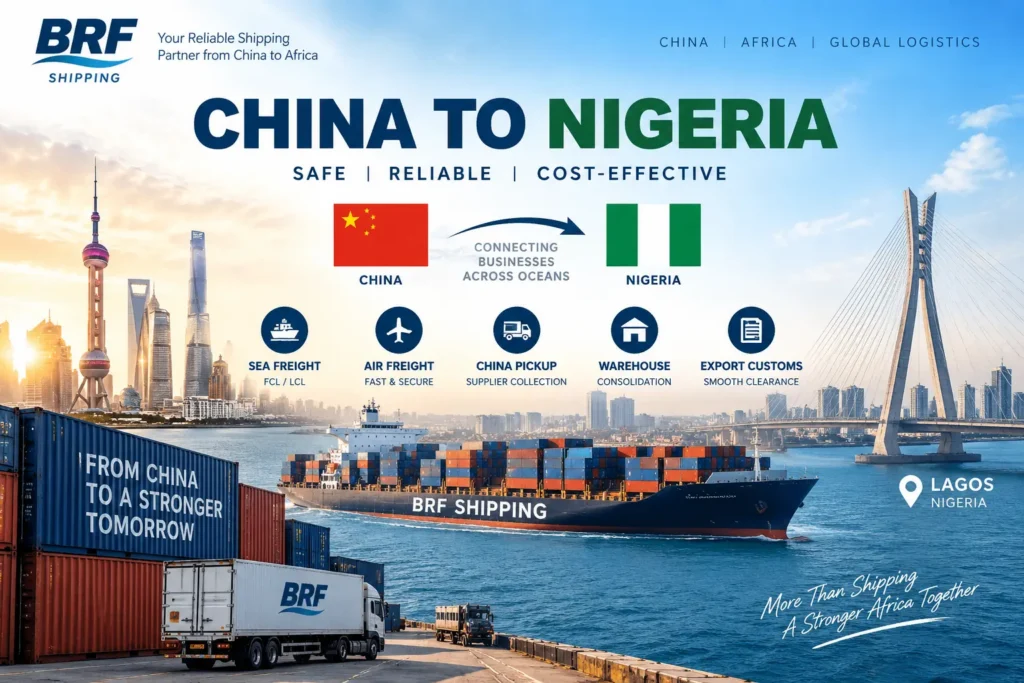
BRF SHIPPING provides shipping solutions from major Chinese manufacturing regions to Nigeria, including China factory pickup, warehouse receiving, multi-supplier consolidation, export customs declaration, FCL shipping, LCL shipping and air freight.
For Nigeria-bound cargo, the service can be planned around major gateways such as Lagos Port Complex (Apapa), Tin Can Island Port, Lekki Deep Sea Port and Onne Port. These ports are listed within the Nigerian Ports Authority’s national port network.
This guide explains how to ship from China to Nigeria, which transport method to choose, how container shipping works, what affects freight costs and what importers should prepare before cargo leaves China.
How Can You Ship from China to Nigeria?
There are three main international freight options:
The correct method depends on your cargo volume, weight, value, delivery deadline and final Nigerian destination.
For most commercial and industrial cargo, sea freight from China to Nigeria is the preferred option because it can handle large volumes at a lower cost per unit than air freight.
Air freight is normally used when the shipment is urgent, valuable or relatively small.
Sea Freight from China to Nigeria
Sea freight is commonly used for:
- Machinery and industrial equipment
- Aluminum and steel products
- Building materials
- Furniture
- Solar equipment
- Automotive parts
- Textiles
- Packaging materials
- Household goods
- Retail inventory
- General commercial cargo
BRF SHIPPING can arrange ocean freight from major Chinese ports including:
- Qingdao
- Shanghai
- Ningbo
- Shenzhen / Yantian
- Guangzhou / Nansha
- Tianjin
- Xiamen
The most suitable Chinese export port does not always mean the geographically closest port.
A good freight forwarder should compare:
Factory location → domestic trucking cost → sailing frequency → freight rate → transit route → Nigeria destination
For example, a supplier in Shandong will often be routed through Qingdao, while cargo from Zhejiang may be more efficiently shipped through Ningbo.
Cargo from Guangdong may use Yantian, Shekou or Nansha depending on the carrier and sailing.
FCL Shipping from China to Nigeria
FCL means Full Container Load.
The importer uses an entire container instead of sharing container space with other customers.
This is normally the preferred option when cargo volume is large, the shipment is heavy or the buyer wants greater control over container loading.
Common container types include:
20GP Container
A 20ft container is frequently used for dense cargo such as:
- Machinery
- Metal products
- Hardware
- Building materials
- Industrial components
- Heavy packaged goods
Because container payload limits also matter, heavy cargo should be checked carefully before loading.
40GP Container
A 40ft standard container offers considerably more loading volume and is suitable for larger commercial shipments.
Common cargo includes:
- Furniture
- Consumer goods
- Machinery
- Building products
- Packaged industrial goods
40HQ Container
A 40HQ container provides additional internal height and is one of the most frequently selected options for China exports.
It is particularly suitable for lightweight but bulky goods such as:
- Furniture
- Plastic products
- Packaging
- Fencing
- Building panels
- Household products
- Retail inventory
The choice between 20GP, 40GP and 40HQ shipping from China to Nigeria should be made after reviewing package dimensions, total CBM and cargo weight rather than simply choosing the largest container.
LCL Shipping from China to Nigeria
Not every importer needs a full container.
If your shipment occupies only several cubic meters, LCL shipping from China to Nigeria may be more economical.
LCL means Less than Container Load.
Your cargo shares container space with shipments belonging to other importers.
A typical LCL process looks like this:
China Supplier
↓
Factory Pickup
↓
China Warehouse / CFS
↓
LCL Consolidation
↓
Export Customs
↓
Ocean Freight
↓
Nigeria Destination CFS
↓
Cargo Release
LCL is particularly useful for:
- New importers testing products
- Small wholesale orders
- Replacement parts
- Samples and commercial inventory
- Buyers purchasing from several Chinese factories
However, LCL should not automatically be assumed to be cheaper.
When cargo volume becomes relatively large, the total LCL charges may approach or exceed the cost of an FCL container.
For this reason, importers shipping approximately 12–18 CBM or more should normally compare LCL versus FCL rather than automatically booking shared-container freight.
The exact break-even point depends on current freight rates, cargo density and destination charges.
Multi-Supplier Consolidation in China
Many Nigerian importers purchase products from several Chinese factories.
For example:
Supplier A – Guangzhou – 4 CBM
Supplier B – Foshan – 5 CBM
Supplier C – Dongguan – 3 CBM
Supplier D – Yiwu – 4 CBM
Instead of exporting each order separately, BRF SHIPPING can arrange supplier pickup and route the cargo to a China warehouse for consolidation.
The process becomes:
Multiple Suppliers
↓
China Warehouse
↓
Quantity & Package Check
↓
Consolidation
↓
FCL or LCL Comparison
↓
Export Customs
↓
Shipping to Nigeria
This can reduce repeated export handling and make the shipment easier to control.
BRF SHIPPING’s warehouse operation supports cargo receiving, storage, consolidation, relabeling, repacking, palletizing, measurements and FCL container loading before export.
China Factory Pickup for Nigeria Shipments
If your purchase term is EXW, the supplier may only be responsible for preparing the cargo at the factory.
The importer then needs to arrange transportation from the supplier to the export warehouse or port.
BRF SHIPPING can coordinate factory pickup throughout major Chinese manufacturing regions, including supplier collection, FCL trucking, LCL pickup and delivery to export handling facilities.
Typical examples include:
Shandong Factory → Qingdao Port
Zhejiang Factory → Ningbo Port
Jiangsu Factory → Shanghai Port
Guangdong Factory → Yantian / Nansha
Hebei Factory → Tianjin Port
Choosing the correct export gateway can help reduce unnecessary domestic trucking costs.
Major Ports in Nigeria
Nigeria has several commercial ports, but Lagos remains particularly important for imported container cargo.
Lagos Port Complex – Apapa
Lagos Port Complex at Apapa is one of Nigeria’s principal commercial gateways.
It serves Lagos and provides access to Nigeria’s largest commercial market.
For many China to Lagos container shipments, Apapa is one of the main destination options.
Tin Can Island Port
Tin Can Island Port is another major Lagos-area gateway for imported commercial cargo.
When comparing Apapa and Tin Can Island, importers should evaluate:
- Carrier service
- Terminal
- Container availability
- Destination charges
- Final warehouse location
- Current congestion conditions
Lekki Deep Sea Port
Lekki Deep Sea Port provides another container gateway in the Lagos region and has expanded the range of routing options available to international container services.
Onne Port
Onne Port is located in Rivers State and is particularly relevant for industrial, energy and project cargo.
The Nigerian Ports Authority describes Onne as an important port complex supporting oil, gas and industrial logistics.
The correct Nigerian destination should therefore be selected according to the final delivery area and available shipping service—not simply by choosing Lagos automatically.
Air Freight from China to Nigeria
Air freight is much faster than ocean freight and is suitable for:
- Spare parts
- Electronics
- Samples
- Medical products
- Components needed for production
- High-value goods
- Urgent inventory
For Lagos-bound air cargo, Murtala Muhammed International Airport is a major cargo gateway.
FAAN confirms that the airport has dedicated cargo facilities with separate logistics handling and warehousing operations.
Common China departure airports include:
- Shanghai PVG
- Guangzhou CAN
- Shenzhen SZX
- Beijing PEK / PKX
- Hong Kong HKG
- Xiamen XMN
- Qingdao TAO
Air freight is normally calculated using chargeable weight.
This means the airline compares:
Actual Gross Weight
with
Volumetric Weight
and charges according to whichever is higher under the airline’s applicable calculation rules.
Large but lightweight cartons can therefore be surprisingly expensive to ship by air.
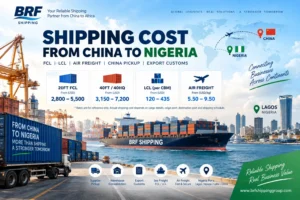
China to Nigeria Shipping Cost
There is no single fixed price for shipping from China to Nigeria.
Freight rates change according to several factors.
China Pickup Location
Cargo located far from the export port requires additional domestic trucking.
Container Size
A 20GP, 40GP and 40HQ each have different freight and handling costs.
Cargo Volume
For LCL shipments, CBM has a major impact on pricing.
Cargo Weight
Heavy cargo may affect trucking, container loading and warehouse handling.
Shipping Line
Different carriers may offer different:
- Freight rates
- Transit routes
- Sailing schedules
- Free time
- Equipment availability
- Transshipment arrangements
Cargo-Ready Date
Ocean freight rates can change between sailings.
A quotation made several weeks before cargo is ready may no longer be valid when the shipment actually books.
Destination Port
Apapa, Tin Can Island, Lekki and other Nigerian destinations can have different carrier availability and destination costs.
For the most accurate quotation, provide:
- China supplier address
- Product name
- HS code if known
- Number of packages
- Package dimensions
- Gross weight
- Total CBM
- Container type if FCL
- Destination port
- Cargo-ready date
- Incoterm
China Export Customs Clearance
Commercial cargo leaving China must complete the required export procedures before departure.
BRF SHIPPING can coordinate export declaration support, including commercial-document review, declaration data, HS-code information, customs inspection follow-up where applicable and connection with the booked sea or air shipment.
Typical export documents may include:
- Commercial invoice
- Packing list
- Product description
- HS code
- Exporter details
- Consignee information
- Contract or supporting commercial information
- Product-specific documents where required
Incorrect descriptions, values or classifications can delay cargo release.
For that reason, customs preparation should begin before the vessel cutoff—not after the cargo reaches the port.
Nigeria Import Customs: Form M, PAAR and SGD
Importers should also prepare Nigeria-side customs requirements before shipment.
Nigeria Customs Service currently operates its Unified Customs Management System, known as B’Odogwu, which has been introduced to replace the former NICIS II platform. Nigeria Customs describes it as the digital platform for customs trade processing.
Depending on the cargo and importer, the process can involve:
Form M
The importer typically begins the commercial import process using Form M through the appropriate Nigerian banking and trade system.
PAAR
PAAR stands for Pre-Arrival Assessment Report.
It forms part of the customs assessment process before the cargo arrives.
Single Goods Declaration
The importer or appointed customs representative submits the goods declaration and supporting import information for customs assessment.
Nigeria Customs’ published import procedure identifies Form M, PAAR and the Single Goods Declaration among the key stages of the import process.
Import requirements can vary according to commodity.
Certain products may require additional regulatory documentation or certificates.
Importers should therefore confirm their product’s requirements with a licensed Nigerian customs professional before cargo departs China.
Does BRF SHIPPING Provide Nigeria Customs Clearance?
For the China-to-Nigeria route, BRF SHIPPING’s primary service focus is:
China Factory Pickup
↓
China Warehouse
↓
Cargo Consolidation
↓
Container Loading
↓
China Export Customs
↓
FCL / LCL / Air Freight
↓
Nigeria Port or Airport
Destination customs clearance and Nigerian inland delivery can be reviewed separately according to the importer, cargo type and available local service arrangement.
Importers should not assume that ocean freight automatically includes Nigeria customs clearance, import duties, taxes, terminal fees or inland trucking unless these items are specifically listed in the quotation.
This approach keeps the shipping scope clear and reduces misunderstandings after cargo arrives.
What Products Are Commonly Shipped from China to Nigeria?
China-to-Nigeria trade covers a broad range of commercial products.
BRF SHIPPING can evaluate transportation for products including:
Machinery and Industrial Equipment
Manufacturing machinery, generators, pumps, compressors, tools and spare parts.
Construction Materials
Aluminum profiles, fencing, gates, steel products, hardware, panels and building products.
Solar and Energy Equipment
Solar panels, lighting products, batteries and related equipment subject to carrier and regulatory requirements.
Automotive Parts
Vehicle components, tyres, accessories and workshop equipment.
Furniture
Residential, commercial and hospitality furniture.
Consumer Products
Household items, packaging materials, retail inventory and general merchandise.
Special cargo such as batteries, chemicals, liquids, powders, oversized equipment and dangerous goods must be declared before booking.
How to Choose a China to Nigeria Freight Forwarder
A freight forwarder should do more than send you an ocean freight price.
A reliable China to Nigeria freight forwarder should help control the entire China-side process.
Important capabilities include:
- Communication with Chinese suppliers
- Factory pickup
- China warehouse receiving
- Multi-supplier consolidation
- Cargo measurement
- FCL container loading
- LCL consolidation
- China export customs
- Shipping-line booking
- Shipping documents
- Shipment tracking
- Destination-agent coordination
BRF SHIPPING combines these China-origin services with its international sea and air freight network. Its sea-freight service includes supplier pickup, warehouse receiving, consolidation, container loading, export declaration and shipping-document coordination.
China to Nigeria Shipping Process
A typical shipment can follow this workflow:
Step 1 – Send Cargo Information
Provide supplier address, cargo description, package dimensions, weight and destination.
Step 2 – Compare Shipping Methods
Determine whether FCL, LCL or air freight is the better solution.
Step 3 – Arrange China Pickup
Cargo is collected from the supplier or delivered to the designated warehouse.
Step 4 – Warehouse & Consolidation
Multiple supplier orders can be combined where required.
Step 5 – Container Loading or CFS Delivery
FCL cargo is loaded into the booked container.
LCL cargo is transferred to the export CFS.
Step 6 – China Export Customs
Export declaration and shipping documents are coordinated before departure.
Step 7 – International Freight
Cargo moves by sea or air to Nigeria.
Step 8 – Nigeria Arrival
The consignee or nominated local customs representative handles the agreed destination procedures.
Frequently Asked Questions About China to Nigeria Shipping
What is the cheapest way to ship from China to Nigeria?
For large commercial shipments, sea freight is generally more economical than air freight. LCL can work well for smaller cargo, while FCL often becomes more cost-effective as shipment volume increases.
Can I ship one 40HQ from China to Lagos?
Yes. 40HQ container shipping is widely used for high-volume commercial cargo from China.
Can BRF SHIPPING collect cargo from my supplier?
Yes. Factory pickup can be arranged throughout major Chinese manufacturing regions.
Can cargo from several Chinese suppliers be combined?
Yes. Goods from multiple suppliers can be received at a China warehouse and consolidated into one FCL, LCL or air shipment.
Which Nigerian port is best for China cargo?
For many container shipments, Apapa, Tin Can Island and Lekki are important Lagos-area options. Onne can be relevant for industrial and regional cargo. The final decision should depend on carrier routing and the consignee’s final location.
Do I need Form M and PAAR?
These documents form part of Nigeria’s standard commercial import procedures, although requirements depend on the shipment and importer. Confirm current requirements before booking.
Does the sea freight rate include Nigeria import duty?
Not automatically. Freight, duties, taxes, terminal charges, brokerage and delivery should be treated as separate items unless the quotation specifically includes them.
Get a China to Nigeria Shipping Quote
If you are importing commercial cargo from China to Nigeria, BRF SHIPPING can help organize the China side of your shipment and international transportation.
Our services can include:
China Supplier Pickup
↓
Warehouse Receiving
↓
Multi-Supplier Consolidation
↓
20GP / 40GP / 40HQ Loading
↓
China Export Customs
↓
FCL / LCL / Air Freight
↓
Nigeria Port or Airport
For an accurate quotation, send:
- China supplier city
- Product name
- HS code if available
- Package quantity
- Dimensions
- Gross weight
- Total CBM
- Container type if known
- Nigerian destination
- Cargo-ready date
BRF SHIPPING
China Pickup · Warehouse · Export Customs · FCL · LCL · Air Freight · China to Nigeria Shipping
Contact BRF SHIPPING for a current China-to-Nigeria freight plan based on your actual cargo and routing requirements.