Air freight from China to Australia is a practical solution for urgent, valuable or time-sensitive commercial cargo that cannot wait for ocean shipping. It is commonly used for industrial spare parts, electronic components, machinery parts, medical products, samples, replacement equipment, fashion goods and project materials.
BRF SHIPPING coordinates air cargo from factories and suppliers throughout China to Sydney, Melbourne, Brisbane, Perth, Adelaide and other Australian destinations. The service can include supplier pickup, warehouse receiving, cargo checking, export packing, China export customs declaration, airline booking, air transportation, Australian customs coordination and final delivery.
Importers can choose from:
- Airport-to-airport air freight
- Airport-to-door delivery
- EXW pickup from a Chinese supplier
- Consolidated air cargo
- Priority or standard air freight
- Express courier for smaller shipments
- DAP delivery
- DDP coordination where the cargo and importer arrangement allow it
For a comparison with FCL, LCL and door-delivery costs, visit our Shipping Cost from China to Australia guide. For a complete overview of available transport methods, see Shipping from China to Australia.
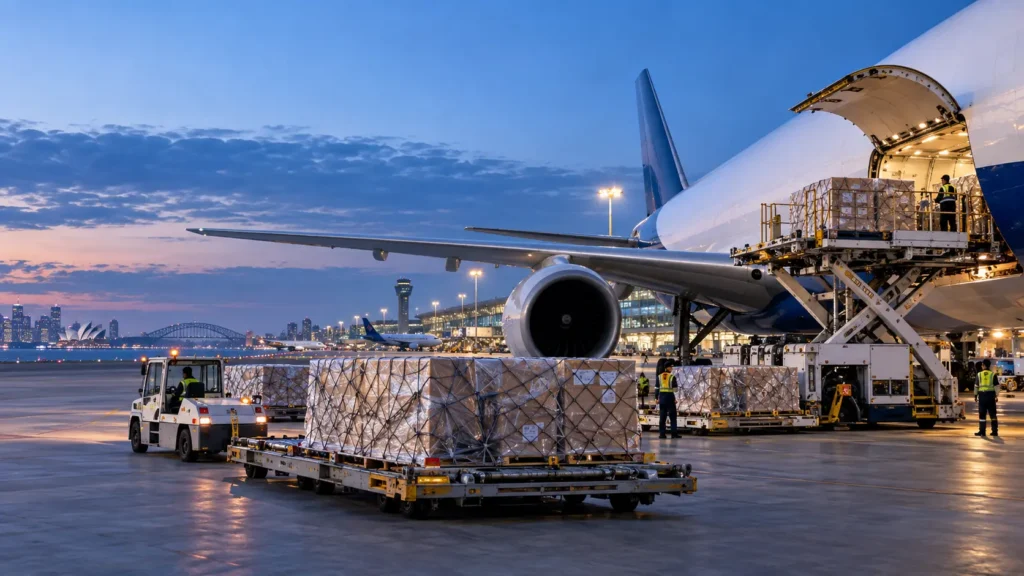
China to Australia Air Freight Overview
| Air shipping option | Typical planning time | Suitable cargo | Pricing basis |
|---|---|---|---|
| Express courier | About 2–6 days door to door | Documents, samples and small parcels | Chargeable weight and service level |
| Priority air freight | About 2–5 days airport to airport | Critical components and urgent commercial cargo | Chargeable kilograms |
| Standard air freight | About 3–8 days airport to airport | General commercial cargo | Chargeable kilograms |
| Consolidated air cargo | About 5–10 days airport to airport | Flexible shipments without a fixed daily departure requirement | Chargeable kilograms |
| Air freight door to door | About 5–12 days | Commercial cargo requiring pickup, clearance and delivery | Complete customized quotation |
These times are planning estimates, not guarantees. The total schedule depends on the Chinese pickup location, flight availability, export documentation, direct or connecting service, Australian customs and biosecurity status, and final delivery postcode.
How Much Does Air Freight from China to Australia Cost per KG?
The air freight cost from China to Australia is normally calculated according to chargeable weight rather than actual weight alone.
As an indicative September 2026 planning reference, standard commercial air freight on common China–Australia routes may start from approximately USD 3.70 per chargeable kilogram for suitable shipments above 100 kg. Express services may start from approximately USD 5.90 per chargeable kilogram. These figures are general market-planning references, not fixed BRF SHIPPING tariffs.
The actual air freight rate per kg depends on:
- Chinese departure airport
- Australian arrival airport
- Actual gross weight
- Package dimensions
- Chargeable weight
- Commodity and HS code
- Number of packages
- Direct or connecting flight
- Standard, priority or express service
- Airline capacity
- Fuel and security surcharges
- Dangerous-goods status
- Cargo-ready date
- Airport-to-airport or door-to-door scope
- Australian delivery postcode
Indicative Air Freight Planning Ranges
| Chargeable weight | Indicative planning range | Important note |
|---|---|---|
| 45–100 kg | Approximately USD 5.50–8.50/kg | Minimum charges and handling have a greater effect |
| 100–300 kg | Approximately USD 4.20–6.80/kg | Suitable for standard commercial air cargo |
| 300–500 kg | Approximately USD 3.70–6.00/kg | Better airline breakpoints may become available |
| Above 500 kg | Live quotation required | Compare standard, consolidated and part-charter options |
| Express courier | From approximately USD 5.90/kg | Final cost depends heavily on parcel dimensions and service level |
These ranges exclude some or all of the following unless specifically included:
- Supplier pickup in China
- Export packing or palletization
- China warehouse handling
- Export customs declaration
- Airport terminal charges
- Air waybill and documentation fees
- Security screening
- Dangerous-goods handling
- Australian terminal and airline handling
- Customs broker fees
- Import duty and GST
- Biosecurity assessment or inspection
- Storage
- Final delivery
A low airport-to-airport rate should not be compared directly with a quotation covering factory pickup, customs clearance and Australian door delivery.
How Chargeable Weight Is Calculated
Airlines compare the cargo’s actual gross weight with its volumetric weight. The higher figure is generally used as the chargeable weight.
Chargeable weight = the greater of actual gross weight or volumetric weight
A commonly used international air freight formula is:
Volumetric weight in kg = Length × Width × Height in centimetres ÷ 6,000
Some courier or express services may use a different divisor, such as 5,000. The divisor and rounding method stated in the quotation always control the final calculation.
Chargeable Weight Example
Assume a shipment consists of two pallets.
- Dimensions per pallet: 120 × 100 × 150 cm
- Actual weight per pallet: 150 kg
- Total actual weight: 300 kg
Volumetric weight per pallet:
120 × 100 × 150 ÷ 6,000 = 300 kg
Total volumetric weight:
300 kg × 2 pallets = 600 kg
The airline may charge the shipment as 600 kg, even though the cargo physically weighs only 300 kg.
This is why an accurate air freight quotation requires the dimensions and weight of every package. Total weight without dimensions is not enough.
What Is Included in an Air Freight Quotation?
A complete China-to-Australia air cargo quotation can be divided into five stages.
1. China Supplier Pickup
BRF SHIPPING can collect cargo from factories, trading companies and warehouses throughout China.
Pickup planning considers:
- Supplier address
- Number and size of packages
- Total gross weight
- Cargo-ready date
- Loading conditions
- Tail-lift or forklift requirements
- Dangerous-goods status
- Distance to the departure airport or consolidation warehouse
When products come from several suppliers, they can be collected through our China pickup service and delivered to a consolidation warehouse.
2. Warehouse Receiving and Export Preparation
Warehouse services may include:
- Package counting
- Dimension and weight verification
- Exterior packing inspection
- Cargo photographs
- Repacking
- Palletization
- Export labels and shipping marks
- Consolidation of several supplier orders
- Temporary storage
- Dangerous-goods document checking
Air freight is sensitive to package dimensions. Reducing unnecessary packing volume can lower chargeable weight, but the cargo must remain adequately protected during handling and flight transportation.
Learn more about China warehouse storage and consolidation.
3. China Export Customs and Airline Booking
Commercial air cargo normally requires accurate export documentation before airline acceptance.
Common information includes:
- Commercial invoice
- Packing list
- Exporter and consignee details
- Product description
- HS code
- Quantity and declared value
- Country of origin
- Number of packages
- Gross and net weight
- Package dimensions
- Material and intended use
- Dangerous-goods information where applicable
BRF SHIPPING can coordinate China export customs clearance when the supplier cannot export directly or when cargo from several suppliers is consolidated.
4. International Air Transportation
The international air freight charge may include:
- Airline freight
- Fuel surcharge
- Security surcharge
- Air waybill fee
- Terminal handling
- Screening
- Export documentation
- Special handling when required
The lowest air rate does not always produce the best result. A connecting service may cost less but add handling points and schedule risk. Urgent cargo should be compared using the complete route, confirmed flight plan and expected availability time—not the rate per kilogram alone.
5. Australian Clearance and Door Delivery
After arrival, the shipment must be made available by the airline or cargo terminal and receive all required customs and biosecurity releases before delivery.
Destination costs may include:
- Airline or terminal handling
- Cargo availability fees
- Customs broker service
- Import Processing Charge
- Customs duty
- Import GST
- Biosecurity document assessment
- Inspection or treatment
- Storage
- Airport collection
- Local truck delivery
- Tail-lift or special unloading
For the full import process, read our Australia Customs Clearance and Door-to-Door Delivery guide.
Major Air Freight Routes from China to Australia
China has several important international air cargo gateways. The most suitable airport is not always the airport geographically closest to the supplier.
BRF SHIPPING may route cargo through:
- Shanghai Pudong International Airport (PVG)
- Guangzhou Baiyun International Airport (CAN)
- Shenzhen Bao’an International Airport (SZX)
- Beijing Capital International Airport (PEK)
- Zhengzhou Xinzheng International Airport (CGO)
- Hong Kong International Airport (HKG), when commercially and operationally suitable
The route should be selected by comparing:
- Factory-to-airport trucking
- Export handling cost
- Available airline services
- Direct or connecting schedule
- Cargo dimensions
- Commodity acceptance
- Rate validity
- Space availability
- Australian destination
Air Freight from China to Sydney
Sydney is one of the main air cargo gateways for New South Wales and the wider Australian market.
Air freight to Sydney is commonly used for:
- Industrial spare parts
- Electronic components
- Machinery components
- Medical and dental products
- Samples
- Fashion and retail stock
- Replacement equipment
- Urgent construction materials
Cargo may depart from Shanghai, Guangzhou, Shenzhen, Beijing, Zhengzhou or Hong Kong, depending on the supplier location and airline service.
After arrival, delivery can be arranged to Sydney CBD, South Sydney, the Inner West, Parramatta, Auburn, Bankstown, Wetherill Park, Smithfield, Eastern Creek, Blacktown and other metropolitan or regional New South Wales destinations.
For ocean cargo and general route information, see Shipping from China to Sydney.
Air Freight from China to Melbourne
Air freight to Melbourne serves importers in Victoria and southern Australia.
It may be suitable for:
- Automotive and machinery parts
- Electronics
- Medical supplies
- Commercial samples
- Retail inventory
- Maintenance and repair components
- Time-critical project cargo
The complete quotation should include the final Victorian postcode. Airport collection and delivery to metropolitan Melbourne are different from regional delivery to locations farther from the cargo terminal.
Air Freight from China to Brisbane
Brisbane is a major air cargo destination for Queensland and South East Queensland.
Air freight to Brisbane may support delivery to:
- Brisbane metropolitan warehouses
- Gold Coast
- Sunshine Coast
- Ipswich
- Logan
- Commercial and industrial destinations across Queensland
For cargo destined for Queensland, compare direct Brisbane arrival with routing through Sydney or Melbourne. A lower international rate through another airport can be offset by higher domestic transfer and delivery costs.
Air Freight to Perth and Adelaide
Perth serves Western Australia, while Adelaide serves South Australia.
Direct capacity, connecting schedules and freight costs vary by origin airport and cargo type. The route should be selected according to the complete door-delivery plan rather than the international rate alone.
For urgent industrial cargo moving to Western Australian mining, construction or maintenance projects, provide the final postcode, required delivery date and unloading conditions before booking.
Air Freight Transit Time from China to Australia
| Route or service | Indicative airport-to-airport time | Indicative door-to-door time |
|---|---|---|
| Shanghai to Sydney/Melbourne | About 3–7 days | About 5–10 days |
| Guangzhou/Shenzhen to Sydney/Melbourne | About 3–8 days | About 5–12 days |
| China to Brisbane | About 3–8 days | About 5–12 days |
| China to Perth/Adelaide | About 4–9 days | About 6–14 days |
| Priority air freight | About 2–5 days | About 4–8 days |
| Express courier | Not normally quoted airport to airport | About 2–6 days |
Air freight transit time can increase because of:
- Factory pickup delays
- Cargo-ready date changes
- Incorrect documents
- Missed airline cut-off
- Security screening
- Airline space restrictions
- Dangerous-goods approval
- Connecting-flight schedules
- Customs review
- Biosecurity inspection
- Import permits
- Weekend or holiday arrivals
- Delivery appointment requirements
Importers should not promise customers a delivery date based only on the flight departure and arrival times.
China to Australia Air Freight Documents
Common air cargo documents include:
Commercial Invoice
The commercial invoice should show the seller, buyer, product description, quantity, unit price, total value, currency, country of origin and Incoterm.
Descriptions such as “parts,” “accessories,” “equipment” or “samples” may be too general for customs and airline processing. Use a clear commercial description.
Packing List
The packing list should show:
- Number of cartons, pallets or crates
- Dimensions of each package
- Net and gross weight
- Product quantities
- Packing type
- Shipping marks
Air Waybill
The Air Waybill records the shipper, consignee, airports, package count, chargeable weight and transportation instructions. Depending on the consolidation arrangement, the shipment may use a Master Air Waybill and House Air Waybill.
Certificate of Origin
A Certificate of Origin may be required when the importer claims preferential customs-duty treatment under the China–Australia Free Trade Agreement. Eligibility depends on the tariff classification, origin rules and supporting documents.
Product and Compliance Documents
Depending on the commodity, additional documents may include:
- Import permit
- Manufacturer declaration
- Material Safety Data Sheet
- Dangerous Goods Declaration
- UN 38.3 test summary
- Battery specification
- Product catalogue
- Treatment certificate
- Health or phytosanitary certificate
- Technical specifications
An Australia Packing Declaration is mainly associated with containerised sea cargo and should not automatically be treated as a standard air freight document. Importers comparing air and sea shipping can read our separate guide on How to Complete an Australia Packing Declaration Form.
Australian Customs Clearance for Air Cargo
Commercial air cargo remains under customs control until the applicable declaration, payment and release requirements are completed.
The Australian Border Force states that goods valued above AUD 1,000 generally require an Import Declaration, with relevant duties, taxes and charges payable before release. The current ABF guidance is available on its Import Declarations page.
Customs assessment may consider:
- Importer information
- Supplier information
- Product description
- HS classification
- Customs value
- Freight and insurance
- Country of origin
- Customs duty
- GST
- Permits and restrictions
- Trade-agreement eligibility
ABF currently lists an electronic Full Import Declaration processing charge for air consignments over AUD 1,000. Government charges can change, so importers should confirm the current amount on the official Import Processing Charge page before shipment.
Customs Duty and Import GST
Customs duty depends on the HS code, product description, customs value, origin and available tariff treatment.
Eligible China-origin goods may receive preferential customs-duty treatment under ChAFTA when the relevant origin requirements are met. This does not automatically remove import GST or other charges.
Australian import GST is generally 10% of the Value of the Taxable Importation. The calculation commonly includes:
- Customs value
- Customs duty
- International transport and insurance
- Wine Equalisation Tax where applicable
Importers should confirm the treatment with their customs broker and the current Australian Border Force GST guidance.
Australian Biosecurity Requirements for Air Cargo
Air freight is not exempt from Australian biosecurity controls.
Goods that may need additional assessment include:
- Food and ingredients
- Plant and animal products
- Seeds
- Timber or bamboo products
- Wooden packaging
- Used machinery
- Outdoor equipment
- Agricultural products
- Goods contaminated by soil or organic material
Australia’s Department of Agriculture, Fisheries and Forestry uses the Biosecurity Import Conditions system to publish commodity-specific import requirements. BICON identifies whether goods are permitted and whether an import permit, treatment or supporting documentation is required.
Where a permit is required, DAFF advises that it must be granted before the goods arrive in Australia. Current guidance is available on the official BICON import permits page.
An urgent flight does not override import requirements. Shipping regulated cargo before a permit is granted can lead to storage, treatment, export or destruction costs.
Shipping Lithium Batteries and Dangerous Goods by Air
Lithium batteries, chemicals, aerosols, magnets, liquids, powders and other regulated products must be declared before booking.
The shipper may need to provide:
- Accurate product description
- Safety Data Sheet
- UN number
- Dangerous-goods classification
- Packing instruction
- UN specification packaging where required
- Marks and labels
- Shipper’s Declaration for Dangerous Goods
- UN 38.3 test summary for applicable batteries
- Battery watt-hour rating
- State-of-charge information
IATA’s 2026 battery guidance states that lithium and sodium-ion batteries are regulated as dangerous goods because of thermal-runaway risk. The requirements differ depending on whether batteries are shipped alone, packed with equipment or installed in equipment. Consult the current IATA battery guidance before booking.
Do not describe battery cargo as ordinary electronics to obtain a lower rate. Incorrect declarations can cause airline rejection, delays, penalties and serious safety risks.
What Cargo Is Suitable for Air Freight?
Air freight is commonly suitable for:
- Industrial spare parts
- Machinery components
- Electronic components
- Medical and dental products
- Commercial samples
- Fashion and seasonal inventory
- High-value instruments
- Replacement equipment
- Urgent project materials
- Time-sensitive production supplies
Air freight may not be economical for:
- Low-value bulky cargo
- Large furniture shipments
- Long construction products
- Heavy building materials
- High-volume general inventory
- Cargo that can meet the schedule by sea
For bulky or non-urgent cargo, compare Sea Freight from China to Australia and LCL Shipping Cost from China to Australia.
Air Freight vs Sea Freight from China to Australia
| Factor | Air freight | Sea freight |
|---|---|---|
| Main pricing basis | Chargeable kilograms | Container type or chargeable CBM |
| Typical transit | About 3–8 days airport to airport | About 15–38+ days port to port |
| Best for | Urgent, valuable or lighter cargo | Heavy, bulky or non-urgent cargo |
| Typical shipment size | Cartons, pallets and urgent parts | Pallets, LCL cargo and full containers |
| Handling risk | Fewer days in transit, but multiple terminal handling points remain | LCL receives more handling; FCL stays in one container |
| Documentation | Air Waybill and applicable customs/compliance documents | Bill of Lading, customs documents and relevant sea-cargo declarations |
| Main cost risk | Volumetric weight and airline capacity | Destination charges, storage, demurrage and detention |
For borderline shipments, request both air and LCL quotations. Air freight can sometimes be competitive for dense, urgent cargo with low volume, while LCL may be more suitable for heavier or less urgent goods.
Door-to-Door Air Freight from China to Australia
Door-to-door air freight combines the major shipping stages under one coordinated plan:
- Supplier pickup in China
- Warehouse receiving and cargo checking
- Export packing and labeling
- Export customs declaration
- Airline booking and departure
- Arrival at the Australian airport
- Customs and biosecurity coordination
- Duty and GST payment coordination
- Cargo release
- Final truck delivery
Door-to-door does not automatically mean every possible charge is included. The quotation should identify whether it includes:
- Customs duty
- GST
- Import Processing Charge
- Customs broker fee
- Biosecurity assessment
- Inspection
- Storage
- Dangerous-goods handling
- Tail-lift delivery
- Residential delivery
- Regional delivery
- Waiting time or redelivery
Learn more about Door-to-Door Shipping from China.
DAP and DDP Air Freight to Australia
DAP Air Freight
Under DAP, the seller arranges transportation to the agreed destination, while the buyer normally handles import clearance, customs duty and GST.
The quotation should clearly identify who pays:
- Airport destination charges
- Customs broker fees
- Duty and GST
- Biosecurity fees
- Final unloading
DDP Air Freight
Under DDP, the seller accepts broader responsibility for import formalities, duties and taxes under the agreed commercial arrangement.
A compliant DDP solution requires confirmation of:
- Importer-of-record structure
- HS code
- Product eligibility
- Customs value
- Duty and GST
- Biosecurity conditions
- Australian product compliance
- Delivery address
DDP is not automatically available for every product or importer. Sensitive, regulated, high-value or dangerous cargo should be reviewed before a DDP price is offered.
How to Reduce Air Freight Cost from China to Australia
Reduce Unnecessary Packing Volume
Because volumetric weight can exceed actual weight, reducing empty carton space may lower the chargeable kilograms. Do not compromise cargo protection merely to make the package smaller.
Consolidate Several Suppliers
Collecting products from multiple factories into one warehouse can reduce repeated minimum charges and create one coordinated air shipment.
Provide Exact Dimensions Before Booking
Estimated package sizes can produce an inaccurate quotation. Measure every carton, pallet or crate after final packing.
Compare Departure Airports
The closest airport may not offer the best rate or schedule. Shanghai, Guangzhou, Shenzhen, Zhengzhou and Hong Kong can have different airline capacity and commodity acceptance.
Select the Correct Service Level
Not every urgent shipment needs express courier. Compare:
- Express courier
- Priority air freight
- Standard air freight
- Consolidated air cargo
Prepare Documents Early
Correct invoice descriptions, HS codes, permits and dangerous-goods documentation reduce airline rejection and destination delays.
Split Critical and Non-Critical Cargo
When only part of an order is urgent, send the critical quantity by air and move the remaining volume by sea. This can protect the production schedule without paying air freight for the complete order.
Information Required for an Air Freight Quote
Send BRF SHIPPING:
- Chinese supplier or pickup address
- Australian destination airport or delivery postcode
- Product name and intended use
- HS code if available
- Number of packages
- Dimensions of every package
- Gross weight of every package
- Total gross weight
- Commercial value
- Cargo-ready date
- Required delivery date
- Incoterm
- Stackable or non-stackable status
- Dangerous-goods status
- Battery details where applicable
- Temperature-control requirements
- Pickup and delivery loading conditions
- Product and packing photographs
For air freight, dimensions and weight are both essential. A quotation based only on kilograms may change after the airline or warehouse measures the cargo.
Frequently Asked Questions
How much is air freight from China to Australia per kg?
As a September 2026 planning reference, standard commercial air freight on common routes may start from approximately USD 3.70 per chargeable kilogram for suitable shipments above 100 kg. Smaller, urgent, oversized or special cargo can cost more. A live rate requires the package dimensions, weight, commodity, origin, destination and cargo-ready date.
How long does air freight from China to Australia take?
Standard air freight commonly takes approximately 3–8 days airport to airport. A complete door-to-door shipment may take approximately 5–12 days after allowing for pickup, export handling, customs, biosecurity and final delivery.
Is air freight charged by actual weight?
Airlines generally compare actual gross weight and volumetric weight. The greater figure becomes the chargeable weight.
What is the volumetric-weight formula for air freight?
A common formula is length × width × height in centimetres ÷ 6,000. Some express services use a different divisor, so confirm the quotation terms.
What is the cheapest way to send urgent cargo from China to Australia?
The answer depends on cargo size and urgency. Express courier can suit small parcels, while standard or consolidated air freight can be more economical for larger commercial shipments. If the cargo can wait, compare LCL sea freight.
Can BRF arrange air freight to Sydney?
Yes. BRF SHIPPING can coordinate supplier pickup, export handling, air freight, Australian customs support and delivery to Sydney and regional New South Wales according to the agreed service scope.
Can BRF arrange air freight to Melbourne and Brisbane?
Yes. Air cargo can be arranged to Melbourne, Brisbane and other Australian gateways, subject to the cargo type, airline acceptance, available schedule and destination requirements.
Does air freight include Australian customs duty and GST?
Not automatically. Airport-to-airport and standard freight rates normally exclude customs broker fees, duty, GST, biosecurity and delivery unless the quotation specifically includes them.
Is a Packing Declaration required for air freight?
An Australia Packing Declaration is principally used for applicable containerised sea cargo. Air shipments may require different customs, biosecurity and commodity documents. Check the actual product and packaging requirements through BICON and the appointed customs broker.
Can lithium batteries be shipped by air to Australia?
Some batteries and battery-powered equipment can be shipped when they meet the applicable classification, testing, packing, labeling, documentation and airline-acceptance requirements. Complete battery details must be provided before booking.
Can air cargo be delayed after arriving in Australia?
Yes. Cargo can be delayed by airline availability, terminal handling, customs review, biosecurity directions, missing permits, document discrepancies, unpaid charges or delivery scheduling. See our guide to cargo delays after arrival in Australia.
Request an Air Freight Quote from China to Australia
BRF SHIPPING provides coordinated air freight from major Chinese manufacturing areas to Sydney, Melbourne, Brisbane, Perth, Adelaide and other Australian destinations.
Our service can include:
- Supplier pickup in China
- Multi-supplier consolidation
- Warehouse receiving
- Export packing and labeling
- China export customs declaration
- Standard and priority air freight
- Dangerous-goods coordination where accepted
- Australian customs and biosecurity support
- Airport collection
- Commercial and warehouse delivery
- DAP or DDP coordination where suitable
Contact BRF SHIPPING with the pickup address, Australian postcode, product description, package dimensions, gross weight and cargo-ready date for a current air freight quotation.
Rates and transit times in this article are indicative planning references and are not fixed quotations. Airline capacity, market conditions, government requirements and destination charges can change. Confirm the applicable booking, customs, biosecurity and delivery terms for each shipment.