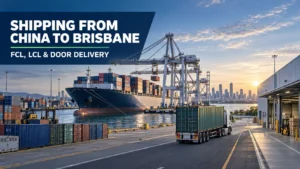
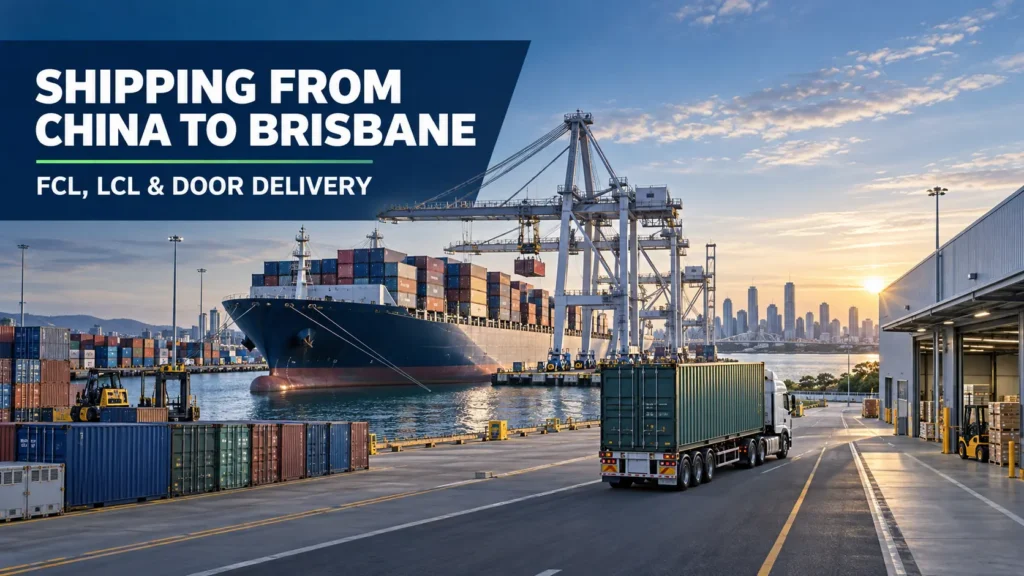
Shipping from China to Brisbane can be arranged by full container load (FCL), less than container load (LCL), air freight or a coordinated door-to-door service. The best method depends on cargo volume, weight, product type, required delivery date and the final destination in Brisbane, the Gold Coast or another part of Queensland.
BRF Shipping can coordinate collection from the supplier in China, export customs declaration, ocean or air freight, Australian customs and biosecurity processing, and final delivery. Delivery options include sealed-container transport, side-loader delivery, depot unpack, pallet delivery and warehouse delivery, subject to cargo and site conditions.
This guide explains the main China-to-Brisbane freight options, typical transit times, cost components, Port of Brisbane arrival procedures, Queensland delivery planning and the special considerations for machinery, building materials and containerised cargo.
Request a quote: Send the pickup city, cargo description, packing list, total weight and volume, Incoterm, required shipping date and Queensland delivery postcode to BRF Shipping.
China to Brisbane Shipping Options
| Shipping method | Best suited to | Typical freight time* | Brisbane and Queensland delivery |
|---|---|---|---|
| FCL sea freight | Large, heavy or high-volume cargo using a dedicated container | About 15–30 days port to port | Standard trailer, side-loader, depot unpack or project delivery |
| LCL sea freight | Commercial cargo that does not fill a container | About 20–40+ days port to port | Pallet, crate or loose-cargo delivery |
| Air freight | Urgent, lightweight or high-value cargo | About 3–8 days airport to airport | Brisbane warehouse or business delivery |
| Door-to-door sea freight | Importers needing one coordinated route from supplier to destination | Commonly 22–48+ days | Brisbane, Gold Coast and regional Queensland |
*These are planning ranges, not guaranteed schedules. The actual timeline depends on the Chinese origin, sailing route, transshipment, consolidation, cargo availability, customs and biosecurity status, terminal or depot release, and delivery bookings.
For a country-wide service comparison, visit shipping from China to Australia. For an overview of all cost categories, see shipping cost from China to Australia.
Why Ship Through the Port of Brisbane?
The Port of Brisbane is the principal international cargo gateway for Brisbane and a major entry point for freight serving South East Queensland. Queensland Government port information describes it as the state’s largest general cargo port. Its container facilities at Fisherman Islands connect imported goods with industrial and distribution areas across Brisbane, Logan, Ipswich, the Gold Coast, the Sunshine Coast and inland Queensland.
For importers, the port can be practical when the cargo’s final destination is in:
- Brisbane metropolitan industrial areas
- Logan and the southern Brisbane corridor
- Ipswich and western Brisbane
- The Gold Coast
- The Sunshine Coast
- Toowoomba and the Darling Downs
- Other Queensland destinations reached through an onward road-freight service
The port of discharge should be chosen according to total landed cost. A lower ocean rate through another Australian port may not save money if it creates a longer interstate movement, additional handling or an unsuitable empty-container return arrangement.
Official operational information is available from the Port of Brisbane and the Queensland Government’s Brisbane port procedures.
Main Shipping Routes from China to Brisbane
BRF Shipping can arrange freight from major Chinese ports and inland manufacturing regions. The most suitable loading port depends on the factory address, equipment availability, vessel schedule, origin charges and total inland transport cost.
Common routes include:
- Shanghai to Brisbane: Frequently used for cargo from Shanghai, Jiangsu, Zhejiang and nearby eastern China manufacturing areas.
- Ningbo to Brisbane: Suitable for suppliers in Zhejiang and parts of the Yangtze River Delta.
- Shenzhen or Yantian to Brisbane: Common for cargo from Shenzhen, Dongguan, Huizhou and the Pearl River Delta.
- Guangzhou or Nansha to Brisbane: Often used for factories in Guangzhou, Foshan, Zhongshan and surrounding cities.
- Qingdao to Brisbane: A practical gateway for cargo from Shandong and northern coastal manufacturing regions.
- Tianjin to Brisbane: Used for suppliers in Tianjin, Beijing, Hebei and parts of northern China.
- Xiamen to Brisbane: Common for goods produced in Fujian and nearby areas.
Some sailings may be direct, while others may transship. The fastest advertised sailing is not automatically the fastest door-to-door option. Origin pickup, cut-off time, consolidation and destination availability must also be considered.
FCL Shipping from China to Brisbane
FCL gives one shipper the use of a full container. It is normally selected for larger shipments, dense goods, machinery, long products, fragile cargo or orders that benefit from fewer handling points.
20ft container shipping to Brisbane
A 20ft general-purpose container is commonly used for dense cargo such as machinery, metal components, stone products, tiles, construction hardware and other heavy manufactured goods. Internal space may remain available even when the safe payload or road-transport limit has been reached, so cargo weight and distribution must be reviewed before loading.
See 20ft container shipping cost from China to Australia for the main pricing factors.
40ft and 40HQ container shipping to Brisbane
A 40ft general-purpose or 40HQ container is normally suitable for high-volume cargo such as furniture, building products, fencing, packaging, light machinery and retail inventory. A 40HQ provides additional internal height, but the final choice must be based on package dimensions, volume, cargo weight and loading method.
See 40ft container shipping cost from China to Australia for a detailed guide.
When FCL is the better option
FCL may be appropriate when:
- The cargo occupies a substantial part of a container
- The shipment is heavy or difficult to handle in a shared container
- Long or irregular pieces require a controlled loading plan
- Multiple supplier orders can be consolidated in China
- The importer wants a sealed-container movement
- The Queensland receiving site can accept and unload the container
- Fewer cargo-handling points are preferred
The container plan should be confirmed using the packed dimensions and gross weight of every item. Product quantity alone is not enough to select the right equipment.
LCL Shipping from China to Brisbane
LCL shipping allows several shippers to share one container. It is usually suitable for smaller commercial shipments that do not justify the cost of a dedicated container.
LCL charges are commonly based on chargeable volume in cubic metres, subject to minimum charges and weight-to-measurement rules. A complete quote can include China pickup, origin warehouse receiving, export declaration, consolidation, ocean freight, destination unpack charges, customs brokerage, biosecurity handling and final delivery.
LCL cargo passes through more handling stages than FCL cargo. Export-quality crates, pallets or cartons, clear shipping marks and accurate dimensions are important for reducing damage and billing discrepancies.
LCL may be suitable when:
- The cargo volume is too small for a full container
- The goods can be packed securely for consolidation
- The importer can allow additional time for container unpacking
- Delivery as pallets, crates or cartons is practical
- Inventory is being imported in smaller replenishment batches
For detailed pricing factors, read LCL shipping cost from China to Australia.
Air Freight from China to Brisbane
Air freight is suitable for urgent spare parts, samples, electronics, medical or technical equipment, and other cargo with a high value relative to its weight. Cargo may move through Brisbane Airport or another suitable Australian gateway, depending on airline schedules, service selection and the final delivery plan.
Air freight is charged according to chargeable weight, which is the higher of actual gross weight and calculated volumetric weight under the applicable carrier rules. The quote therefore requires the dimensions and weight of every package.
Pickup in China, export handling, Australian clearance and delivery to a Brisbane or Queensland address can be coordinated as one service. Visit air freight from China for general service information.
China to Brisbane Transit Times
Transit time should be measured from the supplier’s readiness date to final delivery—not only from vessel departure to port arrival.
| Shipment stage or service | Typical planning range* |
|---|---|
| Supplier pickup and export preparation | 1–5 business days |
| FCL sea freight to Brisbane | About 15–30 days port to port |
| LCL sea freight to Brisbane | About 20–40+ days port to port |
| Air freight to Brisbane | About 3–8 days airport to airport |
| Sea freight door-to-door | Commonly 22–48+ days |
| Customs, biosecurity and local delivery | Varies by documents, cargo and availability |
*All ranges are indicative. Vessel changes, blank sailings, transshipment, weather, inspections, treatment, port congestion and delivery capacity can extend the timeline.
To reduce avoidable delays, send the commercial invoice, packing list, product details and required biosecurity documents before departure. Import permits or treatment certificates may be required for particular commodities.
Shipping Cost from China to Brisbane
There is no permanent flat rate for China-to-Brisbane freight. Prices change with carrier capacity, fuel, equipment supply, seasonal demand, cargo characteristics and the service scope.
A complete shipment quote may include:
- Factory pickup or inland transport in China
- Origin warehouse, loading or consolidation charges
- China export customs declaration
- Ocean or air freight
- Carrier documentation and handling fees
- Australian terminal or unpack-depot charges
- Customs brokerage and biosecurity processing
- Duty, GST and government charges where applicable
- Delivery in Brisbane, the Gold Coast or regional Queensland
- Empty-container return for FCL shipments
- Waiting time, side-loader, crane, tail-lift or other special equipment when required
For FCL cargo, container size, weight, origin port and delivery method significantly affect the final cost. For LCL, both the chargeable volume and the Brisbane destination charges matter. For machinery and building materials, special loading, treatment, lifting or site-access requirements may add costs that do not appear in a basic port-to-port quote.
Quotes should always be compared using the same Incoterm and service boundary. A low ocean freight rate may exclude origin charges, Brisbane handling, customs clearance or final delivery.
Port of Brisbane Arrival Process
When an FCL shipment arrives, the container is discharged at the terminal and must complete the relevant release procedures before collection. LCL cargo is normally transferred to a nominated depot for unpacking before the individual consignment becomes available.
A typical arrival process includes:
- The shipping line or destination agent issues arrival information.
- Customs and biosecurity documents are reviewed.
- Duty, GST and applicable destination charges are handled.
- The shipping line, terminal or depot confirms cargo availability.
- A truck or local delivery vehicle is booked.
- The cargo is delivered to the Brisbane or Queensland destination.
- For FCL, the empty container is returned to the nominated depot within the permitted period.
Cargo availability is not the same as cargo release. Customs status, biosecurity status, carrier release, terminal or depot availability and payment requirements must all be satisfied before collection.
Australian Customs Clearance for Brisbane Imports
Commercial imports require accurate product descriptions, values, tariff classifications and supporting documents. The Australian Border Force states that imported goods are cleared through declarations lodged by importers or licensed customs brokers acting on their behalf. The applicable declaration process depends on value, cargo type and other circumstances.
Common documents include:
- Commercial invoice
- Packing list
- Bill of lading or air waybill
- Import Declaration information
- Tariff classification and detailed commodity description
- Evidence of origin when a preferential tariff is claimed
- Permits, licences or certificates for controlled goods
Import GST is generally calculated at 10% of the value of the taxable importation. Customs duty depends on tariff classification, origin and any valid concession or free-trade preference. Importers should not assume that every product manufactured in China automatically qualifies for duty-free entry.
Official information is available from the Australian Border Force:
For a wider process guide, see Australia customs clearance and door-to-door delivery.
Biosecurity and Packing Declaration Requirements
Australia applies strict biosecurity controls to cargo, containers and packaging. Importers should check the Biosecurity Import Conditions system before shipping regulated products.
For containerised sea freight, the packing declaration provides information about container cleanliness and packing materials. The Department of Agriculture, Fisheries and Forestry warns that missing or inaccurate information can cause inspection, treatment, delay and additional charges.
Before loading, confirm that:
- The container is clean internally and externally
- Goods and packaging are free from soil, seeds, insects and animal or plant material
- Timber packaging is treated by an acceptable method and free from bark
- A valid treatment certificate is available when required
- Straw or other prohibited packing material has not been used
- The commodity meets the current conditions in BICON
- The proposed unpack or inspection arrangement is suitable
Use the official BICON import conditions search and the department’s preparing for import guidance.
For form guidance, read how to complete an Australia Packing Declaration form.
Brisbane Warehouse Delivery
Freight can be delivered to warehouses and commercial premises across metropolitan Brisbane, subject to carrier coverage, cargo type and safe site access. Common industrial and distribution areas include:
- Pinkenba, Lytton and Hemmant
- Murarrie and Cannon Hill
- Eagle Farm and Brisbane Airport industrial areas
- Rocklea, Acacia Ridge and Coopers Plains
- Wacol, Darra and Richlands
- Berrinba, Crestmead and Logan industrial areas
- Yatala and the southern logistics corridor
The delivery address must be checked individually. A warehouse postcode does not automatically confirm that the site can receive a container, heavy machinery or long building products.
Before booking, provide:
- Full delivery address and postcode
- Receiving contact and operating hours
- Loading-dock height or ground-level access
- Forklift type and lifting capacity
- Gate width, turning space and height restrictions
- Delivery appointment or site-induction requirements
- Maximum unloading time
- Weight and dimensions of the heaviest piece
- Container placement requirements, if applicable
Gold Coast Delivery from the Port of Brisbane
Cargo discharged in Brisbane can be delivered to Gold Coast businesses, warehouses and project sites. Common commercial destinations include Yatala, Ormeau, Coomera, Molendinar, Arundel and Burleigh Heads, subject to service availability and site conditions.
Gold Coast delivery can be arranged as:
- Sealed FCL container delivery
- Side-loader container delivery
- Depot unpack followed by local truck delivery
- LCL pallet or crate delivery
- Machinery or building-material delivery using suitable equipment
The quote should include the exact postcode and delivery method. A sealed-container delivery may require an empty return to a nominated Brisbane-area depot, while depot unpack may be more practical for sites with restricted access.
Importers searching for shipping from China to Gold Coast should compare both the ocean freight and the complete Brisbane-to-Gold-Coast delivery cost.
Queensland Delivery Beyond Brisbane
Freight can also be quoted to destinations such as Ipswich, Toowoomba, the Sunshine Coast and other Queensland regions. Long-distance delivery requires additional planning for vehicle availability, cargo weight, site access and container return.
Regional pricing depends on:
- Exact postcode and distance from the release point
- FCL, pallet, crate or loose-cargo format
- Container weight and equipment type
- Delivery appointments and permitted access hours
- Unloading equipment available at the destination
- Empty-container return location and deadline
- Whether cargo requires an escort, crane or other specialised arrangement
Always provide the complete address rather than requesting a general “Queensland delivery” rate.
Container Delivery Options in Brisbane
The correct last-mile method depends on the receiving site and how the cargo will be unloaded.
Standard trailer delivery
The container remains on the trailer while the receiver unloads it. This option is suitable when the site has safe access, enough space and the equipment or labour needed to complete unloading within the booked period.
Side-loader delivery
A side-loader can place the container on the ground beside the vehicle, subject to firm and level ground, adequate overhead clearance, safe access, sufficient lateral space and carrier approval. The empty container must still be collected or returned under the agreed arrangement.
Depot unpack and loose delivery
When a warehouse or project site cannot receive a full container, the container can be unpacked at a depot. Pallets, crates or individual pieces are then delivered on a suitable local vehicle. This method adds handling but can reduce access problems at the final destination.
Tail-lift or pallet delivery
Smaller LCL cargo may be delivered using a tail-lift vehicle when the shipment and site are suitable. Tail-lifts have weight and dimension limits; heavy machinery or long construction materials usually require a forklift, crane or specialised vehicle.
Machinery Shipping from China to Brisbane
Machinery shipments require more information than a standard carton shipment. Before booking, provide the machine’s packed dimensions, gross weight, centre of gravity, lifting points, packaging method and photographs or drawings.
Important planning points include:
- Whether the machine fits a general-purpose container
- Whether an open-top or flat-rack service is required
- How the machine will be loaded and secured in China
- Whether timber packaging complies with Australian requirements
- Whether oils, batteries, refrigerants or dangerous components are present
- The forklift or crane capacity at the Brisbane destination
- Whether the delivery site can accept a container or heavy vehicle
For machinery packed inside an FCL container, weight distribution and cargo securing are essential. For out-of-gauge machinery, carrier acceptance, lifting arrangements and destination transport should be confirmed before the supplier finalises packing.
Building Materials Shipping to Brisbane and Queensland
Common building and project cargo shipped from China includes:
- Aluminium fencing and gates
- Scaffolding and formwork components
- Tiles, stone and engineered surfaces
- Windows, doors and architectural products
- Metal panels and acoustic panels
- WPC products and decking
- Sanitary ware and fittings
- Structural or fabricated metal components
- Construction machinery and spare parts
Building materials can be dense, long, fragile or difficult to unload. The shipping plan should address package length, stackability, crate strength, moisture protection, lifting points and the destination site’s unloading equipment.
For mixed building-material orders, BRF Shipping can receive goods from multiple suppliers through China warehouse storage and consolidation before container loading.
Other Cargo Commonly Shipped to Brisbane
Subject to carrier acceptance and Australian import requirements, common commercial cargo includes:
- Industrial equipment and spare parts
- Furniture and homeware
- Automotive components
- Solar and electrical products
- Fitness equipment
- Packaging materials
- Retail and e-commerce inventory
- Outdoor products
- Manufactured metal and plastic products
Cargo containing batteries, chemicals, liquids, food, timber, vehicles, medical products or other regulated items must be reviewed before booking. Accurate cargo disclosure is required.
Door-to-Door Shipping Process from China to Brisbane
A coordinated door-to-door shipment normally follows these stages:
- Cargo review: Confirm the commodity, packing, dimensions, weight, value and Queensland destination.
- Method selection: Compare FCL, LCL and air freight based on cost, cargo and deadline.
- Pickup in China: Collect from the supplier or receive goods at a China warehouse.
- Origin handling: Complete consolidation, loading, export declaration and carrier handover.
- International transport: Ship the cargo to Brisbane by sea or air.
- Pre-arrival preparation: Review customs, duty, GST and biosecurity requirements.
- Destination clearance: Complete the applicable Australian clearance process.
- Delivery planning: Match the vehicle and unloading method to the Brisbane or Queensland site.
- Final delivery: Deliver the container, pallet, crate or loose cargo.
- Empty return: Return the empty container within the applicable period when FCL delivery is used.
Early document and delivery planning reduces the risk of terminal storage, detention, failed delivery and emergency handling costs.
EXW, FOB, DAP and DDP Shipping Terms
The agreed Incoterm affects the division of transport tasks, costs and risks.
- EXW (Ex Works): The buyer generally controls transport from the supplier’s premises, including pickup and origin arrangements, subject to the sales contract.
- FOB (Free on Board): The supplier generally handles export formalities and delivery to the named Chinese port; the buyer controls the main freight and destination process.
- DAP (Delivered at Place): The seller arranges delivery to the named destination, while the buyer generally handles import clearance, duty and tax.
- DDP (Delivered Duty Paid): The seller assumes extensive delivery and import obligations. The arrangement must be reviewed carefully to ensure importer, tax and compliance responsibilities are lawful and clearly documented.
“Door-to-door” describes the transport scope; it does not automatically mean that duty, GST, inspections, treatment, storage, unloading or waiting time are included. The written quotation should state every inclusion and exclusion.
Avoiding Demurrage, Detention and Storage
Destination charges can increase quickly when cargo is not released or collected within the available time.
- Demurrage generally relates to a container remaining at the terminal beyond the permitted period.
- Detention generally relates to carrier equipment remaining outside the terminal beyond the permitted period.
- Storage may apply at terminals, unpack depots, warehouses or inspection facilities.
- Waiting time may apply when the truck cannot access the site or complete delivery within the booked time.
Risk can be reduced by:
- Providing complete documents before vessel arrival
- Checking biosecurity conditions before loading
- Confirming importer details and payment arrangements early
- Planning delivery before the container becomes available
- Ensuring the site has the correct unloading equipment
- Returning the empty container promptly
See why cargo problems still happen after arriving in Australia for a detailed explanation.
Information Required for a Brisbane Freight Quote
Provide the following information:
- Supplier address or nearest Chinese loading port
- Final delivery address and postcode
- Product description and HS code, if known
- Number and type of packages
- Dimensions and weight of every package
- Total gross weight and cubic volume
- Cargo value and Incoterm
- Preferred shipping method
- Cargo-ready date and required delivery date
- Dangerous-goods, battery, liquid, timber or regulated content
- Photos and technical drawings for machinery or oversized cargo
- Forklift, crane, side-loader or ground-placement requirements
Preliminary dimensions can be used for an initial estimate, but the quotation must be checked against the final packing list before booking.
Why Choose BRF Shipping for China to Brisbane Freight?
BRF Shipping coordinates the shipment across the main origin, international and destination stages. Depending on the agreed scope, this can include supplier pickup, cargo consolidation, export declaration, FCL or LCL sea freight, air freight, Australian clearance coordination and Queensland delivery.
This approach is particularly useful for importers handling machinery, building materials, multiple suppliers, heavy containers or sites requiring a specific delivery method.
Related services:
- Pickup service in China
- China export customs declaration
- FCL shipping
- LCL shipping
- Sea freight from China
- Door-to-door shipping from China
Frequently Asked Questions
What is the cheapest way to ship from China to Brisbane?
Sea freight is usually the most economical method for heavy or bulky commercial cargo. LCL can suit smaller shipments, while FCL often becomes more efficient as the cargo volume increases. Compare complete landed costs rather than ocean freight alone.
How long does sea freight from China to Brisbane take?
FCL sea freight commonly requires about 15–30 days port to port. LCL may take about 20–40 days or longer because consolidation and destination unpacking add time. The complete door-to-door lead time is longer.
Should I use FCL or LCL shipping to Brisbane?
FCL suits larger, heavier or sensitive shipments that benefit from a dedicated container. LCL suits smaller consignments packed strongly enough for shared-container handling. The comparison should include China origin and Brisbane destination charges.
Can you deliver a container to a Brisbane warehouse?
Yes, subject to safe truck access, site suitability, unloading equipment and carrier availability. The address, access conditions, unloading time and required delivery method should be confirmed before booking.
Can you deliver from the Port of Brisbane to the Gold Coast?
Yes. Sealed-container, side-loader, depot-unpack and pallet-delivery options can be quoted to Gold Coast destinations. Provide the precise postcode and receiving-site details.
Can you ship machinery from China to Brisbane?
Yes. The quotation requires packed dimensions, gross weight, lifting information, photographs, packaging details and any hazardous or regulated components. Special equipment may be needed for oversized or heavy machinery.
Can you ship building materials to Queensland?
Yes. Fencing, gates, scaffolding, panels, tiles, windows, doors and other manufactured building products can be shipped, subject to import requirements and carrier acceptance. Package length, weight and unloading arrangements should be reviewed before booking.
Do I need a Packing Declaration?
Containerised sea-freight shipments commonly require packing information for Australian biosecurity assessment. The document must accurately describe packing materials and container cleanliness and should be prepared by an eligible party involved in or observing the packing.
Will I pay customs duty and GST?
Import GST generally applies to taxable importations. Customs duty depends on the product’s tariff classification, origin and any valid concession or preferential treatment. Confirm the treatment of the actual goods before shipping.
What can delay delivery after arrival in Brisbane?
Common causes include missing documents, customs or biosecurity holds, inspection or treatment, terminal or depot availability, unpaid charges, limited truck capacity, unsuitable site access and late empty-container return arrangements.
Request a Shipping Quote from China to Brisbane
Whether you are importing one LCL consignment, a 20ft container, a 40HQ container, heavy machinery or building materials, the freight plan should cover the complete route from the Chinese supplier to the final Queensland destination.
Contact BRF Shipping with the packing list, pickup location, delivery postcode, cargo description and required shipping date. We will review the shipment and recommend an appropriate FCL, LCL, air-freight or door-delivery solution.