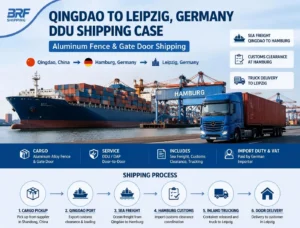
How much does it cost to ship goods from China to Germany in 2026?
The answer depends on much more than the ocean freight rate.
The shipping cost from China to Germany can include factory pickup in China, export customs clearance, FCL or LCL freight, air or rail transportation, German destination charges, customs clearance, import duty, 19% import VAT and final truck delivery to the buyer’s warehouse.
For German importers purchasing machinery, aluminum products, fitness equipment, furniture, building materials, automotive parts or general commercial goods from China, the correct question is therefore not simply:
“What is the freight rate?”
It is:
“What is the total cost to move my cargo from the Chinese supplier to my final German destination?”
BRF SHIPPING provides China-to-Germany logistics solutions covering sea freight, air freight, rail freight, China pickup, consolidation, customs coordination and door-to-door delivery.
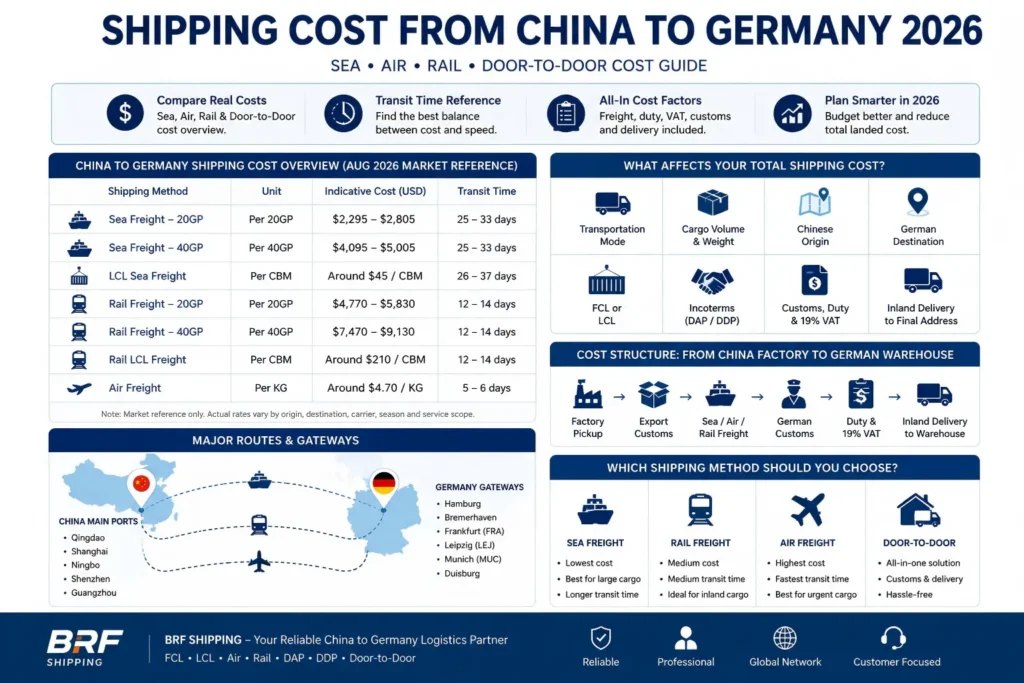
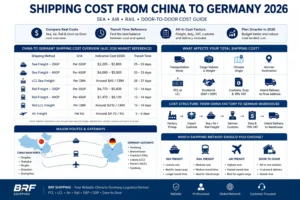
China to Germany Shipping Cost at a Glance
The following figures are market planning references, not fixed BRF SHIPPING quotations.
Public August 2026 market data shows significant differences between sea, rail and air transport. One published China–Germany market reference lists approximately:
| Shipping Method | Indicative August 2026 Cost | Typical Main-Freight Time |
|---|---|---|
| Sea Freight — 20GP | USD 2,295–2,805 | Approx. 25–33 days |
| Sea Freight — 40GP | USD 4,095–5,005 | Approx. 25–33 days |
| LCL Sea Freight | Around USD 45/CBM | Approx. 26–37 days |
| Rail — 20GP | USD 4,770–5,830 | Approx. 12–14 days |
| Rail — 40GP | USD 7,470–9,130 | Approx. 12–14 days |
| Rail LCL | Around USD 210/CBM | Approx. 12–14 days |
| Air Freight | Around USD 4.70/kg in the cited market reference | Approx. 5–6 days |
These rates move with carrier capacity, routing, fuel, season, cargo type and service scope. They should therefore be used for initial budgeting only.
Other 2026 market references show broader ranges, illustrating why importers should always compare rates using the same service definition—port-to-port, airport-to-airport and door-to-door prices are not directly comparable.
What Determines the Shipping Cost from China to Germany?
The China to Germany shipping cost is mainly affected by seven variables:
- Transportation mode
- Cargo volume and weight
- Chinese origin
- German destination
- FCL or LCL
- Incoterm
- Customs, duty, VAT and inland delivery
A shipment from a factory in Qingdao to Hamburg Port has a very different cost structure from a shipment picked up in Shenzhen and delivered to Munich.
That is why a freight forwarder normally needs the complete cargo details before giving an accurate quotation.
Sea Freight Cost from China to Germany
For large or heavy commercial shipments, sea freight is usually the lowest-cost shipping method from China to Germany.
It is particularly suitable for:
- Machinery
- Aluminum fencing
- Aluminum gates
- Building materials
- Fitness equipment
- Furniture
- Industrial equipment
- Auto parts
- Outdoor products
- Commercial inventory
- Project cargo
BRF SHIPPING’s Germany route currently uses Hamburg and Bremerhaven as the main ocean gateways and supports 20GP, 40GP and 40HQ container shipping.
20ft Container Shipping Cost from China to Germany
A 20GP container is often suitable for dense or heavy cargo that does not require the cubic capacity of a 40ft container.
Public August 2026 market references indicate approximately:
USD 2,295–2,805 per 20GP
for selected China-to-Hamburg/Bremen base ocean freight examples.
However, this is not the final landed cost.
A complete 20GP quotation may also contain:
- China factory pickup
- Container positioning
- Warehouse or loading charges
- Export declaration
- Origin terminal charges
- Documentation
- Ocean freight
- Destination terminal charges
- German customs brokerage
- Customs duty
- Import VAT
- Hamburg/Bremerhaven trucking
- Empty container return
Therefore:
Container Ocean Rate ≠ Total China-to-Germany Shipping Cost
The 20ft container price deserves its own detailed page rather than putting every 20GP rate variation into this parent article.
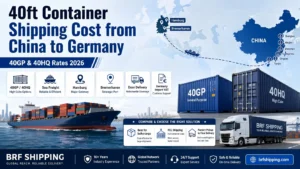
40ft Container Shipping Cost from China to Germany
For larger shipments, importers usually compare:
40GP
and
40HQ
A 40HQ is especially useful for bulky but relatively lightweight products such as:
- Aluminum fences
- Furniture
- WPC panels
- Building products
- Fitness equipment
- Packaging products
- Consumer goods
A public August 2026 reference puts selected 40GP China–Germany ocean freight around:
USD 4,095–5,005
before additional origin, destination, customs and inland-delivery costs.
A separate dedicated page should later target:
40ft container shipping cost from China to Germany
and cover:
- 40GP
- 40HQ
- Hamburg rates
- Bremerhaven rates
- German inland trucking
- Loading capacity
- Door-to-door costs
That keeps this page focused on overall shipping-cost comparison.
LCL Shipping Cost from China to Germany
If the shipment is too small for a full container, LCL — Less than Container Load may be more economical.
Instead of paying for an entire container, the importer shares container space with other cargo.
LCL pricing is usually based on:
- CBM
- Chargeable weight
- Origin charges
- Destination handling
- Customs clearance
- Final delivery
A current public August 2026 reference shows approximately:
USD 45 per CBM
for a selected China-to-Germany LCL ocean freight example.
But importers should be careful.
A low LCL ocean freight rate does not necessarily mean a low final cost.
LCL shipments can include additional:
- Consolidation charges
- CFS handling
- Deconsolidation
- Documentation
- Destination warehouse fees
- Customs handling
- Delivery charges
For this reason, when comparing FCL and LCL, always compare:
Total Delivered Cost
rather than only:
Freight per CBM
When Does FCL Become Cheaper Than LCL?
There is no universal CBM point where FCL automatically becomes cheaper.
It depends on:
- Route
- Container rate
- Cargo density
- Destination handling
- Port charges
- Final delivery
- Shipment frequency
For example, an 8 CBM shipment may still make sense as LCL.
But when cargo becomes significantly larger, the combined LCL freight and destination handling can approach the cost of a full 20GP.
BRF SHIPPING can compare both options before booking.
Air Freight Cost from China to Germany
For urgent, valuable or production-critical cargo, air freight offers much faster transit than ocean transport.
Typical German air cargo gateways include:
- Frankfurt — FRA
- Leipzig/Halle — LEJ
- Munich — MUC
These airports are also identified in BRF SHIPPING’s current China-to-Germany route structure.
Air freight is commonly used for:
- Spare parts
- Electronics
- Samples
- Medical equipment
- Urgent production materials
- High-value commercial goods
- Time-sensitive shipments
How Much Does Air Freight from China to Germany Cost?
Public 2026 market references vary considerably depending on whether the quotation is:
- Airport-to-airport
- Freight only
- Door-to-door
- Duty paid
- General cargo
- Battery cargo
One June 2026 market guide placed standard airport-to-airport China–Germany air freight at approximately:
USD 4.50–7.30/kg
depending on origin, shipment weight and season.
Another late-August published rate showed selected China–Germany air freight beginning around:
USD 5.92/kg
for its particular service channel, with the publisher explicitly stating that duty and tax were separate.
This difference demonstrates why quoting only:
“Air freight = $X/kg”
can be misleading.
Air Freight Uses Chargeable Weight
Air freight is not always charged according to the actual physical weight.
The airline or forwarder normally compares:
- Gross weight
- Volumetric weight
and charges according to the applicable chargeable weight.
This means a shipment may weigh only 150 kg physically but occupy enough space to be charged as a much heavier shipment.
For lightweight but bulky cargo, this can make air freight considerably more expensive than expected.
When requesting an air-freight quotation, always provide:
Number of Cartons + Gross Weight + Dimensions of Each Carton
rather than weight alone.
Rail Freight Cost from China to Germany
Rail freight occupies the middle position between sea and air.
In general:
Sea Freight → Lowest cost / longest transit
Rail Freight → Medium cost / medium transit
Air Freight → Highest cost / shortest transit
Rail can be particularly useful for cargo moving toward inland German logistics hubs.
Duisburg is one of the important inland destinations included in BRF SHIPPING’s current Germany logistics structure.
China to Germany Rail Freight Cost
A public August 2026 market reference lists approximately:
- 20GP rail: USD 4,770–5,830
- 40GP rail: USD 7,470–9,130
- Rail LCL: around USD 210/CBM
with an indicative 12–14 day rail transit reference for the listed services.
Other published rail services use per-kilogram pricing instead.
A late-August 2026 example advertised rail service beginning around USD 2.24/kg, demonstrating that rail quotations can use very different service models and inclusions.
For this reason, a rail freight quote should clearly state:
- Terminal-to-terminal or door-to-door
- Customs included or excluded
- Duty/VAT included or excluded
- Final German delivery included or excluded
- Transit-time definition
Sea vs Air vs Rail Shipping Cost from China to Germany
For most importers, the best shipping mode can be summarized as follows:
| Mode | Relative Cost | Relative Speed | Best For |
|---|---|---|---|
| Sea FCL | Lowest for large cargo | Slow | Containers, heavy cargo |
| Sea LCL | Low for small-volume cargo | Slow | Small commercial shipments |
| Rail | Medium | Medium | Time-sensitive inland cargo |
| Air | High | Fast | Urgent / high-value cargo |
| Express | Highest | Fastest | Samples and small parcels |
There is no single “best” shipping method.
The correct solution depends on the value of time.
Example: Choosing Between Sea, Rail and Air
Assume a German importer has 3,000 kg of industrial components.
Option A — Sea Freight
Best when:
- Delivery date is flexible
- Cargo is not urgently required
- Lowest logistics cost is the priority
Option B — Rail Freight
Best when:
- The buyer cannot wait for ocean transit
- Air freight is too expensive
- Inland German delivery fits the rail network
Option C — Air Freight
Best when:
- Production could stop without the cargo
- The products have high value
- A few days saved are worth the additional freight cost
The cheapest freight mode can sometimes become the most expensive business decision if late cargo stops a production line.
Shipping cost should therefore be measured against:
Cargo Value + Inventory Cost + Delivery Deadline + Business Risk
Shipping Cost from Major Chinese Ports to Germany
The Chinese origin can significantly affect the total cost.
BRF SHIPPING currently supports export routing from major manufacturing regions through gateways such as Qingdao, Shanghai, Ningbo, Shenzhen and Guangzhou.
Qingdao to Germany
Qingdao is particularly suitable for factories in:
- Qingdao
- Weifang
- Zibo
- Jinan
- Linyi
- Dezhou
- Yantai
- Shandong Province
A Shandong manufacturer shipping to Hamburg may avoid unnecessary inland trucking to Shanghai or Ningbo.
Typical routing:
Shandong Factory → Qingdao → Hamburg → German Customs → Truck Delivery
Shanghai to Germany
Shanghai is an important gateway for suppliers in:
- Shanghai
- Suzhou
- Kunshan
- Wuxi
- Southern Jiangsu
It provides extensive Europe carrier coverage and regular FCL/LCL services.
Ningbo to Germany
Ningbo is usually worth comparing for suppliers located in:
- Ningbo
- Hangzhou
- Yiwu
- Shaoxing
- Taizhou
- Zhejiang
Moving Zhejiang cargo to Shanghai simply because Shanghai is more famous can unnecessarily increase origin trucking.
Shenzhen / Guangzhou to Germany
South China cargo may move through:
- Yantian
- Shekou
- Nansha
depending on factory location, carrier schedule and freight rate.
Common production areas include:
- Shenzhen
- Dongguan
- Guangzhou
- Foshan
- Huizhou
- Zhongshan
Hamburg vs Bremerhaven Shipping Cost
Germany’s main container gateways include:
Hamburg
and
Bremerhaven
BRF SHIPPING’s China-to-Germany route supports both gateways.
The cheapest ocean freight port is not automatically the cheapest total route.
For example:
Option A
China → Hamburg
Ocean Freight = cheaper
German Trucking = higher
Option B
China → Bremerhaven
Ocean Freight = slightly higher
Final Trucking = lower
Option B could still produce a lower total delivered cost.
Therefore importers should compare:
Port + Final German Postcode
rather than port rate alone.
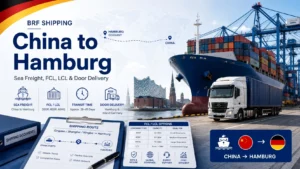
China to Hamburg Shipping Cost
Hamburg is already covered by BRF SHIPPING as a dedicated route.
The cost structure generally includes:
China Side
Factory pickup
Warehouse / consolidation
Container loading
Export customs
Origin terminal fees
Ocean Freight
FCL or LCL freight
Carrier surcharges
Hamburg Side
Terminal handling
Customs brokerage
Duty
Import VAT
Truck / rail delivery
Empty-container return
The BRF SHIPPING Hamburg guide emphasizes that ocean freight alone should not be treated as the total China-to-Hamburg cost.
Germany Inland Delivery Cost
Many China-to-Germany containers do not end their journey at Hamburg or Bremerhaven.
The final customer may be in:
- Berlin
- Leipzig
- Hanover
- Frankfurt
- Cologne
- Düsseldorf
- Stuttgart
- Munich
- Duisburg
The final German postcode can significantly change the freight cost.
For example:
China → Hamburg Port
is not the same quotation as:
China Factory → Hamburg → Munich Warehouse
The second route requires hundreds of additional kilometres of inland transport.
Door-to-Door Shipping Cost from China to Germany
For importers wanting one coordinated logistics chain, BRF SHIPPING can plan:
China Supplier
↓
Factory Pickup
↓
China Warehouse / Container Loading
↓
Export Customs
↓
Sea / Air / Rail Freight
↓
German Customs
↓
Final Delivery
Door-to-door shipping is easier to manage, but the quote must clearly identify what is included.
What Should a Door-to-Door Quote Include?
A professional quote should state whether it includes:
- Factory pickup
- Export declaration
- Warehouse charges
- Ocean / air / rail freight
- Destination handling
- Customs brokerage
- Customs duty
- Import VAT
- Delivery appointment
- Final trucking
- Tail-lift or special unloading
- Demurrage / detention
- Customs inspection
Otherwise two quotations that appear similar may actually include completely different services.
DAP vs DDP Shipping Cost to Germany
The Incoterm can significantly change the quoted amount.
DAP Shipping to Germany
Under a typical DAP structure, transportation can be arranged to the German destination while the buyer generally deals with the import clearance obligations and import taxes allocated to it under the Incoterm.
A German importer may prefer this structure when it already has:
- EORI
- German VAT registration
- Customs broker
- Established import procedures
DDP Shipping to Germany
DDP involves a broader seller-side responsibility.
A DDP quotation can therefore appear higher because more components may be included.
However:
DDP does not mean “no tax.”
Duty and VAT still exist.
The important questions are:
- Who is importer of record?
- Which EORI is used?
- Who pays duty?
- Who pays import VAT?
- Can import VAT be deducted?
- Who is responsible for product compliance?
DDP shipping deserves its own dedicated China-to-Germany SEO page rather than being treated simply as another freight rate.
German Import Duty and 19% Import VAT
Freight is only one part of landed cost.
Germany generally applies a standard 19% import VAT rate, while certain qualifying products may be subject to a reduced rate.
Customs duty is different.
There is no universal German customs-duty percentage because duty depends on factors such as:
- CN / TARIC classification
- Product type
- Country of origin
- Customs value
- Anti-dumping measures
- Trade-policy measures
BRF SHIPPING’s dedicated Germany VAT and Duty guide explains these elements in detail.
Freight Cost Is Not the Same as Landed Cost
This distinction is extremely important.
Freight Cost
Usually refers to transportation.
Landed Cost
Can include:
Product Cost
China Pickup
Export Handling
Freight
Destination Charges
Customs Duty
Import VAT
Customs Brokerage
Final Delivery
=
Total Landed Cost in Germany
An ocean quote of USD 4,500 can therefore result in a significantly higher final logistics and import cost.
Example China to Germany Landed Cost Calculation
Assume:
Goods value:
EUR 50,000
International freight and relevant customs-value costs:
EUR 4,000
Simplified customs value:
EUR 54,000
Assume, purely for illustration, an applicable customs-duty rate of:
4%
Estimated duty:
EUR 2,160
Simplified VAT assessment base before any other applicable additions:
EUR 56,160
At 19%:
Estimated import VAT:
EUR 10,670.40
This example shows why the buyer should not budget using the freight price alone.
The real shipment could also include:
- China origin costs
- German customs brokerage
- Terminal handling
- Delivery
- Storage
- Inspection
- Other customs adjustments
The actual duty rate must always be checked against the correct TARIC classification.
Can German Companies Deduct Import VAT?
For eligible German companies, import VAT may generally be deductible as input VAT when the legal and documentation requirements are met.
That means:
Customs Duty
can become part of the permanent landed cost.
while:
Import VAT
may in qualifying cases function more like a cash-flow item than a permanent cost.
The exact VAT treatment should be confirmed with the importer’s accountant or tax adviser.
BRF SHIPPING covers this question in detail in the dedicated Germany Import VAT and Duty guide.
What Causes China to Germany Freight Rates to Change?
Freight rates do not stay fixed throughout the year.
Important factors include:
1. Peak Season
Rates can rise around:
- Chinese New Year
- Golden Week
- European inventory seasons
- Christmas purchasing periods
2. Vessel Capacity
Blank sailings and carrier capacity management can affect FCL rates.
3. Routing
Changes to Europe-bound shipping routes can increase:
- Transit time
- Fuel consumption
- Vessel requirements
- Freight rates
4. Container Availability
Shortages of:
- 20GP
- 40GP
- 40HQ
can affect individual loading ports differently.
5. Fuel
Fuel-related surcharges can change overall carrier costs.
6. Port Congestion
Congestion can create additional:
- Storage
- Demurrage
- Truck waiting
- Rail delays
7. Cargo Type
Dangerous goods, batteries, liquids, powders, oversized cargo and controlled commodities require different pricing.
How to Reduce Shipping Cost from China to Germany
Choose the Correct Chinese Port
Use the port that makes sense for the supplier location.
Do not automatically choose Shanghai for every shipment.
Consolidate Multiple Suppliers
If a German buyer purchases from several Chinese factories, BRF SHIPPING can coordinate:
Supplier A
Supplier B
Supplier C
↓
China Warehouse
↓
Consolidation
↓
One Export Shipment
This can reduce duplicated logistics expenses.
Compare FCL and LCL
For growing shipment volumes, compare:
LCL Total Cost
against:
20GP FCL Total Cost
not simply the basic freight rate.
Plan Before Peak Season
Advance booking can improve:
- Equipment availability
- Carrier choice
- Sailing options
- Rate stability
Provide the Final German Postcode
Without the delivery postcode, a forwarder cannot properly calculate the inland portion of the route.
Provide Accurate Cargo Dimensions
This is especially important for:
- Air freight
- LCL
- Rail LCL
- Bulky products
Incorrect dimensions can cause significant re-rating after cargo reaches the warehouse.
Which Shipping Method Is Cheapest from China to Germany?
For most large commercial shipments:
Sea Freight
is generally the cheapest option.
For smaller cargo that does not fill a container:
LCL
can be more economical.
When faster transportation is required:
Rail Freight
can provide a middle option.
For urgent cargo:
Air Freight
provides the shortest transit but usually at the highest cost per kilogram.
Which Shipping Method Should You Choose?
Choose Sea Freight If:
- Cost is the priority
- Cargo is heavy
- Cargo is bulky
- You can accept longer transit
- You are shipping FCL
Choose LCL If:
- Shipment volume is small
- You do not need a full container
- Delivery is not urgent
Choose Rail If:
- Sea freight is too slow
- Air freight is too expensive
- Inland Germany is the destination
Choose Air Freight If:
- Cargo is urgent
- Product value is high
- Production depends on fast delivery
How BRF SHIPPING Calculates a China to Germany Quote
For an accurate quotation, provide:
China Information
- Factory address
- Supplier city
- Preferred pickup arrangement
Cargo Information
- Product description
- HS code if available
- Number of packages
- Gross weight
- Dimensions
- Total CBM
- Dangerous-goods status
Shipping Information
- FCL / LCL / Air / Rail
- 20GP / 40GP / 40HQ if known
- Cargo-ready date
- Incoterm
Germany Information
- Destination city
- Postcode
- Commercial or residential address
- Unloading requirements
- EORI / importer information where relevant
BRF SHIPPING can then compare the complete route rather than giving only a base freight figure.
Shipping from China to Germany with BRF SHIPPING
BRF SHIPPING can coordinate:
- Factory pickup across China
- Multi-supplier consolidation
- China warehouse
- FCL
- LCL
- 20GP / 40GP / 40HQ
- Air freight
- Rail freight
- Export customs
- Hamburg / Bremerhaven routing
- German customs coordination
- DAP / DDP logistics
- Truck delivery
- Door-to-door shipping
BRF SHIPPING’s current Germany route already connects Chinese manufacturing regions with Hamburg, Bremerhaven, Frankfurt, Duisburg, Leipzig, Berlin, Munich and other German destinations.
Shipping Cost from China to Germany FAQ
How much does it cost to ship from China to Germany?
The cost depends on cargo volume, weight, shipping mode, Chinese origin, German destination and service scope. August 2026 public market references show selected 20GP ocean freight around USD 2,295–2,805 and 40GP around USD 4,095–5,005, but these figures are not door-to-door quotations.
What is the cheapest way to ship from China to Germany?
For larger commercial cargo, sea freight is usually the lowest-cost transportation option. LCL can be economical for smaller shipments.
How much is a 20ft container from China to Germany?
Current public market examples are around the mid-USD 2,000 range for selected base ocean services, but the final cost depends on origin, destination, carrier and additional charges.
How much is a 40ft container from China to Germany?
Public August 2026 examples show approximately USD 4,095–5,005 for selected 40GP ocean services. Actual 40GP and 40HQ quotations change with the market.
How much is LCL shipping from China to Germany?
LCL is charged by volume or chargeable weight plus origin and destination charges. One August 2026 market reference lists approximately USD 45/CBM for base LCL freight on this trade lane.
How much is air freight from China to Germany?
Published 2026 market references commonly place standard air freight in a broad range of roughly USD 4.5–7+ per kg depending on service, cargo weight and route. Door-to-door or duty-paid air services can cost more.
Is rail cheaper than air freight?
Rail is generally cheaper than air and faster than sea for suitable cargo, although rates depend heavily on shipment size and service structure.
Is German import VAT included in freight rates?
Usually not unless the quotation specifically states that tax is included. Germany’s standard import VAT rate is generally 19%, subject to the applicable product and tax rules.
Does the freight quote include customs duty?
Not automatically. Duty depends on the product’s TARIC classification and the agreed service structure.
Can BRF SHIPPING arrange door-to-door delivery?
Yes. BRF SHIPPING can coordinate China pickup, international freight, German customs workflow and inland delivery subject to cargo, Incoterm and importer requirements.
Get a Shipping Cost from China to Germany
To receive an accurate China-to-Germany freight quotation, send BRF SHIPPING:
Product
China Pickup Address
Number of Packages
Gross Weight
Dimensions / CBM
20GP / 40GP / 40HQ / LCL
German Postcode
Cargo-Ready Date
Preferred Incoterm
BRF SHIPPING can compare Sea Freight, Air Freight, Rail Freight and Door-to-Door options and build the route according to your cargo, deadline and German destination.
BRF SHIPPING
China Factory Pickup → International Freight → German Customs → Door Delivery