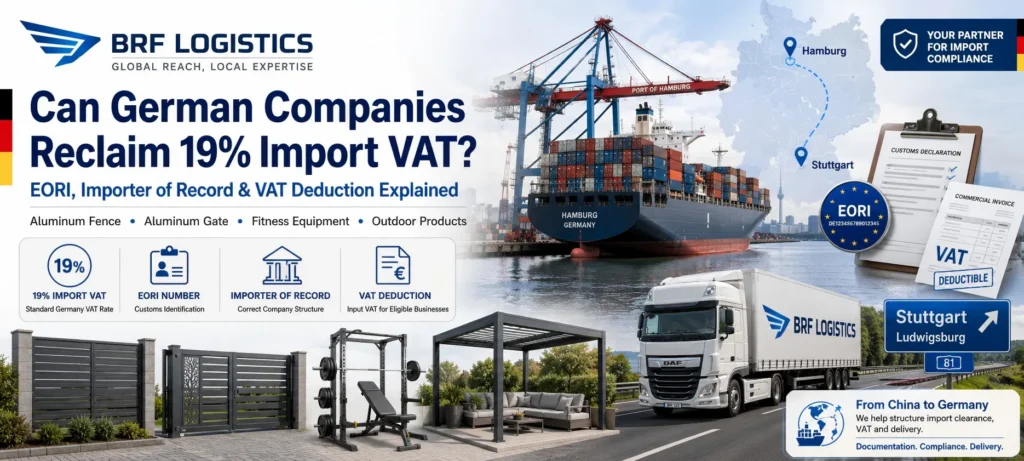
Importing goods from China into Germany involves more than paying international freight charges. Importers also need to understand German customs duty, import VAT, EORI requirements, TARIC classification, customs value, and the importer-of-record structure before the shipment arrives.
For most commercial imports into Germany, two of the most important import charges are:
- Customs duty
- Import VAT (Einfuhrumsatzsteuer / EUSt)
Germany’s standard import VAT rate is generally 19%, while certain qualifying goods may use the reduced 7% rate. Customs duty is different: there is no single German import duty percentage. The applicable rate depends mainly on the product classification, country of origin and EU tariff measures.
This guide explains how German import VAT and customs duty work for companies importing products from China and how to prepare a shipment before customs clearance.
Germany Import VAT and Duty: Quick Answer
| Item | Germany Import Rule |
|---|---|
| Standard Import VAT | 19% |
| Reduced Import VAT | 7% for certain qualifying products |
| Customs Duty | Depends on CN/TARIC code and origin |
| Customs System | EU Common Customs Tariff |
| Business Customs ID | EORI generally required for economic operators |
| Import VAT Recovery | May be deductible for eligible businesses |
| Customs Duty Recovery | Normally treated as an import cost rather than recoverable input VAT |
| Main Customs Classification | CN / TARIC |
| Import from China | Classified as import from a non-EU country |
The EU applies a Common Customs Tariff to imports from non-EU countries. Duty rates vary according to the type and origin of the goods rather than the German destination city or port.
What Taxes Do You Pay When Importing from China to Germany?
A commercial shipment entering Germany may involve several different charges.
The most common are:
1. Customs Duty
Customs duty is calculated according to the applicable EU customs tariff.
The percentage depends on factors including:
- Product description
- CN/TARIC commodity code
- Country of origin
- Customs value
- Preferential origin, where applicable
- Tariff quotas
- Anti-dumping measures
- Countervailing duties
- Other EU trade measures
There is therefore no universal import duty rate for goods shipped from China to Germany.
2. Import VAT
Import VAT is collected when goods are imported into Germany from outside the EU.
The standard German import VAT rate is generally:
19%
Some qualifying products may instead be subject to:
7% reduced VAT
German Customs identifies 19% as the standard rate and 7% as the reduced rate for selected goods such as certain food products and books.
3. Excise Duties
Certain products may additionally be subject to excise duties.
Examples can include:
- Alcohol
- Tobacco
- Energy products
- Coffee and certain related goods
Most ordinary industrial products, machinery, building materials and general cargo do not fall into the same excise-tax categories, but product classification must still be confirmed before shipment.
4. Anti-Dumping or Countervailing Duty
Some products originating in China are subject to additional EU trade-defense duties.
These charges can be significantly higher than the ordinary customs duty.
The EU TARIC database includes measures such as:
- Anti-dumping duties
- Countervailing duties
- Safeguard measures
- Tariff quotas
- Import restrictions
Therefore, checking only a basic HS-code duty rate is sometimes insufficient.
What Is the German Import VAT Rate?
For most commercial goods imported into Germany:
Standard Import VAT: 19%
Germany generally applies a standard 19% import VAT rate.
Examples of goods commonly falling under the standard rate include many types of:
- Machinery
- Industrial equipment
- Furniture
- Building products
- Aluminum products
- Fitness equipment
- Electronics
- Outdoor products
- Automotive parts
- Consumer goods
However, the VAT treatment should always be confirmed according to the exact product classification.
Reduced Import VAT: 7%
Certain goods may qualify for Germany’s reduced VAT rate.
Examples can include specific categories of:
- Food
- Books
- Publications
- Certain cultural goods
Do not assume that a product automatically qualifies for the reduced VAT rate simply because a similar product does.
The exact classification matters.
How Is Customs Duty Calculated in Germany?
A simplified customs-duty calculation is:
Customs Duty = Customs Value × Applicable Duty Rate
For example:
Customs value:
€50,000
Applicable customs duty:
4%
Customs duty:
€50,000 × 4% = €2,000
The importer would therefore owe approximately:
€2,000 customs duty
before calculating import VAT and any other applicable charges.
The actual customs value and duty calculation may differ depending on the shipment structure and valuation rules.
What Is Customs Value?
The customs value is extremely important because both customs duty and import VAT can depend on it.
It is not always simply the price shown on the supplier’s commercial invoice.
Depending on the Incoterm and transaction, customs valuation can take into account costs associated with bringing the goods to the relevant EU customs border.
This may include items such as:
- Product value
- International transportation
- Insurance
- Packing costs
- Certain assists or commissions
- Other costs required under EU customs valuation rules
For example, an EXW supplier invoice cannot simply be treated the same way as a CIF import value without examining the freight and other costs.
Using an artificially low commercial invoice value can result in customs questions, reassessment, penalties or shipment delays.
How Is Germany Import VAT Calculated?
A simplified calculation can be understood as:
Import VAT Base = Customs Value + Customs Duty + Applicable Excise Duties and Certain Additional Costs
Then:
Import VAT = Import VAT Base × VAT Rate
German Customs confirms that the import-VAT assessment base includes the customs value plus customs duty and, where applicable, excise duties.
Germany Import VAT Calculation Example
Assume a German company imports industrial products from China.
Shipment Details
Goods customs value:
€50,000
Customs duty rate:
4%
Customs duty:
€2,000
Simplified VAT assessment base:
€52,000
German import VAT:
19%
Import VAT:
€52,000 × 19% = €9,880
Estimated Import Charges
| Charge | Amount |
|---|---|
| Customs Value | €50,000 |
| Customs Duty | €2,000 |
| Import VAT | €9,880 |
| Total Duty + VAT | €11,880 |
This example is simplified for illustration.
Actual customs calculations can also be affected by transportation costs, insurance, excise taxes, anti-dumping duties, valuation adjustments and other customs rules.
How Do I Find the German Import Duty Rate?
Germany follows the EU customs classification system.
Two important systems are:
CN — Combined Nomenclature
The Combined Nomenclature is the EU’s 8-digit customs classification system.
It is based on the international Harmonized System.
The CN code helps determine:
- Customs duty
- Statistical treatment
- Product classification
- Certain regulatory measures
TARIC — Integrated Tariff of the European Union
TARIC goes further than the basic HS or CN classification.
It integrates EU measures including:
- Third-country duty
- Preferential tariffs
- Anti-dumping duty
- Countervailing duty
- Tariff quotas
- Import restrictions
- Additional commodity codes
- Trade-policy measures
The European Commission states that TARIC data is transmitted daily to EU national customs administrations, making it the key system for checking current tariff measures.
HS Code vs CN Code vs TARIC Code
Importers sometimes use these terms interchangeably, but they are not exactly the same.
HS Code
The international Harmonized System forms the basis of customs classification worldwide.
CN Code
The EU expands the HS classification into its 8-digit Combined Nomenclature.
TARIC Code
Additional EU subdivisions may be used to identify the exact tariff and trade-policy measures applicable to a product.
For German imports, relying only on a broad six-digit HS heading can therefore be risky.
A more detailed classification may be required.
Example German Customs Duty Rates
Duty rates vary significantly depending on the product.
German Customs publishes indicative examples showing how rates can differ between categories. Examples include:
| Product Category | Indicative Customs Duty |
|---|---|
| Smartphones | 0% |
| Notebook Computers | 0% |
| Some Sports Equipment | 0–4.7% |
| Furniture | 0–5.6% |
| Auto Parts | Approx. 3.5–4.5% |
| Textile Clothing | Approx. 8–12% |
These examples demonstrate why an importer should never assume that all Chinese imports have a fixed 5%, 10% or another universal duty rate. German Customs also warns that rates can vary according to the specific characteristics of the goods.
For products such as aluminum fencing, aluminum gates, fitness equipment, outdoor products, machinery or building materials, the exact TARIC classification should be checked before quotation or customs declaration.
Do German Companies Need an EORI Number?
For regular commercial customs activity, the EORI number — Economic Operators Registration and Identification number — is one of the most important customs identifiers.
German Customs states that an economic operator involved in activities covered by customs legislation generally needs an EORI number.
A German importer should therefore confirm its EORI arrangement before the goods arrive.
An EORI number is different from:
- German VAT number
- German tax number
- Company registration number
- Chinese export customs registration
Having a German VAT number does not automatically mean the importer has completed every customs-registration requirement.
Documents Required for Germany Import Customs Clearance
Typical commercial shipments from China to Germany may require:
- Commercial invoice
- Packing list
- Bill of lading or air waybill
- Importer’s EORI number
- Commodity / TARIC code
- Country of origin
- Customs value information
- Freight cost information
- Insurance information where applicable
- Purchase contract or payment records if requested
- Customs authorization
- Product compliance documentation
- Certificates or licences where required
Certain products may require additional compliance documents.
Examples may include:
- CE-related documentation
- Safety documentation
- Test reports
- MSDS
- REACH-related information
- Product-specific licences
- Packaging compliance information
Customs clearance and product compliance are related but separate issues.
Paying duty and VAT does not automatically mean a product is legally compliant for sale in the EU.
Can a German Company Reclaim the 19% Import VAT?
This is one of the most important questions for German B2B importers.
In many cases, yes.
If a German business is entitled to input VAT deduction and the imported goods are used for its business, the import VAT incurred may generally be deductible as input VAT (Vorsteuer) subject to the applicable conditions and documentation.
German VAT law §15 specifically provides for deduction of import VAT incurred on goods imported for the business.
This means import VAT can be very different economically from customs duty.
Example
A German company imports machinery.
Import VAT paid:
€9,880
If the importer satisfies the requirements for full input VAT deduction, that amount may potentially be claimed as input VAT through the company’s German VAT accounting.
Therefore:
Import VAT may represent a cash-flow cost rather than a permanent cost for an eligible VAT-registered business.
The company’s accountant or tax adviser should confirm the exact VAT treatment.
Can German Companies Reclaim Customs Duty?
Normally, customs duty should not be confused with VAT.
If:
- Customs duty = €2,000
- Import VAT = €9,880
the €9,880 import VAT may potentially be deductible if the legal requirements are satisfied.
The €2,000 customs duty is normally an import cost and is not reclaimed through the VAT input-tax mechanism in the same way.
This distinction is extremely important when calculating landed cost.
Import VAT Payment Deferral in Germany
Import VAT can also create cash-flow pressure for frequent importers.
German VAT legislation allows specific payment-deferral arrangements in situations where the import VAT can be fully deducted as input VAT, subject to the applicable customs and authorization requirements.
Businesses importing containers regularly should therefore discuss:
- Import VAT deduction
- Customs deferment
- Payment arrangements
- Customs representation
- Accounting structure
with their customs broker, accountant or tax adviser.
Import VAT vs German Sales VAT
Another common misunderstanding is treating import VAT and sales VAT as exactly the same transaction.
They are related but arise at different stages.
Import VAT
Occurs when goods are imported into Germany from outside the EU.
German Output VAT
May arise later when the German company sells the goods to its customer.
For an eligible business:
Import → Import VAT → Input VAT deduction → Domestic sale → Output VAT
This is why maintaining correct customs and tax documentation is critical.
DDP vs DAP / DDU Shipping to Germany
The selected Incoterm directly affects the customs and tax structure.
DAP / Traditional DDU-Style Shipping
Under a typical DAP or duty-unpaid arrangement:
BRF SHIPPING may coordinate:
- China supplier pickup
- Warehouse consolidation
- Export customs clearance
- Sea freight
- Air freight
- Rail freight
- German customs broker coordination
- Port or terminal release
- Truck delivery
The German importer normally remains responsible for:
- Import declaration structure
- EORI
- Customs duty
- Import VAT
- Product compliance obligations applicable to the importer
For VAT-registered German businesses, this structure can sometimes make the import VAT documentation and input-tax position easier to understand.
DDP Shipping to Germany
Under DDP — Delivered Duty Paid, the seller carries broader responsibility for getting the goods to the agreed destination, including import formalities and import charges under the Incoterm structure.
However, DDP into Germany should not simply be described as:
“tax-free shipping.”
Duty and VAT still exist.
The key question is:
Who is legally acting as importer and how are the customs duty, EORI, import VAT and VAT documentation structured?
Before accepting a Germany DDP shipment, the parties should clarify:
- Importer of record
- Customs representative
- EORI
- VAT registration requirements
- Import VAT ownership
- Ability to deduct import VAT
- Customs duty payment
- Product compliance
- Final consignee details
BRF SHIPPING’s door-to-door service already coordinates supplier pickup, freight, destination customs support, duties and taxes according to the agreed Incoterm and final delivery.
Which Is Better for a German Business: DDP or DAP?
There is no universal answer.
DAP / Duty-Unpaid Arrangement May Be Better When:
- The German buyer has its own EORI
- The German buyer is VAT registered
- It wants customs declarations in its own company name
- It plans to deduct import VAT
- It imports regularly
- It has an established customs/accounting process
DDP May Be Attractive When:
- The buyer wants a predictable door-delivered logistics quotation
- It does not want to coordinate several freight providers
- Customs arrangements have already been legally structured
- The seller or logistics solution has a compliant importer/VAT arrangement
For larger B2B imports, the tax structure should be confirmed before the container departs China.
2026 Update: €3 Customs Duty for Low-Value Imports into the EU
An important EU customs change took effect on July 1, 2026.
The European Commission states that a temporary €3 customs duty per item now applies to certain low-value consignments of up to €150 imported from outside the EU.
The measure is intended to remain in place until July 1, 2028, when the broader customs reform is expected to transition low-value imports toward the normal tariff system.
This change is especially relevant to:
- Cross-border e-commerce
- Small parcels
- Direct-to-consumer shipments
- Online sellers
It is generally less relevant to conventional B2B FCL and LCL container shipments, which normally have values well above €150.
Common Germany Customs Mistakes
Several customs problems can be prevented before the shipment leaves China.
1. Using the Wrong HS or TARIC Code
A broad product description is not enough.
Incorrect classification can create:
- Incorrect duty
- Customs inspection
- Additional tax
- Anti-dumping exposure
- Delayed clearance
2. Declaring an Unrealistically Low Value
Customs can request additional evidence such as:
- Purchase contract
- Payment records
- Supplier invoice
- Freight invoice
- Product specifications
The declared customs value should be supportable.
3. Shipping Before Confirming EORI
An EORI problem discovered after cargo reaches Hamburg or Bremerhaven can delay clearance.
4. Assuming VAT and Customs Duty Are the Same
They are completely different charges.
Customs duty may become a permanent landed cost.
Import VAT may potentially be deductible for an eligible business.
5. Ignoring Anti-Dumping Duties
Some Chinese-origin products can face significant additional trade-defense duties.
Always check TARIC rather than relying only on a general internet duty-rate calculator.
6. Treating DDP as “No Tax”
DDP reallocates commercial responsibilities.
It does not eliminate German import taxation.
7. Ignoring Product Compliance
Customs clearance does not replace CE marking, product safety, packaging, environmental or other compliance obligations.
Shipping from China to Germany with BRF SHIPPING
BRF SHIPPING provides international freight forwarding services for companies importing goods from China into Germany.
Services can include:
China Factory Pickup
Cargo collection from manufacturers in:
- Qingdao
- Shanghai
- Ningbo
- Shenzhen
- Guangzhou
- Tianjin
- Xiamen
- Dalian
- Shandong Province
- Jiangsu
- Zhejiang
- Guangdong
- Other manufacturing regions
China Warehouse & Consolidation
For buyers purchasing from multiple suppliers, cargo can be collected into one Chinese warehouse for:
- Receiving
- Quantity checking
- Consolidation
- Repacking
- Palletizing
- Container loading
BRF SHIPPING’s existing sea-freight service supports multi-supplier pickup, China warehouse consolidation and FCL/LCL loading.
Sea Freight to Germany
Common gateways include:
- Hamburg
- Bremerhaven
Services can include:
Air Freight to Germany
Air freight can be arranged for:
- Urgent cargo
- High-value products
- Samples
- Spare parts
- Commercial shipments
Frankfurt is one of the main German air-cargo gateways.
Rail and Multimodal Transport
Depending on the shipment and schedule, China–Europe rail or multimodal transportation may also be considered for inland German destinations.
German Customs Clearance Coordination
BRF SHIPPING can coordinate with destination customs agents for:
- Documentation review
- HS/TARIC confirmation support
- Customs declaration
- Duty and VAT calculation
- Customs examination coordination
- Cargo release
Germany Door Delivery
After customs clearance, delivery can be arranged to cities including:
- Hamburg
- Bremen
- Berlin
- Leipzig
- Duisburg
- Cologne
- Frankfurt
- Stuttgart
- Munich
- Düsseldorf
- Hanover
as well as factories, warehouses, distribution centers and project sites throughout Germany.
How to Get an Accurate China-to-Germany Landed Cost
Do not calculate the shipment based only on the ocean freight rate.
A proper landed-cost estimate should consider:
Product Cost
China Pickup
Warehouse / Loading
Export Customs
Ocean / Air / Rail Freight
Destination Charges
Customs Duty
Import VAT
Customs Brokerage
Final Truck Delivery
=
Total Landed Cost in Germany
For an accurate quotation, provide BRF SHIPPING with:
- China supplier location
- Product description
- HS/TARIC code if known
- Commercial value
- Number of packages
- Gross weight
- Dimensions
- Total CBM
- Container type
- German destination postcode
- Preferred Incoterm
- Cargo-ready date
Germany Import VAT and Duty FAQ
What is the import VAT rate in Germany?
Germany’s standard import VAT rate is generally 19%. Certain qualifying products may be subject to the reduced 7% rate.
What is the import duty from China to Germany?
There is no universal rate. Import duty depends on the product’s CN/TARIC code, customs value, origin and applicable EU tariff or trade-defense measures.
Does Germany charge customs duty on Chinese goods?
Yes, where the applicable EU tariff provides for customs duty. Some products have a 0% ordinary duty rate, while others have higher rates.
Is German import VAT calculated on the product value only?
Not necessarily. The import-VAT assessment base generally starts from the customs value and can include customs duty and other applicable charges.
Can a German company reclaim 19% import VAT?
An eligible business may generally deduct import VAT as input VAT when the imported goods are for its business and the applicable legal and documentation requirements are satisfied.
Can customs duty be reclaimed as VAT?
No. Customs duty and import VAT are different. Customs duty is not recovered through the normal input-VAT deduction mechanism.
Do German importers need an EORI number?
Commercial economic operators involved in EU customs activities generally require an EORI arrangement. This should be confirmed before the shipment arrives.
What is a TARIC code?
TARIC is the EU’s integrated customs tariff system. It combines tariff classification with customs-duty rates and measures such as anti-dumping duties, quotas and import restrictions.
Can BRF SHIPPING arrange customs clearance in Germany?
Yes. Depending on the shipment and agreed Incoterm, BRF SHIPPING can coordinate freight, destination customs clearance support and final truck delivery.
Can BRF SHIPPING provide DDP shipping from China to Germany?
DDP solutions may be arranged after confirming the cargo, importer structure, EORI/VAT requirements, customs duty, import VAT, product compliance and final delivery address.
Need Help Calculating Germany Import VAT, Duty and Shipping Cost?
The lowest ocean freight rate does not always produce the lowest landed cost.
Before shipping from China to Germany, BRF SHIPPING can review:
China Pickup → Export Customs → Sea / Air / Rail Freight → German Customs → Duty & VAT → Door Delivery
Send us your:
Product + HS Code + Commercial Value + Weight + CBM + China Pickup Location + German Postcode
and we can build a practical China-to-Germany logistics plan based on your cargo and Incoterm.
BRF SHIPPING
China Freight Forwarder for Sea Freight, Air Freight, Customs Clearance and Door-to-Door Shipping to Germany