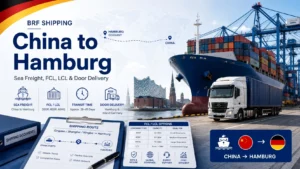
Hamburg is one of the most important gateways for cargo moving from China into Germany and the wider European market.
For importers sourcing machinery, aluminum products, building materials, furniture, fitness equipment, industrial products or general commercial cargo from China, shipping from China to Hamburg can provide access not only to Hamburg itself but also to inland destinations such as Berlin, Leipzig, Hanover, Frankfurt, Stuttgart, Munich, Cologne and other German industrial regions.
BRF SHIPPING provides China-to-Hamburg logistics solutions covering:
- China factory pickup
- Warehouse consolidation
- FCL container shipping
- LCL sea freight
- Export customs clearance
- Ocean freight to Hamburg
- German customs-clearance coordination
- Import duty and VAT support
- Port release
- Truck or rail delivery
- DAP / DDP solutions
- Door-to-door shipping
For a broader overview of all German destinations, see Shipping from China to Germany.
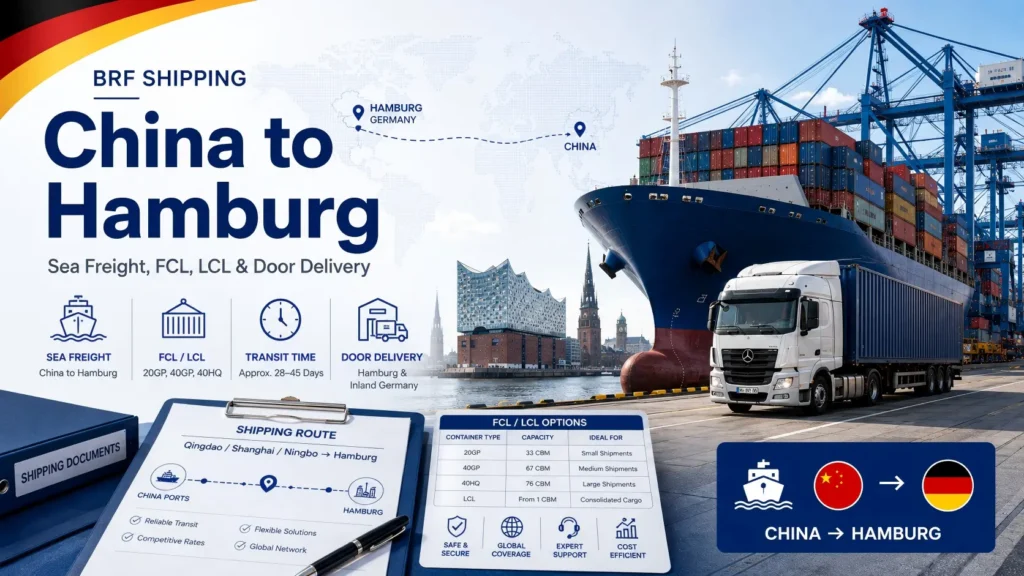
China to Hamburg Shipping at a Glance
| Shipping Item | Typical Option |
|---|---|
| Main Transport Mode | Sea Freight |
| Destination Port | Port of Hamburg |
| Common Containers | 20GP / 40GP / 40HQ |
| LCL Available | Yes |
| Typical Planning Range | Approx. 28–45 days for China–Northern Europe sea freight |
| China Pickup | Available |
| Export Customs | Available |
| Germany Customs Coordination | Available |
| Import VAT | Usually 19% standard rate, subject to product |
| Inland Delivery | Truck / Rail |
| Door-to-Door | DAP / DDP subject to cargo and importer structure |
BRF SHIPPING’s current China-to-Germany planning page uses approximately 28–45 days as an indicative Northern Europe sea-freight range. Actual transit time depends on the Chinese origin port, carrier, direct or transshipment service, vessel schedule, port congestion and inland-delivery requirements.
Why Ship from China to Hamburg?
Hamburg is much more than a destination port for companies located in northern Germany.
It is an important logistics gateway linking ocean freight with:
- German trucking
- Container rail
- Inland distribution
- Central Germany
- Southern Germany
- Eastern Germany
- Central and Eastern Europe
The Port of Hamburg describes its location as well connected to German and European markets through rail, truck and inland waterways. Its hinterland infrastructure makes Hamburg particularly useful for containers that need to continue beyond the port after discharge.
For Chinese exporters and German importers, this means one shipment can be planned as:
China Factory → China Port → Hamburg Port → German Customs → Rail / Truck → Final Warehouse
rather than treating ocean freight and inland delivery as completely separate transactions.
Sea Freight from China to Hamburg
For most commercial cargo, sea freight from China to Hamburg is the primary transportation option.
It is especially suitable for:
- Large-volume cargo
- Heavy products
- Containerized industrial goods
- Building materials
- Aluminum fences and gates
- Machinery
- Fitness equipment
- Furniture
- Automotive parts
- Packaging materials
- Retail inventory
- Project cargo
BRF SHIPPING can connect factory pickup and export operations with ocean freight and destination delivery through its existing sea-freight network.
Major China Ports Shipping to Hamburg
Cargo does not always need to move through the nearest famous port.
The correct origin should be selected according to:
Factory Location + Trucking Cost + Carrier Schedule + Ocean Rate + Transit Time + Equipment Availability
BRF SHIPPING supports major Chinese export gateways including Qingdao, Shanghai, Ningbo-Zhoushan, Shenzhen, Guangzhou/Nansha, Tianjin, Xiamen and Dalian.
Shanghai to Hamburg
Shanghai is one of the most important gateways for exporters in the Yangtze River Delta.
It can serve factories in:
- Shanghai
- Suzhou
- Kunshan
- Wuxi
- Changzhou
- Jiangsu manufacturing areas
Typical cargo includes:
- Machinery
- Electronics
- Auto parts
- Industrial equipment
- Furniture
- Commercial products
For factories in Shanghai or southern Jiangsu, Shanghai can often provide an efficient route to Hamburg.
Ningbo to Hamburg
Ningbo-Zhoushan is another major China–Europe export gateway.
It is especially practical for suppliers in:
- Ningbo
- Yiwu
- Hangzhou
- Shaoxing
- Taizhou
- Zhejiang Province
Typical shipments include:
- Furniture
- Hardware
- Household goods
- Machinery
- Building products
- Consumer goods
- E-commerce inventory
When a supplier is located in Zhejiang, moving the cargo to Shanghai unnecessarily can sometimes increase origin trucking cost. Ningbo should therefore be compared before booking.
Qingdao to Hamburg
Qingdao is a strategic gateway for Shandong and parts of northern China.
BRF SHIPPING has strong pickup coverage throughout Shandong, including:
- Qingdao
- Weifang
- Zibo
- Jinan
- Linyi
- Dezhou
- Yantai
- Weihai
Typical cargo shipped from Qingdao includes:
- Aluminum fences
- Aluminum gates
- Fitness equipment
- Machinery
- Tyres
- Metal products
- Building materials
- Industrial goods
BRF SHIPPING’s Qingdao Port guide already identifies Hamburg as one of the major European destinations served from Qingdao.
For Shandong manufacturers, a typical route is:
Factory in Shandong → Qingdao Port → Hamburg → German Customs → Final Delivery
Shenzhen / Yantian to Hamburg
South China exporters may use Shenzhen, particularly Yantian, for cargo manufactured in:
- Shenzhen
- Dongguan
- Huizhou
- Pearl River Delta manufacturing zones
Typical cargo includes:
- Electronics
- Furniture
- Consumer products
- Equipment
- Lighting
- E-commerce inventory
Guangzhou / Nansha to Hamburg
Nansha may be suitable for cargo originating around:
- Guangzhou
- Foshan
- Zhongshan
- Western Pearl River Delta
The final port selection should depend on the supplier location and available sailing schedule.
Tianjin to Hamburg
Tianjin can serve:
- Tianjin
- Beijing
- Hebei
- Shanxi
- Northern industrial regions
It can be particularly relevant for heavy industrial cargo, machinery, metals and commercial containerized products.
Xiamen to Hamburg
For cargo originating in Fujian, Xiamen can be a practical export gateway.
Common sourcing areas include:
- Xiamen
- Quanzhou
- Zhangzhou
- Fujian manufacturing regions
China to Hamburg Transit Time
One of the first questions importers ask is:
How long does shipping from China to Hamburg take?
A practical planning range for China-to-Northern-Europe ocean freight is approximately:
28–45 days port to port
depending on the route.
This should be treated as a planning estimate rather than a guaranteed schedule.
Actual transit time can change because of:
- Chinese origin port
- Carrier
- Direct sailing or transshipment
- Vessel rotation
- Blank sailings
- Weather
- Red Sea / routing conditions
- European port congestion
- Terminal conditions
- Customs inspection
- Rail or truck availability
Port-to-Port Time Is Not Door-to-Door Time
A 30-day vessel transit does not mean the buyer receives the cargo after exactly 30 days.
Door-to-door transportation also includes:
Factory Pickup
↓
Container Loading / Warehouse
↓
China Export Customs
↓
Port Gate-In
↓
Vessel Departure
↓
Ocean Transit
↓
Hamburg Discharge
↓
German Customs Clearance
↓
Container Release
↓
Truck / Rail Delivery
↓
Empty Container Return
For this reason, importers should plan according to the complete supply-chain timeline rather than the shipping line’s vessel transit alone.
FCL Shipping from China to Hamburg
For larger shipments, FCL shipping from China to Hamburg is usually the preferred option.
FCL means Full Container Load.
Common containers include:
20GP
Suitable for:
- Heavy cargo
- Machinery
- Metal products
- Dense commercial products
- Smaller full-container shipments
40GP
Suitable for general containerized cargo where additional cubic capacity is required.
40HQ
40HQ is particularly popular for lighter but bulky products.
Examples include:
- Aluminum fencing
- Furniture
- Building products
- WPC products
- Fitness equipment
- Packaging
- Consumer goods
BRF SHIPPING currently supports 20GP, 40GP and 40HQ FCL solutions together with port-to-door and door-to-door delivery.
LCL Shipping from China to Hamburg
Not every shipment requires a full container.
LCL — Less than Container Load allows several importers’ cargo to share container space.
LCL can be suitable when:
- Cargo volume is small
- A full container is unnecessary
- The buyer imports from one or several suppliers
- Shipment frequency is more important than container utilization
For example:
A buyer has cargo from three factories:
Supplier A — Shanghai
Supplier B — Suzhou
Supplier C — Ningbo
The cargo can potentially be collected, consolidated and shipped under an LCL logistics plan.
FCL vs LCL China to Hamburg
| Factor | FCL | LCL |
|---|---|---|
| Shipment Size | Medium / Large | Small |
| Container | Exclusive | Shared |
| Cost Basis | Per Container | CBM / Weight |
| Handling | Less consolidation handling | More handling |
| Large Cargo | Better | Less suitable |
| Small Orders | Less economical | Usually better |
| Multi-Supplier Consolidation | Possible | Very suitable |
The best choice depends on cargo volume, density, shipment frequency and final German delivery location.
China Factory Pickup for Hamburg Shipments
BRF SHIPPING can arrange pickup from Chinese factories before the main freight begins.
Current pickup coverage includes major manufacturing zones around:
- Qingdao
- Tianjin
- Shanghai
- Ningbo
- Xiamen
- Shenzhen
- Guangzhou
- Dalian
- Other Chinese export regions
Multi-supplier pickup can also be coordinated when products come from different factories.
Multi-Supplier Consolidation
Many German importers source from more than one Chinese supplier.
Instead of allowing each supplier to arrange a separate export shipment, BRF SHIPPING can coordinate:
Supplier A Pickup
Supplier B Pickup
Supplier C Pickup
↓
China Warehouse
↓
Cargo Consolidation
↓
Container Loading
↓
Export Customs
↓
Shipping to Hamburg
This can simplify purchasing and logistics management.
What Happens After the Container Arrives in Hamburg?
The ocean leg is only one part of the shipment.
Once a vessel arrives at Hamburg, the process may include:
- Container discharge
- Terminal handling
- Import customs declaration
- Customs duty assessment
- Import VAT handling
- Customs examination if selected
- Cargo / container release
- Rail or truck arrangement
- Delivery to importer
- Empty-container return
Good inland planning is therefore essential.
Port of Hamburg Container Infrastructure
Hamburg has four major modern container terminals, together with multipurpose facilities.
The port’s container terminals are also connected to rail infrastructure, allowing containers to move directly between maritime terminals and Germany’s inland logistics network.
This is one reason Hamburg can work well for both:
Hamburg-area importers
and
German inland importers
Hamburg Is a Major Rail Gateway
Hamburg’s hinterland railway is especially important for China–Germany supply chains.
According to current Port of Hamburg statistics, the port railway handled approximately 44.4 million tonnes and 2.6 million TEU in 2025. Around 200 freight trains operate daily across a network extending nearly 300 kilometres.
This gives importers another inland option besides long-distance trucking.
Hamburg to German Inland Destinations
After customs clearance, cargo can continue by truck or rail to destinations throughout Germany.
Common examples include:
Hamburg to Berlin
Suitable for importers and distribution centers in Berlin and Brandenburg.
Hamburg to Leipzig
An important option for cargo moving into Saxony and central/eastern Germany.
Hamburg to Hanover
A relatively convenient inland route for northern-central Germany.
Hamburg to Frankfurt
Containers can move south toward Hesse and major distribution locations.
Hamburg to Stuttgart
Relevant to Baden-Württemberg manufacturers and industrial businesses.
Hamburg to Munich
For Bavaria, rail or combined rail/truck solutions may be considered depending on cargo, time and equipment.
Hamburg to Cologne / Düsseldorf
Suitable for importers in North Rhine-Westphalia.
The Port of Hamburg identifies Bavaria, Baden-Württemberg, Saxony, Hesse and North Rhine-Westphalia among its important German rail hinterland markets.
Hamburg Customs Clearance
Cargo arriving from China enters the customs territory of the European Union and must complete the applicable import formalities before release.
Commercial clearance normally requires information such as:
- Commercial invoice
- Packing list
- Bill of lading
- EORI number
- Importer details
- Commodity / TARIC code
- Country of origin
- Customs value
- Freight information
- Product documentation
- Licences or certificates where required
The exact requirements depend on the product.
Germany Import VAT and Customs Duty
German importers should distinguish between:
Customs Duty
Customs duty varies according to:
- Product classification
- CN / TARIC code
- Origin
- EU tariff measures
- Anti-dumping measures where applicable
Import VAT
Germany generally applies a 19% standard import VAT rate, although some qualifying products may use a reduced rate.
For the full tax explanation, link this page to:
Germany Import VAT and Duty
Recommended URL:
/germany-import-vat-duty/
That page should remain responsible for:
- 19% German import VAT
- TARIC
- EORI
- Customs-value calculation
- Duty calculation
- Import VAT deduction
- German company VAT recovery
while China to Hamburg only explains these topics briefly.
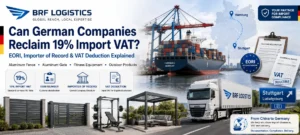
Can German Companies Reclaim Import VAT?
For eligible German businesses, import VAT may generally be deductible as input VAT when the applicable legal conditions are satisfied.
This is one reason the identity of the importer should be confirmed before using a DDP, DAP or other import structure.
For a detailed explanation, use the separate Germany Import VAT and Duty article rather than duplicating the full tax discussion on this page.
DAP Shipping from China to Hamburg
Under a typical DAP arrangement, BRF SHIPPING can coordinate:
- China pickup
- Export handling
- Sea freight
- Hamburg arrival
- Customs-broker coordination
- Final inland delivery
while the German buyer generally remains responsible for import clearance obligations, duties and taxes under the Incoterm structure.
For established German importers with:
- German EORI
- VAT registration
- Regular customs activity
DAP can be a practical B2B shipping structure.
DDP Shipping from China to Hamburg
Some buyers prefer a more integrated DDP shipping China to Hamburg solution.
DDP may include:
China Factory
↓
Pickup
↓
Export Customs
↓
Ocean Freight
↓
Hamburg
↓
German Import Process
↓
Duty / VAT Arrangement
↓
Final Delivery
However, DDP should not simply be understood as “tax-free shipping.”
The importer structure, EORI, VAT treatment and customs responsibilities must be confirmed before shipment.
BRF SHIPPING’s door-to-door service already supports integrated China pickup, international freight, customs coordination and final delivery subject to cargo and destination requirements.
China to Hamburg Door-to-Door Shipping
For many German buyers, the easiest shipping structure is:
Supplier Door in China → Buyer Door in Germany
BRF SHIPPING can coordinate the different transportation stages through one logistics plan.
A typical process is:
Step 1 — Send Cargo Information
Provide:
- Product
- Pickup address
- Number of packages
- Gross weight
- Dimensions
- CBM
- HS code if known
- Cargo-ready date
- German delivery postcode
Step 2 — Select the China Export Port
BRF SHIPPING compares:
- Factory location
- Origin trucking
- Shipping rates
- Schedules
- Transit time
Step 3 — Pickup or Container Loading
Cargo can be:
- Picked up to warehouse
- Consolidated
- Loaded into container at warehouse
- Loaded at supplier factory
Step 4 — China Export Customs
Export documents and customs declaration are arranged before sailing.
Step 5 — Sea Freight to Hamburg
FCL or LCL cargo moves to Germany.
Step 6 — German Customs
Destination agents coordinate clearance based on the agreed shipment structure.
Step 7 — Inland Delivery
After release, BRF SHIPPING can coordinate trucking or other inland transport to the final destination.
Cargo We Ship from China to Hamburg
BRF SHIPPING can handle a broad range of commercial cargo.
Typical products include:
Aluminum Fences and Gates
Common for German construction, residential and landscaping customers.
Building Materials
Including:
- WPC products
- Panels
- Metal products
- Outdoor products
- Construction components
Fitness Equipment
China remains an important manufacturing base for commercial and home fitness equipment.
Machinery
Including:
- Industrial machinery
- Production equipment
- Processing equipment
- Spare parts
Furniture
FCL and 40HQ shipments are common due to high volume.
Automotive Parts
China–Germany manufacturing supply chains generate regular demand for containerized automotive components.
General Commercial Cargo
Such as:
- Packaging
- Hardware
- Consumer goods
- Retail products
- E-commerce inventory
Cargo That Requires Extra Review
Certain products should be declared before booking.
Examples include:
- Batteries
- Chemicals
- Dangerous goods
- Liquids
- Powders
- Food
- Agricultural products
- Used machinery
- Magnetic cargo
- Controlled products
BRF SHIPPING also advises customers to identify special or controlled cargo before confirming a door-to-door quotation.
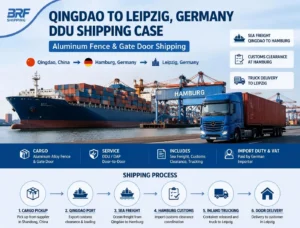
Real BRF SHIPPING Route: Qingdao → Hamburg → Leipzig
BRF SHIPPING has handled a practical Germany door-delivery shipment involving aluminum fencing and gates.
The logistics structure was:
Shandong Supplier
↓
Qingdao Port
↓
Ocean Freight
↓
Hamburg
↓
German Customs Clearance
↓
Truck Delivery
↓
Leipzig
This illustrates why Hamburg should not be viewed only as a port destination.
For many importers, Hamburg is the gateway into the German inland market.
China to Hamburg Shipping Cost
The cost of shipping from China to Hamburg cannot be determined from ocean freight alone.
A complete quotation may include:
China Side
- Factory pickup
- Warehouse
- Consolidation
- Container loading
- Export customs
- Documentation
- Origin terminal costs
Ocean Freight
- FCL ocean freight
- LCL freight
- Carrier surcharges
- Peak-season adjustments
Hamburg Side
- Destination terminal charges
- Customs brokerage
- Customs duty
- Import VAT
- Inspection if applicable
- Container storage if delayed
- Truck / rail delivery
- Empty-container return
Therefore:
Total China-to-Hamburg Cost
should be calculated as:
Origin Cost + Ocean Freight + Destination Charges + Customs + Inland Delivery
rather than using only the carrier’s base ocean rate.
What Affects China to Hamburg Freight Rates?
Freight prices can change because of:
- China origin port
- FCL or LCL
- 20GP / 40GP / 40HQ
- Cargo weight
- Carrier
- Direct or transshipment service
- Season
- Vessel capacity
- Container availability
- Red Sea routing
- Fuel cost
- European congestion
- Inland trucking capacity
BRF SHIPPING has also noted that Hamburg and other Northern European gateways can experience pressure from schedule instability and inland logistics capacity, making advance planning particularly important.
How to Reduce China to Hamburg Shipping Costs
1. Choose the Correct Origin Port
Do not automatically move every shipment to Shanghai.
For example:
- Shandong cargo → compare Qingdao
- Zhejiang cargo → compare Ningbo
- Guangdong cargo → compare Shenzhen / Nansha
- Fujian cargo → compare Xiamen
2. Compare FCL and LCL
A growing LCL shipment may eventually become more economical as FCL.
3. Consolidate Suppliers
Combine several orders before export when practical.
4. Book Early
Especially before:
- Chinese New Year
- Golden Week
- European peak seasons
- Major capacity disruptions
5. Provide the Final German Postcode
A cheap ocean rate may be offset by expensive inland trucking.
Always calculate the route to the final delivery address.
Port of Hamburg Congestion and Inland Planning
The Port of Hamburg remains a major European logistics hub, but importers should not assume every container will move immediately after vessel discharge.
Potential delays can arise from:
- Vessel bunching
- Terminal congestion
- Customs inspection
- Rail capacity
- Truck availability
- Container release issues
- Documentation errors
For cargo destined for inland Germany, the inland leg should ideally be planned before the vessel arrives.
Why Work with BRF SHIPPING for China to Hamburg?
BRF SHIPPING can combine multiple logistics stages rather than leaving the importer to coordinate several unrelated providers.
Services include:
- China supplier pickup
- Multi-supplier consolidation
- Warehouse receiving
- FCL shipping
- LCL shipping
- 20GP / 40GP / 40HQ
- Export customs
- Sea freight to Hamburg
- German customs coordination
- DAP / DDP planning
- Truck delivery
- Door-to-door logistics
BRF SHIPPING’s broader route network already includes Hamburg as a key European gateway.
China to Hamburg FAQ
How long does sea freight from China to Hamburg take?
A practical planning range is approximately 28–45 days port to port, depending on the Chinese origin port, carrier, route and current operating conditions.
Can I ship a 20ft container from China to Hamburg?
Yes. BRF SHIPPING can arrange 20GP FCL shipping from major Chinese ports to Hamburg.
Can I ship a 40HQ container to Hamburg?
Yes. 40HQ is a common option for bulky commercial cargo such as furniture, aluminum fencing, building materials and equipment.
Does BRF SHIPPING provide LCL shipping to Hamburg?
Yes. Smaller shipments can be consolidated into LCL cargo where appropriate.
Can you pick up from my supplier in China?
Yes. Pickup can be arranged across major Chinese manufacturing and export-port regions.
Can BRF SHIPPING collect goods from multiple Chinese suppliers?
Yes. Multi-supplier pickup and warehouse consolidation can be arranged before shipment.
What is the import VAT in Germany?
Germany generally applies a standard 19% import VAT rate, although the exact tax treatment depends on the goods and importer.
Do I need an EORI number to import through Hamburg?
Commercial importers participating in EU customs activities generally need an appropriate EORI arrangement.
Can you arrange Hamburg customs clearance?
BRF SHIPPING can coordinate destination customs-clearance support with local partners according to the shipment and Incoterm.
Can you deliver from Hamburg to Leipzig?
Yes. Hamburg can be used as an entry gateway for inland delivery to Leipzig and other German cities.
Can you deliver from Hamburg to Munich?
Yes. Depending on the shipment, inland delivery may use truck, rail or combined transport.
Do you provide DDP shipping to Germany?
DDP solutions may be available subject to the product, importer structure, tax requirements, customs feasibility and final address.
Get a China to Hamburg Shipping Quote
For an accurate China to Hamburg freight quote, send BRF SHIPPING:
China Pickup Address
Product Description
HS Code
Packages
Gross Weight
Dimensions / CBM
20GP / 40GP / 40HQ or LCL
Hamburg Port or Final German Postcode
Cargo-Ready Date
BRF SHIPPING can then compare the origin port, transportation mode, container option and inland route.
BRF SHIPPING
China Factory Pickup → Sea Freight → Hamburg Customs → Germany Door Delivery
For complete Germany logistics solutions, see Shipping from China to Germany.
For FCL services, see FCL Shipping from China.
For ocean freight services, see Sea Freight from China.
For integrated delivery, see Door-to-Door Shipping from China.