Shipping commercial fitness equipment from China to the United States requires more than simply booking an ocean container.
The shipment must be coordinated from the supplier’s factory, transported to the export port, cleared through Chinese Customs, loaded onto the correct vessel, prepared for U.S. import clearance and finally delivered from the destination port to the consignee.
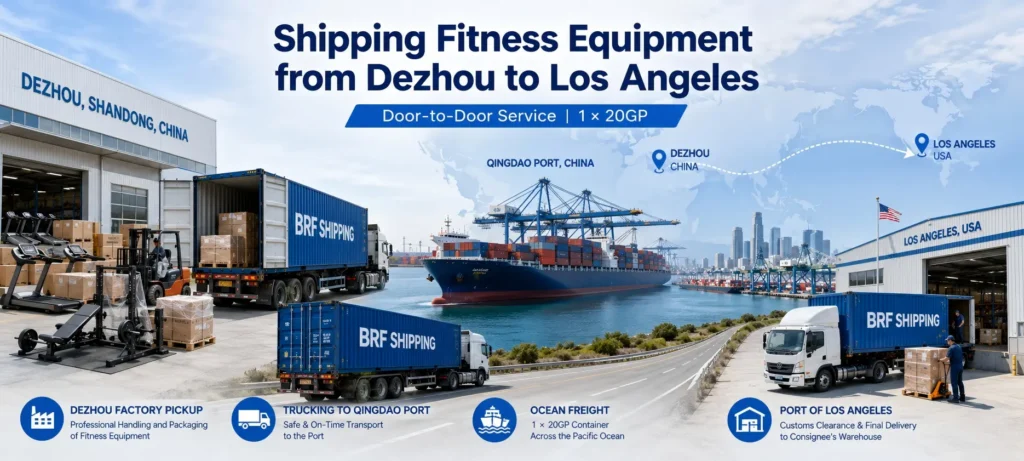
In this shipment, BRF SHIPPING arranged one 20GP container of fitness equipment from Dezhou, Shandong Province, China, via Qingdao Port to the Port of Los Angeles, USA, providing a complete door-to-door logistics solution.
The service covered:
Factory pickup in Dezhou → container trucking → Qingdao Port → China export customs clearance → ocean freight → Los Angeles → U.S. customs clearance → container pickup → final delivery.
This case demonstrates how manufacturers, distributors and fitness equipment importers can use a single freight forwarding solution to manage the entire transportation process from China to the United States.
Shipment Overview
| Item | Shipment Details |
|---|---|
| Origin | Dezhou, Shandong, China |
| Export Port | Qingdao Port, China |
| Destination Port | Los Angeles, California, USA |
| Commodity | Fitness Equipment |
| Container | 1 × 20GP |
| Shipping Mode | FCL Ocean Freight |
| Origin Service | Factory Pickup |
| Export Customs | Included |
| Ocean Freight | Qingdao to Los Angeles |
| U.S. Customs Clearance | Arranged |
| Destination Trucking | Included |
| Service Type | Door-to-Door Shipping |
For this shipment, FCL shipping with a 20ft general-purpose container provided the customer with a dedicated container instead of sharing container space with other importers.
Step 1: Factory Pickup in Dezhou, Shandong
The fitness equipment was manufactured in Dezhou, Shandong Province, an important manufacturing area located within trucking distance of Qingdao Port.
Instead of requiring the factory to arrange domestic transportation independently, BRF SHIPPING coordinated the origin pickup.
Once the cargo information and loading schedule were confirmed, we arranged container trucking between the supplier and Qingdao Port.
Depending on the actual loading conditions, a China-to-USA FCL shipment can normally be handled through either:
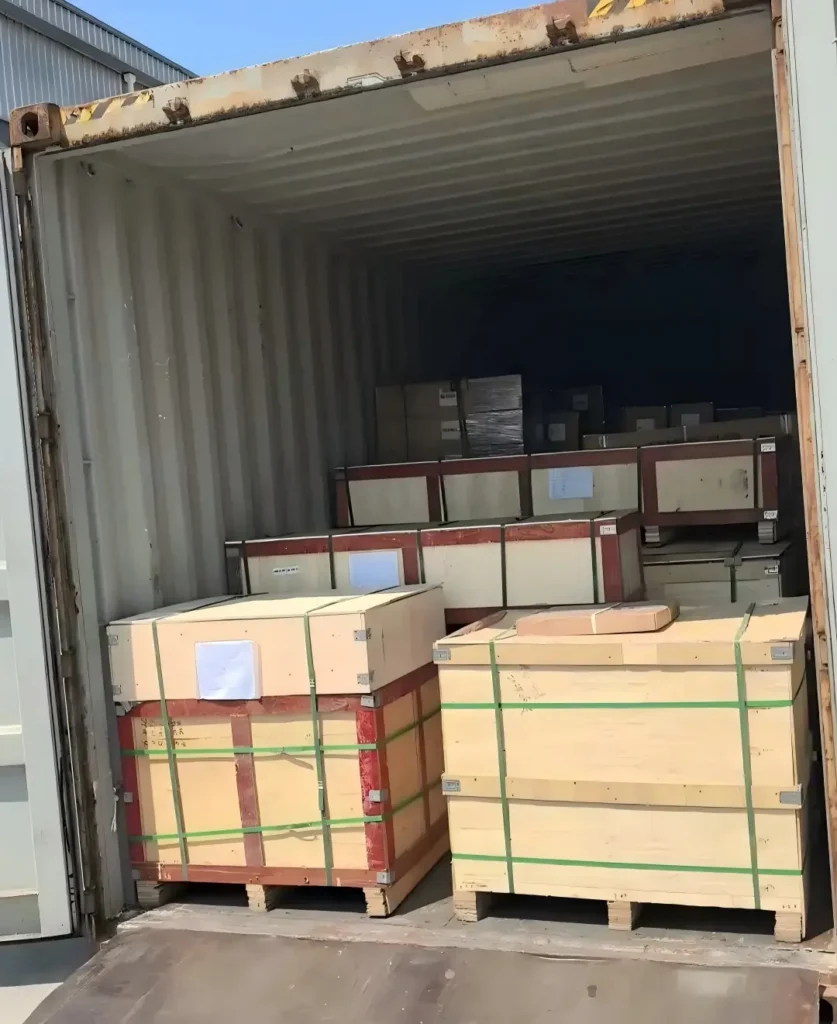
Option 1 – Container Loaded at the Factory
An empty 20GP container is released from the designated container depot and trucked to the factory in Dezhou.
The supplier loads the fitness equipment directly into the container.
After loading is completed, the container is sealed and transported to the Qingdao Port terminal.
Option 2 – Cargo Delivered to Our Warehouse
If the supplier does not have suitable container-loading facilities, individual cargo can first be collected and delivered to a warehouse near Qingdao.
The warehouse can then assist with:
- cargo receiving
- quantity checking
- temporary storage
- pallet handling
- loading supervision
- container loading
- securing cargo inside the container
For importers purchasing fitness equipment from multiple suppliers, the warehouse option can also be used for cargo consolidation before container loading.
Step 2: 20GP Container Loading for Fitness Equipment
Fitness equipment can be relatively heavy and may contain large steel frames, racks, weight systems, benches or other components.
Container loading therefore needs to consider both cargo dimensions and weight distribution.
For this project, the shipment was arranged using:
1 × 20GP standard dry container.
A 20GP is often suitable when the shipment has relatively high weight but does not require the cubic capacity of a 40ft or 40HQ container.
Before loading, the logistics team should confirm:
- number of packages
- dimensions
- gross weight
- packaging method
- loading sequence
- whether pallets are used
- whether any individual units are oversized
- whether additional securing is required
Proper positioning and cargo securing can reduce movement during inland transportation and ocean transit.
For large fitness machines, racks or steel structures, wooden crates, pallets, straps, blocking or other securing methods may be used depending on the cargo configuration.
Step 3: Transport from Dezhou to Qingdao Port
After container loading, the sealed 20GP container was transported from Dezhou to Qingdao Port.
Our origin team coordinated the container trucking schedule with:
- the supplier
- container depot
- customs team
- shipping line
- port terminal
Timing is especially important for international container shipments.
The container must arrive before the shipping line and terminal cut-off requirements so there is sufficient time for export declaration and vessel loading.
Using one freight forwarder to manage both the inland trucking and ocean freight reduces the risk of communication gaps between the factory, trucker and shipping line.
Step 4: China Export Customs Clearance
Before the fitness equipment could leave China, the shipment needed to complete export customs procedures.
Typical documents for a commercial fitness equipment shipment may include:
- Commercial Invoice
- Packing List
- Customs Declaration Information
- Sales Contract when required
- Exporter information
- HS code
- Product description
- Gross and net weight
- Number of packages
- Shipping instruction
The exact declaration information depends on the actual products being exported.
For example, different types of gym equipment or components may fall under different HS classifications.
Therefore, the cargo description and classification should be checked before export declaration rather than simply declaring all products as “fitness equipment.”
BRF SHIPPING can coordinate the documentation between the supplier, exporter, customs declaration team and shipping line before the container enters the export process.
Step 5: Ocean Freight from Qingdao Port to Los Angeles
After completing export customs procedures, the 20GP container was arranged for ocean freight from Qingdao, China to Los Angeles, USA.
Qingdao is one of the key container gateways serving exporters throughout Shandong Province, making it a practical export port for factories located in areas such as Dezhou, Qingdao, Jinan, Weifang, Linyi, Zibo and surrounding manufacturing regions.
At destination, the shipment entered the Port of Los Angeles, which describes itself as America’s No. 1 container port and operates multiple container cargo terminals.
For importers shipping from Shandong to the U.S. West Coast, the route can therefore be structured as:
Dezhou Factory → Qingdao Port → Pacific Ocean → Los Angeles Port → U.S. Customs → Final Delivery
When arranging the booking, our team can compare available carrier schedules according to factors such as:
- sailing schedule
- available container space
- transit requirements
- destination terminal
- freight level
- free-time conditions
- final delivery requirements
The cheapest ocean freight rate is not always the best option. Vessel schedule, destination charges and container free time should also be evaluated.
Step 6: ISF Filing Before Shipment to the United States
For ocean cargo entering the United States, Importer Security Filing (ISF), commonly known as ISF 10+2, is an important part of the import process.
CBP states that ISF applies to cargo arriving in the United States by vessel. Certain required information must generally be transmitted to CBP no later than 24 hours before the cargo is loaded aboard the vessel destined for the United States.
For this reason, U.S. import documentation should not be left until the container reaches Los Angeles.
The importer or its appointed agent should prepare the required information in advance.
Typical information may include details relating to:
- seller
- buyer
- importer of record
- consignee
- manufacturer or supplier
- ship-to party
The exact filing responsibility and information should be confirmed with the U.S. customs broker for the specific shipment.
Step 7: U.S. Customs Clearance in Los Angeles
When the vessel approached or arrived in Los Angeles, the destination team coordinated the import clearance process.
For commercial imports, the U.S. importer should ensure that its importer information and customs arrangements are established before cargo arrival.
Depending on the shipment, the customs broker may require documents such as:
- Commercial Invoice
- Packing List
- Bill of Lading
- Arrival Notice
- Importer of Record information
- Customs bond information
- HTS classification
- Country of origin
- Product description
- Manufacturer information
CBP notes that importers and the importing community share responsibility for compliance with U.S. import laws and regulations.
A customs bond may also be required for many commercial entries; CBP states that commercial imports valued over $2,500, or commodities subject to certain federal requirements, generally require a customs bond.
Fitness Equipment HS Code and Import Duty
The exact U.S. HTS classification should be determined according to the actual fitness equipment being imported.
For example, an importer should not assume that:
- gym machines
- weight-training equipment
- benches
- steel racks
- exercise accessories
- motors
- electronic control components
will necessarily use the same tariff classification.
The duty and any additional tariffs should therefore be checked against the actual product specifications and current U.S. tariff treatment before shipment.
BRF SHIPPING can coordinate with the customer’s customs broker or destination clearance agent to ensure the shipping documents contain the information needed for entry.
Step 8: Container Pickup from Los Angeles Port
After customs clearance and cargo release, the next step was to arrange destination trucking.
The container needed to be picked up from the applicable Los Angeles terminal within the allowed period.
This stage requires coordination between:
Customs Release + Terminal Release + Shipping Line Release + Truck Appointment + Final Delivery
Port delays can become expensive when these steps are not coordinated correctly.
Possible destination costs can include:
- terminal-related charges
- demurrage
- detention
- chassis charges
- storage
- additional truck waiting time
- redelivery charges
Therefore, our destination team tracks the shipment and prepares trucking arrangements before the container becomes available whenever possible.
Step 9: Door Delivery in the United States
The final stage of this shipment was delivery from the Los Angeles port area to the consignee’s designated receiving location.
Once the container was released, a truck collected the 20GP from the terminal and transported it to the customer’s delivery address.
Depending on the customer’s requirements, final delivery can be arranged to locations such as:
- commercial warehouse
- fitness equipment distributor
- gym equipment showroom
- fulfillment warehouse
- project site
- business address
- distribution center
After unloading, the empty container is returned according to the shipping line’s designated return instructions.
This completes the full door-to-door transportation process.
Complete Door-to-Door Shipping Process
The complete logistics chain for this fitness equipment shipment was:
1. Cargo details confirmed
↓
2. 20GP container booking
↓
3. Empty container released
↓
4. Trucking to Dezhou factory
↓
5. Fitness equipment loaded
↓
6. Container transported to Qingdao Port
↓
7. China export customs clearance
↓
8. ISF information prepared for U.S. import
↓
9. Container loaded onto vessel
↓
10. Ocean freight from Qingdao to Los Angeles
↓
11. U.S. customs clearance
↓
12. Los Angeles terminal release
↓
13. Container pickup
↓
14. Final truck delivery
↓
15. Empty container return
Instead of using separate companies for each stage, BRF SHIPPING can coordinate the transportation chain through one point of contact.
Why Use Door-to-Door Shipping for Fitness Equipment?
Door-to-door shipping is particularly useful for importers purchasing fitness equipment directly from Chinese manufacturers.
If an importer books only port-to-port ocean freight, it may still need to separately arrange:
- China factory pickup
- export declaration
- container loading
- port delivery
- ISF coordination
- U.S. customs broker
- destination terminal handling
- drayage
- warehouse delivery
- empty container return
For companies without their own logistics department, coordinating multiple suppliers can be complicated.
A door-to-door freight solution simplifies the process.
BRF SHIPPING can coordinate the shipment from the Chinese supplier through to the customer’s designated delivery location in the United States.
20GP vs 40GP vs 40HQ for Fitness Equipment
Selecting the correct container size can significantly affect shipping efficiency.
20GP
A 20GP container can be suitable for relatively heavy fitness equipment shipments with moderate cargo volume.
Typical applications may include:
- weight-training equipment
- gym racks
- steel fitness frames
- commercial exercise machines
- fitness equipment parts
40GP
A 40GP offers significantly more loading space and may be appropriate when cargo volume rather than weight is the primary limitation.
40HQ
A 40HQ provides additional internal height and volume.
It can be useful for bulky but comparatively lightweight fitness equipment or larger quantities.
Before booking a container, we recommend providing the complete packing list so the container utilization can be evaluated.
What Information Is Needed for a Door-to-Door Quote?
If you are shipping fitness equipment from China to the United States, please provide the following information:
- Pickup address in China
- Destination ZIP code in the USA
- Product name
- HS code if available
- Number of packages
- Total gross weight
- Cargo dimensions or total CBM
- Preferred container size
- Commercial invoice value
- Whether the U.S. consignee has an importer setup/customs bond
- Expected cargo-ready date
For example:
Pickup: Dezhou, Shandong, China
Destination: Los Angeles / California, USA
Commodity: Fitness Equipment
Container: 1 × 20GP
Service: Door-to-Door
Cargo Ready: [Date]
With complete information, the logistics solution can be designed more accurately.
Why Choose BRF SHIPPING for Shandong to USA Shipping?
BRF SHIPPING provides international freight forwarding services for manufacturers and importers shipping from China to the United States.
For cargo originating in Shandong Province, we can coordinate services including:
- Dezhou factory pickup
- Jinan factory pickup
- Qingdao factory pickup
- Weifang factory pickup
- Linyi factory pickup
- Zibo factory pickup
- Qingdao warehouse receiving
- container loading
- China export customs clearance
- FCL ocean freight
- LCL ocean freight
- U.S. customs clearance coordination
- Los Angeles port pickup
- door-to-door delivery
Whether you are importing fitness equipment, machinery, aluminum products, building materials, industrial products or other commercial cargo, we can design the shipping solution according to your supplier location, cargo size and final delivery address.
FAQ – Shipping Fitness Equipment from China to USA
How do I ship fitness equipment from China to the USA?
For commercial quantities, fitness equipment can be shipped by FCL container, LCL sea freight or air freight depending on cargo size and urgency.
For larger shipments, FCL ocean freight is often the practical solution.
The complete process can include factory pickup, export clearance, ocean freight, U.S. customs clearance and final delivery.
Can BRF SHIPPING pick up cargo from Dezhou?
Yes. For shipments originating in Shandong, the logistics process can be arranged from the supplier’s pickup location and connected with export services through Qingdao Port.
Can you arrange a 20GP container from Qingdao to Los Angeles?
Yes. FCL shipments can be arranged using 20GP, 40GP or 40HQ containers depending on cargo volume and weight.
Can you arrange U.S. customs clearance?
U.S. customs clearance can be coordinated with the importer and licensed customs brokerage resources at destination. The importer must provide the necessary company, cargo and entry information.
Do I need ISF for sea freight to the United States?
For applicable ocean shipments, CBP’s Importer Security Filing requirements apply. Required information must be prepared before vessel loading in accordance with CBP rules.
Can you deliver the container after it arrives in Los Angeles?
Yes. After customs and terminal release, destination trucking can be arranged from the Los Angeles terminal to the customer’s designated delivery location.
Can several fitness equipment suppliers be combined into one container?
Yes. If products are purchased from several factories, cargo can be collected into a warehouse before loading into one container, subject to cargo specifications and export requirements.
Ship Fitness Equipment from China to USA with BRF SHIPPING
If you are purchasing gym equipment, fitness machines, weight-training equipment or related products from manufacturers in Dezhou, Shandong or other cities in China, BRF SHIPPING can help you manage the complete international transportation process.
From factory pickup in China to Qingdao Port, ocean freight to Los Angeles, U.S. customs clearance coordination and final truck delivery, we provide a complete logistics solution designed for commercial importers.
Route
Dezhou, Shandong → Qingdao Port → Los Angeles Port → Customs Clearance → Door Delivery
Shipment
Fitness Equipment | 1 × 20GP | FCL | Door-to-Door
Need a shipping quote?
Send us your:
Pickup Address + Destination ZIP Code + Product + Weight + CBM + Container Type + Cargo Ready Date
and BRF SHIPPING can prepare the appropriate China-to-USA door-to-door shipping solution for your cargo.