Causes, Market Trends & How Importers Can Reduce Shipping Costs
Europe’s freight market is entering another period of volatility in 2026. Ocean freight rates from China and Asia to Europe are rising again due to a combination of geopolitical risks, port congestion, carrier capacity control, rising fuel costs, and ongoing supply chain instability.
For importers, exporters, Amazon sellers, and international traders, understanding why freight prices are increasing is essential for controlling logistics budgets and avoiding costly shipment delays.
As a professional China freight forwarder, BRF SHIPPING helps global businesses navigate changing freight markets with flexible sea freight, air freight, FCL, LCL, DDP, and door-to-door logistics solutions.
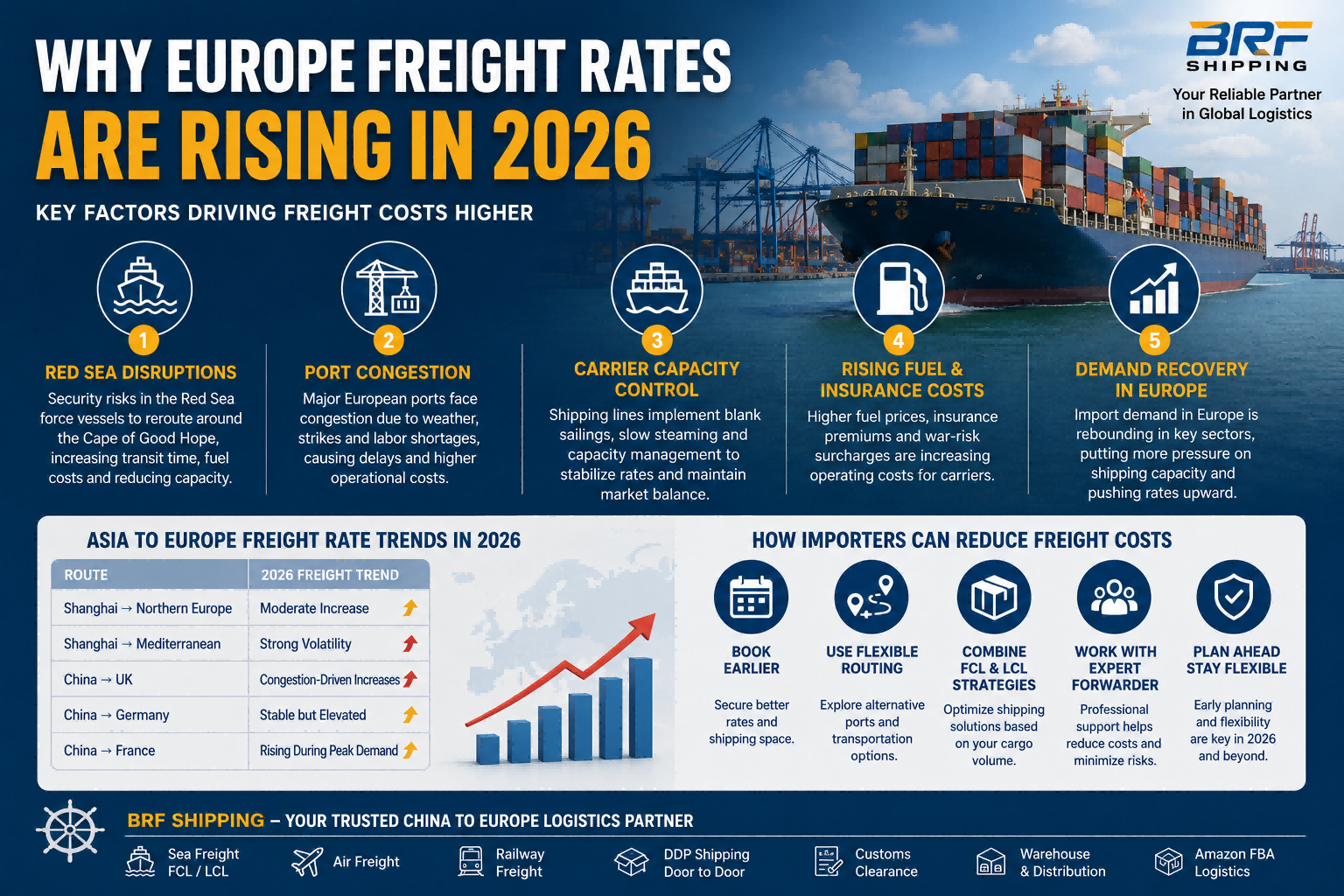
Why Are Europe Freight Rates Increasing in 2026?
Several major factors are driving freight costs higher across Europe-bound shipping routes in 2026.
1. Red Sea Crisis & Suez Canal Disruptions
One of the biggest reasons for rising freight rates is the continuing instability in the Red Sea and Middle East shipping corridors.
Many shipping lines are avoiding the Suez Canal and rerouting vessels around the Cape of Good Hope due to security concerns. This significantly increases:
- Transit time
- Fuel consumption
- Vessel operating costs
- Container equipment shortages
Longer sailing routes reduce available vessel capacity globally, pushing ocean freight prices higher across Asia-Europe trade lanes.
2. Port Congestion Across Europe
Major European ports are experiencing congestion and operational pressure in 2026, including:
- Port of Rotterdam
- Port of Hamburg
- Port of Antwerp
Winter storms, rail strikes, labor shortages, and inland transportation disruptions have all contributed to slower cargo handling and vessel delays.
Port congestion creates a chain reaction throughout the supply chain:
- Containers remain longer in terminals
- Vessel schedules become unreliable
- Empty containers return more slowly
- Shipping lines introduce congestion surcharges
As a result, freight rates continue climbing.
3. Carrier Capacity Control & Blank Sailings
Shipping carriers are actively controlling capacity to prevent freight prices from collapsing.
In 2026, many carriers continue using strategies such as:
- Blank sailings
- Voyage cancellations
- Slow steaming
- Alliance network optimization
These measures reduce available shipping space and help carriers maintain higher freight rates even during weaker demand periods.
At the same time, cargo demand from Asia remains relatively stable after the Lunar New Year recovery, especially for:
- Consumer goods
- Furniture
- Building materials
- E-commerce cargo
- Seasonal retail products
The supply-demand imbalance is pushing rates upward again.
4. Rising Fuel & Insurance Costs
Geopolitical tensions in the Middle East are also increasing:
- Marine insurance premiums
- War risk surcharges
- Emergency fuel surcharges
Shipping lines are transferring these additional operating costs directly to shippers.
In some cases, war-risk insurance costs for Europe-bound vessels have multiplied several times compared to normal market conditions.
5. European Consumer Demand Recovery
Although Europe’s economy remains mixed, import demand is gradually recovering in several sectors:
- Home improvement products
- Furniture
- Solar products
- Construction materials
- Cross-border e-commerce
- Retail replenishment
This has created additional pressure on shipping capacity from China to Europe.
Meanwhile, many importers are booking cargo earlier to avoid future disruptions, which further accelerates freight rate increases.
Asia to Europe Freight Rate Trends in 2026
According to recent market reports, shipping prices on major Europe trade lanes continue fluctuating:
| Route | 2026 Freight Trend |
|---|---|
| Shanghai → Northern Europe | Moderate increase |
| Shanghai → Mediterranean | Strong volatility |
| China → UK | Congestion-driven increases |
| China → Germany | Stable but elevated |
| China → France | Rising during peak demand |
Industry analysts believe freight volatility will remain the “new normal” throughout 2026.
How Importers Can Reduce Freight Costs in 2026
1. Book Space Earlier
Peak season space shortages are returning. Early booking helps secure:
- Better rates
- Stable schedules
- Lower rollover risk
Last-minute bookings usually face much higher pricing.
2. Use Flexible Routing
Alternative routing options may reduce delays and costs.
For example:
- Alternative European ports
- Rail + sea multimodal transport
- Different transshipment hubs
- Flexible carrier selection
Professional freight forwarders can help identify the most cost-effective routes.
3. Combine FCL & LCL Strategies
Businesses shipping smaller volumes can reduce costs through LCL consolidation, while larger shipments benefit from long-term FCL planning.
Hybrid logistics strategies are becoming increasingly common in 2026.
4. Work With an Experienced Freight Forwarder
An experienced logistics partner can help businesses manage:
- Space shortages
- Customs clearance
- Freight cost optimization
- DDP shipping
- Door-to-door delivery
- Cargo insurance
- Europe compliance requirements
BRF SHIPPING provides reliable freight forwarding services from China to Europe with competitive pricing and stable shipping solutions.
BRF SHIPPING Europe Freight Solutions
BRF SHIPPING offers comprehensive logistics services for Europe-bound cargo, including:
- Sea Freight FCL & LCL
- Air Freight
- Railway Freight
- DDP Shipping
- Customs Clearance
- Door-to-Door Delivery
- Amazon FBA Logistics
- Project Cargo Transportation
- Warehouse & Distribution
Main export ports include:
- Shanghai
- Ningbo
- Shenzhen
- Qingdao
- Xiamen
- Tianjin
- Dalian
We support shipments to major European destinations including Germany, France, Italy, Spain, Netherlands, Belgium, and the UK.
Conclusion
Europe freight rates are rising in 2026 due to a combination of geopolitical tensions, Red Sea disruptions, port congestion, carrier capacity management, and rising operating costs.
While the market remains volatile, businesses that plan ahead and work with experienced logistics partners can still reduce shipping risks and maintain stable supply chains.
As global freight conditions continue evolving, flexibility, early planning, and reliable freight forwarding support will become more important than ever.
For competitive China-to-Europe shipping solutions, BRF SHIPPING provides professional and cost-efficient international logistics services tailored to your cargo needs.