Shipping goods by sea remains one of the most cost-effective ways to move commercial cargo from China to the United States. For importers shipping large volumes, heavy products, pallets, machinery, building materials, consumer goods or full container loads, sea freight from China to USA usually provides a better cost per unit than air freight.
BRF SHIPPING provides international ocean freight solutions from major Chinese ports to destinations throughout the United States, including port-to-port, door-to-port and complete door-to-door shipping services.
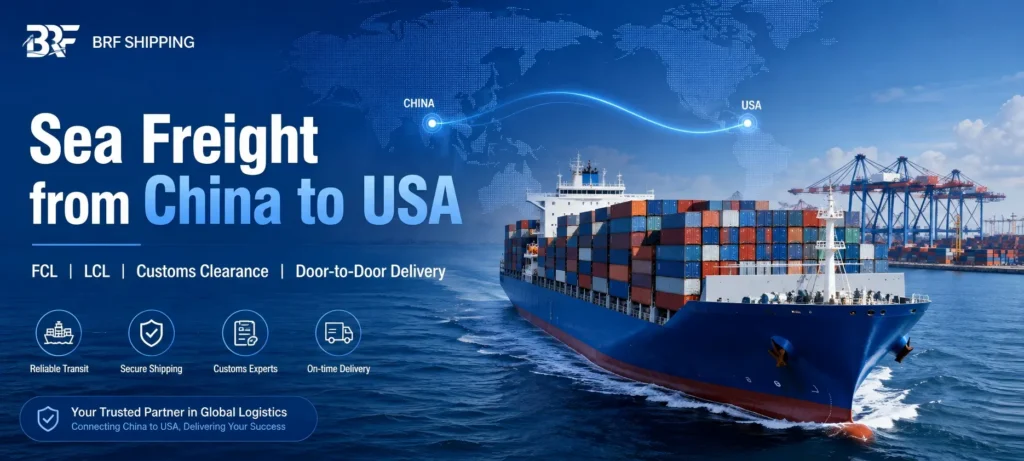
Our services can cover the entire logistics process:
- Factory pickup in China
- Supplier cargo consolidation
- Export customs declaration
- Container loading
- FCL ocean freight
- LCL ocean freight
- US customs clearance coordination
- Import duty and tax handling
- Port pickup
- Truck delivery
- Warehouse delivery
- Amazon FBA delivery
- Door-to-door shipping
Whether you are shipping 1 CBM of consolidated cargo or multiple 40HQ containers, BRF SHIPPING can build a suitable China-to-USA sea freight solution based on your cargo, destination, delivery requirements and budget.
What Is Sea Freight from China to USA?
Sea freight from China to USA refers to transporting cargo from a Chinese seaport to a US port aboard an ocean-going container vessel.
Cargo normally moves through the following process:
Chinese supplier → Pickup → Export warehouse/container loading → Chinese port → Ocean transportation → US port → Customs clearance → Truck delivery → Final destination
Most international commercial cargo is transported using standardized shipping containers.
The most common container sizes include:
| Container | Typical Use |
|---|---|
| 20GP | Heavy or medium-volume cargo |
| 40GP | Larger-volume general cargo |
| 40HQ | High-volume cargo |
| LCL | Small shipments sharing a container |
For companies regularly importing products from China, ocean freight is often the foundation of their international supply chain.
Why Choose Sea Freight from China to USA?
The biggest advantage of ocean shipping is its ability to transport large quantities of cargo at a relatively low transportation cost.
Lower Cost for Large Shipments
Compared with air freight, ocean freight normally becomes much more economical as shipment volume increases.
Sea freight is particularly suitable for:
- Palletized cargo
- Furniture
- Aluminum products
- Building materials
- Machinery
- Auto parts
- Solar products
- Packaging materials
- Textiles
- Consumer goods
- Industrial equipment
- E-commerce inventory
- Amazon FBA inventory
For heavy or bulky products, shipping by air may quickly become uneconomical.
Large Shipping Capacity
A 40HQ container provides approximately 76 cubic meters of internal space, allowing importers to move substantial quantities in a single shipment.
For growing importers, full-container shipping can significantly reduce the freight cost allocated to each individual product.
Extensive Port Network
China and the United States both have extensive container port networks.
This allows cargo to move through multiple shipping routes depending on:
- Supplier location
- Destination city
- Required transit time
- Ocean freight rate
- Shipping line
- Port congestion
- Inland trucking cost
BRF SHIPPING can compare different routing options before booking.
FCL Sea Freight from China to USA
FCL — Full Container Load means one shipper uses an entire shipping container.
Typical options are:
20GP Container
A 20ft general-purpose container is often suitable for relatively heavy cargo where volume is limited.
Common cargo includes:
- Metal products
- Machinery
- Stone products
- Building materials
- Industrial equipment
40GP Container
A standard 40ft container offers approximately twice the loading length of a 20GP and is commonly used for general merchandise.
40HQ Container
The 40HQ, or 40ft High Cube container, is one of the most frequently used container types for China-US trade.
Its additional height provides greater cubic capacity.
Typical products include:
- Furniture
- Fencing
- Building materials
- E-commerce goods
- Packaging products
- Household products
- Lightweight machinery
For high-volume cargo, a 40HQ often provides the best cost per cubic meter.
LCL Sea Freight from China to USA
You do not need to fill an entire container to ship cargo by sea.
LCL — Less than Container Load allows several importers to share one container.
For example:
Your shipment may occupy:
2 CBM, 5 CBM or 10 CBM
while other exporters use the remaining container space.
You mainly pay according to the chargeable volume of your shipment plus applicable local handling charges.
LCL is commonly suitable for:
- Samples
- Small wholesale orders
- Startup importers
- Spare parts
- Small machinery
- Commercial shipments below container-load volume
BRF SHIPPING can collect cargo from multiple suppliers and consolidate shipments before export where appropriate.
FCL vs LCL: Which Is Better?
Choosing between FCL and LCL depends mainly on shipment volume, cargo characteristics and delivery requirements.
| Factor | FCL | LCL |
|---|---|---|
| Container | Dedicated | Shared |
| Best for | Larger shipments | Smaller shipments |
| Handling | Less | More |
| Cargo separation | Dedicated container | Consolidated |
| Freight calculation | Per container | Mainly per CBM |
| Transit process | Simpler | Additional consolidation |
| Delivery flexibility | High | High |
There is no single volume at which FCL always becomes cheaper.
The break-even point changes depending on:
- Route
- Port
- Season
- Ocean freight market
- Destination charges
- Cargo density
BRF SHIPPING can compare FCL vs LCL costs before recommending the most economical solution.
Major Shipping Ports in China
One important part of reducing China-to-USA freight costs is choosing the correct origin port.
BRF SHIPPING can arrange shipments through major Chinese ports including:
Shanghai Port
Shanghai is one of China’s largest container gateways and serves manufacturing regions throughout eastern China.
Common supplier regions include:
- Shanghai
- Jiangsu
- Zhejiang
- Anhui
Ningbo Port
Ningbo is an important export gateway for factories throughout Zhejiang and nearby manufacturing regions.
Shenzhen Port
Shenzhen is a major departure point for cargo manufactured in South China.
Important terminals and port areas include:
- Yantian
- Shekou
It is particularly convenient for suppliers located in:
- Shenzhen
- Dongguan
- Guangzhou
- Huizhou
- Foshan
Guangzhou / Nansha
Nansha is another important South China container gateway and can sometimes provide competitive routing options.
Qingdao Port
Qingdao is one of the main export ports serving northern and eastern China.
It is especially convenient for factories located in:
- Shandong
- Qingdao
- Weifang
- Linyi
- Zibo
- Jinan
BRF SHIPPING has extensive experience coordinating cargo pickup, container loading and international shipping from this region.
Tianjin / Xingang
Tianjin is an important port serving northern China, including suppliers around:
- Beijing
- Tianjin
- Hebei
- Inner Mongolia
Xiamen Port
Xiamen is commonly used for cargo originating in Fujian and surrounding regions.
Major USA Ports for Cargo from China
Selecting the correct US destination port can have a major effect on the total landed logistics cost.
Important US gateways include the following.
Port of Los Angeles
Los Angeles is one of the most important gateways for China-US container trade.
It is commonly selected for cargo destined for:
- Los Angeles
- Southern California
- Nevada
- Arizona
- Inland US destinations
Port of Long Beach
Long Beach is located next to Los Angeles and is another major gateway for Asian container imports.
Los Angeles and Long Beach together handle large volumes of China-origin cargo.
Port of Oakland
Oakland can be suitable for shipments destined for Northern California and nearby regions.
Port of Seattle
Seattle is an important gateway for the Pacific Northwest.
Port of Tacoma
Tacoma is also widely used for cargo entering the Pacific Northwest.
Port of Houston
Houston can be an important option for cargo destined for Texas and surrounding markets.
Cargo can sometimes move directly by ocean service or through alternative intermodal routes depending on the sailing schedule.
Port of Savannah
Savannah is one of the important container gateways serving the southeastern United States.
It can be suitable for shipments destined for:
- Georgia
- Atlanta
- Southeast USA
- Regional distribution centers
Port of New York / New Jersey
New York/New Jersey is a major gateway for cargo moving to the US East Coast and Northeast.
Typical destinations include:
- New York
- New Jersey
- Pennsylvania
- Northeast USA
Other US Ports
Depending on your final destination, shipments may also move through ports such as:
- Norfolk
- Charleston
- Baltimore
- Miami
The cheapest ocean freight rate does not always produce the lowest total shipping cost.
BRF SHIPPING evaluates:
Ocean freight + destination charges + customs + inland delivery
rather than looking at ocean freight alone.
How Long Does Sea Freight from China to USA Take?
One of the most common questions we receive is:
How long does sea freight from China to USA take?
The answer depends heavily on the Chinese departure port, US arrival port, shipping line, service type and final destination.
As a general planning reference:
China to US West Coast
Port-to-port ocean transit may often be approximately:
12–22 days
depending on the route and sailing.
China to US East Coast
Ocean transportation may often require approximately:
25–40+ days
depending on whether the service uses the Panama Canal, Suez routing or another network configuration.
Door-to-Door Transit Time
Door-to-door shipping requires additional time for:
- Factory pickup
- Export customs
- Container loading
- Terminal cutoff
- Vessel schedule
- Ocean transit
- Import customs clearance
- Port availability
- Truck appointment
- Final delivery
For this reason, port-to-port transit time should never be confused with total door-to-door shipping time.
Contact BRF SHIPPING with the origin city and US delivery ZIP code for a more accurate route estimate.
How Much Does Sea Freight from China to USA Cost?
There is no fixed price for shipping a container from China to the United States.
Ocean freight rates can change frequently based on market conditions.
The final price depends on several variables.
1. Origin City
A supplier located near Shanghai may have different local transportation costs from a supplier located in inland China.
2. Departure Port
Freight rates differ between:
- Shanghai
- Ningbo
- Qingdao
- Shenzhen
- Guangzhou
- Tianjin
- Xiamen
3. Destination Port
Rates to Los Angeles can differ substantially from rates to New York, Savannah or Houston.
4. Container Type
Container size affects the price.
Common equipment includes:
- 20GP
- 40GP
- 40HQ
5. Cargo Volume
For LCL cargo, shipment volume plays an important role in the freight calculation.
6. Cargo Weight
Very heavy cargo may require special handling or container loading planning.
7. Commodity
Some products require additional documentation or handling.
Examples include:
- Batteries
- Chemicals
- Food
- Dangerous goods
- Oversized cargo
8. Shipping Season
Ocean freight rates often change around:
- Peak shipping periods
- Chinese holidays
- Retail inventory seasons
- Capacity shortages
- Major supply-chain disruptions
This is why importers should request a current quotation before confirming an order.
What Is Included in a China to USA Sea Freight Quote?
A professional freight quotation should clearly indicate which charges are included.
Depending on the Incoterm and service level, a China-US shipment may involve:
China Origin Charges
- Supplier pickup
- Trucking
- Warehouse receiving
- Container loading
- Documentation
- Export customs declaration
- Terminal charges
Ocean Freight
The international sea transportation charge between China and the United States.
USA Destination Charges
These may include:
- Terminal charges
- Documentation
- Customs broker fees
- Port-related fees
- Container-related charges
- Delivery appointment charges
Inland Delivery
Truck transportation from the US port or terminal to:
- Commercial warehouse
- Distribution center
- Factory
- Construction site
- Amazon fulfillment center
- Business address
BRF SHIPPING can provide a more complete landed logistics quotation when the final delivery address is available.
Door-to-Door Sea Freight from China to USA
Many importers do not want to coordinate several logistics companies.
Instead, they prefer one freight forwarder to manage the entire shipment.
BRF SHIPPING can provide door-to-door sea freight from China to USA.
The process can include:
Step 1 — Factory Pickup in China
We coordinate pickup with your Chinese supplier.
Cargo can be transported to:
- Our warehouse
- Consolidation warehouse
- Container yard
- Export port
Step 2 — Cargo Consolidation
If you purchase from several Chinese suppliers, cargo can sometimes be consolidated into one shipment.
For example:
Supplier A + Supplier B + Supplier C → Consolidation warehouse → One export shipment
This can simplify logistics management.
Step 3 — Export Customs Clearance
Required export documents are prepared and submitted before shipment.
Step 4 — Container Loading
For FCL shipments, container loading may take place:
- At the supplier’s factory
- At a warehouse
- At another approved loading location
Step 5 — Ocean Freight
The container is loaded aboard the selected vessel and shipped to the United States.
Step 6 — US Customs Clearance
Import documents are submitted to US Customs through the appropriate customs clearance process.
Step 7 — Port Pickup
After clearance and cargo release, the shipment can be collected from the terminal.
Step 8 — Final Delivery
Cargo can then be delivered to the requested US destination.
US Customs Clearance for Sea Freight from China
Ocean freight entering the United States must comply with US import requirements.
The importer should normally prepare appropriate documentation before the cargo arrives.
Common documents may include:
- Commercial Invoice
- Packing List
- Bill of Lading
- Importer information
- Product description
- HS/HTS classification
- Country of origin
- Cargo value
Additional documents may be required depending on the commodity.
Importers should confirm product-specific requirements before shipping.
Import Duties for Goods from China to USA
US import duty depends on the product’s classification and applicable tariff rules.
The importer should determine the correct HTS code before the shipment is booked whenever possible.
The classification can affect:
- Basic customs duty
- Additional tariffs
- Regulatory requirements
- Import restrictions
- Documentation requirements
Because tariff treatment can change, importers should verify current requirements for their specific products before shipment.
BRF SHIPPING can coordinate with customs clearance partners to help organize the import process.
ISF Filing for China to USA Ocean Shipments
For many ocean shipments entering the United States, Importer Security Filing (ISF) requirements apply.
Importers should provide the required shipment information before the applicable filing deadline.
Late or incorrect filing can create unnecessary customs issues.
For this reason, shipping documents should be prepared early rather than waiting until the vessel reaches the United States.
Shipping from Chinese Factory to a US Warehouse
One of BRF SHIPPING’s core services is helping overseas buyers coordinate the complete supply chain from Chinese factories to US warehouses.
For example:
Factory in Qingdao
↓
Container pickup
↓
Factory loading
↓
Qingdao Port
↓
Ocean freight
↓
Los Angeles
↓
US customs clearance
↓
Container pickup
↓
Delivery to warehouse
The importer does not need to separately arrange every stage.
Sea Freight from China to Amazon FBA USA
Amazon sellers often require additional delivery coordination.
A typical shipment may follow this process:
Supplier → China warehouse → Ocean freight → US customs → Local warehouse → Appointment → Amazon FBA
Depending on the shipment, additional requirements may include:
- Carton labels
- Palletization
- Amazon labels
- Warehouse appointment
- Delivery scheduling
For Amazon importers, it is important to distinguish between:
Port delivery and final FBA warehouse delivery.
BRF SHIPPING can help coordinate the inland delivery stage after import clearance.
Sea Freight from China to Los Angeles
The China to Los Angeles route is one of the most important freight corridors between Asia and the United States.
Common origin ports include:
- Shanghai
- Ningbo
- Shenzhen
- Qingdao
- Xiamen
Typical cargo includes:
- Furniture
- Consumer goods
- Machinery
- Aluminum products
- Building materials
- E-commerce inventory
Los Angeles also provides access to extensive inland transportation networks.
Sea Freight from China to New York
For companies selling into the Northeast, shipping to New York/New Jersey may help reduce inland transportation distance.
Typical final destinations include:
- New York
- New Jersey
- Pennsylvania
- Boston-area markets
- Northeastern distribution centers
However, the best route should be determined by total landed transportation cost rather than port location alone.
Sea Freight from China to Houston
Houston is an important gateway for importers serving Texas.
BRF SHIPPING can coordinate China-to-Houston ocean freight and inland transportation to destinations such as:
- Houston
- Dallas
- Austin
- San Antonio
- Other Texas locations
Depending on the shipment, routing through another US gateway with rail or truck transportation may also be evaluated.
Sea Freight from China to Savannah
Savannah is especially important for cargo moving into the southeastern United States.
It can support distribution to markets including:
- Savannah
- Atlanta
- Georgia
- Tennessee
- Carolinas
- Southeast regional warehouses
China to USA Sea Freight Shipping Process
For new importers, the complete shipping process can be summarized in ten stages.
Step 1: Send Cargo Information
Provide:
- Product name
- Number of cartons/pallets
- Gross weight
- Cargo dimensions
- Total CBM
- Supplier address
- US delivery address
- Incoterm
Step 2: Compare Shipping Solutions
We determine whether your shipment is better suited for:
- LCL
- 20GP
- 40GP
- 40HQ
Step 3: Select the Route
BRF SHIPPING compares:
- Departure port
- Destination port
- Shipping line
- Transit time
- Freight rate
- Inland delivery
Step 4: Arrange Pickup
Cargo is collected from the supplier if pickup service is required.
Step 5: Export Customs
Export declaration is completed before departure.
Step 6: Load Container
The cargo is loaded and secured.
Step 7: Ocean Transportation
The vessel departs China for the United States.
Step 8: US Customs Clearance
Import clearance is completed.
Step 9: Port Release
Cargo or container is released for collection.
Step 10: Final Delivery
Truck delivery is arranged to the consignee’s destination.
What Information Is Needed for a Sea Freight Quote?
To obtain an accurate quotation for sea freight from China to USA, send BRF SHIPPING the following information:
Cargo Information
- Product name
- Number of cartons
- Pallet quantity
- Dimensions
- Gross weight
- Total CBM
Pickup Information
- Factory address
- Chinese city
- Chinese ZIP/postal code if available
Destination
- US city
- State
- ZIP code
- Full delivery address if available
Shipment Details
- FCL or LCL
- Incoterm
- Expected cargo-ready date
- Special handling requirements
For containers, also indicate whether you require:
20GP / 40GP / 40HQ
If you do not know which container is suitable, BRF SHIPPING can calculate the appropriate option from the cargo dimensions.
EXW vs FOB Shipping from China to USA
Two common purchasing terms are EXW and FOB.
EXW
Under EXW terms, the buyer may need the freight forwarder to arrange transportation beginning at the Chinese factory.
BRF SHIPPING can coordinate:
Factory pickup → Export handling → Ocean freight → US clearance → Delivery
FOB
Under FOB terms, the supplier generally handles specified origin responsibilities until the cargo reaches the agreed export point.
The forwarder then manages the international and destination transportation.
Understanding your purchasing term helps avoid duplicated or missing logistics charges.
DDP Sea Freight from China to USA
Some buyers request DDP shipping from China to USA because they want a simplified landed-cost solution.
A DDP-style logistics solution may combine:
- China pickup
- Export customs
- Ocean freight
- Import customs coordination
- Duties/taxes where applicable to the agreed service
- Final delivery
However, the correct structure depends on:
- Product
- Importer arrangement
- US customs requirements
- Delivery address
- Commercial terms
A detailed quotation should clearly explain the responsibilities of each party.
Common Mistakes When Shipping by Sea from China to USA
Importers can avoid many unnecessary logistics costs by planning ahead.
Choosing Freight Based Only on Ocean Rate
A low ocean rate can be offset by high destination charges or inland trucking.
Compare the total transportation cost, not only the ocean freight line.
Booking Too Late
Waiting until cargo is completely finished before discussing shipping can reduce routing options.
It is better to request shipping schedules before production is completed.
Incorrect Cargo Information
Incorrect weight or dimensions can create extra charges.
Always provide realistic packed dimensions.
Ignoring Import Requirements
Check whether your product requires special:
- Certifications
- Permits
- Labels
- Government agency approval
before shipment.
Missing the Container Free-Time Window
Poor destination planning can lead to:
- Demurrage
- Detention
- Storage charges
Your customs documents and delivery arrangements should therefore be prepared before arrival.
How to Reduce Sea Freight Costs from China to USA
Importers can use several strategies.
Consolidate Orders
Combining several suppliers into one shipment can reduce duplicated handling and freight costs.
Compare FCL and LCL
For medium-volume shipments, always compare both options.
An FCL container may sometimes become more economical than LCL once the shipment reaches a certain volume.
Select the Best Port
The closest port is not always the cheapest overall solution.
BRF SHIPPING can compare:
Origin trucking + Ocean freight + US inland delivery
to identify a more efficient route.
Plan Shipments Early
Early planning provides more flexibility when selecting:
- Shipping lines
- Sailing schedules
- Ports
- Container equipment
Optimize Packaging
Reducing unnecessary packaging volume can directly reduce LCL transportation costs and improve container utilization.
Why Choose BRF SHIPPING for Sea Freight from China to USA?
BRF SHIPPING focuses on international freight forwarding and integrated logistics between China and major overseas markets.
Our China-to-USA shipping services can combine multiple parts of the logistics chain under one solution.
Multiple Chinese Ports
We can coordinate shipments from major ports including:
- Qingdao
- Shanghai
- Ningbo
- Shenzhen
- Guangzhou
- Tianjin
- Xiamen
FCL & LCL Solutions
Whether your shipment is:
2 CBM LCL
or
multiple 40HQ containers
we can design a suitable transportation plan.
China Factory Pickup
Cargo can be collected directly from suppliers and transported to the required warehouse or port.
Supplier Consolidation
Multiple Chinese supplier shipments can be consolidated where appropriate.
US Customs Coordination
We work with the required logistics partners to help coordinate the US import clearance process.
Door-to-Door Delivery
BRF SHIPPING can arrange delivery beyond the US port to warehouses and commercial destinations throughout the United States.
Frequently Asked Questions
How much is sea freight from China to USA?
There is no fixed rate. Prices depend on the departure port, US destination, container size, shipment volume, cargo type, sailing date and market capacity.
Contact BRF SHIPPING for a current quotation.
How long does sea freight from China to USA take?
Port-to-port transit to the US West Coast may often be around 12–22 days, while East Coast services may require approximately 25–40+ days, depending on the route and service.
Additional time is required for customs clearance and final delivery.
What is the cheapest way to ship from China to USA?
For large commercial shipments, sea freight is generally one of the most economical transportation methods.
For small cargo, LCL may be suitable.
For larger cargo volumes, FCL can provide a lower unit transportation cost.
Should I use FCL or LCL?
Use LCL for smaller shipments and compare FCL once cargo volume becomes significant.
The best option depends on both origin and destination costs.
Can BRF SHIPPING pick up cargo from my Chinese supplier?
Yes. Factory pickup can be included in the logistics solution.
Can several Chinese suppliers be combined into one shipment?
Yes, supplier consolidation may be possible depending on the cargo and locations involved.
Can you arrange customs clearance in the USA?
US customs clearance can be coordinated as part of the logistics solution.
Can you deliver the container to my warehouse?
Yes.
Door delivery can be arranged to commercial addresses and warehouses depending on location and delivery conditions.
Can you ship to Amazon FBA warehouses?
Yes. Amazon-related shipments can be coordinated with customs clearance, local warehouse handling and final FBA delivery where required.
Which US port should I use?
The best port depends on your final destination.
For example, importers may consider:
- Los Angeles / Long Beach for Western USA
- Houston for Texas
- Savannah for Southeast USA
- New York/New Jersey for Northeast USA
However, total ocean plus inland cost should always be compared before choosing the port.
Get a Sea Freight Quote from China to USA
Looking for reliable sea freight from China to USA?
Send BRF SHIPPING your shipment information and we can evaluate the most suitable FCL, LCL, port-to-port or door-to-door shipping solution.
Please provide:
1. Product name
2. Number of cartons or pallets
3. Cargo dimensions
4. Total gross weight
5. Total CBM
6. Supplier city in China
7. Destination city and ZIP code in the USA
8. Cargo-ready date
BRF SHIPPING can then compare suitable routes, container options and final delivery solutions.
BRF SHIPPING
China to USA Sea Freight | FCL | LCL | Customs Clearance | Door-to-Door Delivery
Website: brfshippinggroup.com
Email: quotation@brfshippinggroup.com