LCL Shipping Cost from China to Tanzania
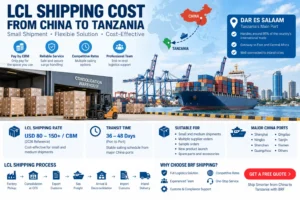
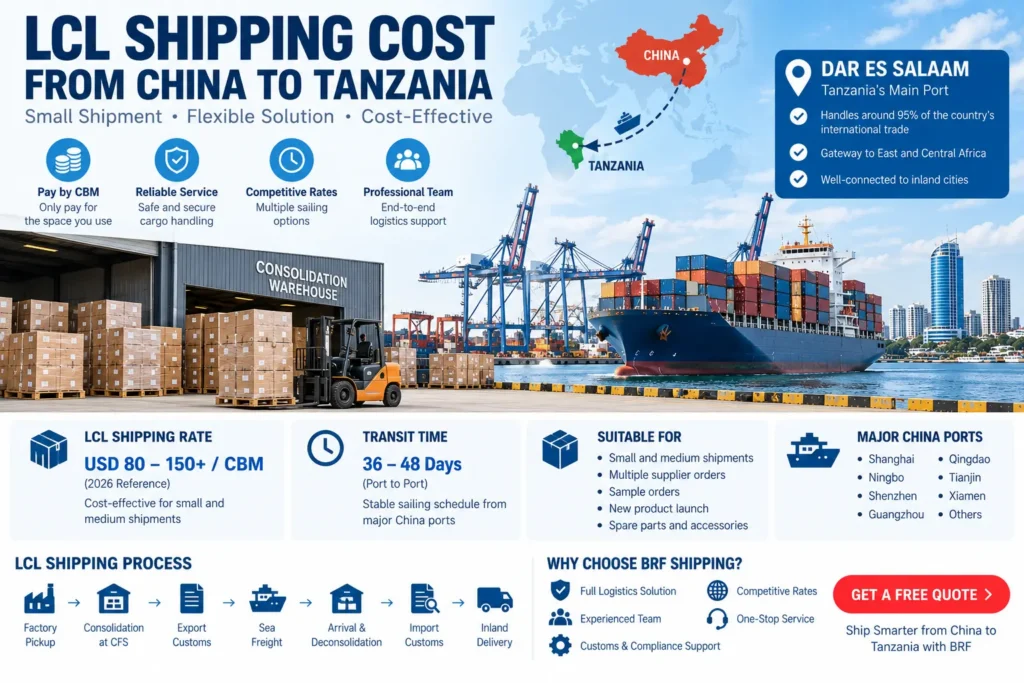
The LCL shipping cost from China to Tanzania generally ranges from approximately USD 80 to USD 150+ per CBM for the base ocean-freight portion in 2026, depending on the Chinese port of loading, cargo volume, cargo density, commodity, carrier, consolidation schedule and current market conditions.
A June 2026 market update quoted approximately USD 102 per CBM for LCL freight from China to Dar es Salaam, with a typical transit time of around 36–48 days. Other 2026 market references show broader ranges of approximately USD 80–180 per CBM, demonstrating why LCL pricing should be treated as an indicative benchmark rather than a fixed rate.
LCL — Less than Container Load — is often the most economical sea-freight option when an importer does not have enough cargo to fill a complete 20ft or 40ft container.
Instead of paying for an entire container, you share container space with other shipments and normally pay according to:
CBM — Cubic Meter
or
W/M — Weight or Measurement
For small and medium-sized commercial shipments, this can significantly reduce the initial transportation cost.
BRF SHIPPING can coordinate the complete China-side logistics process, including:
- Factory pickup
- Multi-supplier collection
- China warehouse receiving
- Cargo consolidation
- Export customs declaration
- LCL booking
- CFS handling
- Ocean freight
- Shipping documents
- Cargo tracking
- Dar es Salaam arrival coordination
- Optional inland delivery coordination
How Much Is LCL Shipping from China to Tanzania per CBM?
For general 2026 budgeting, importers can use:
USD 80–150+ per CBM
as a practical base-ocean-freight reference for many standard commercial LCL shipments from major Chinese ports to Dar es Salaam.
Published 2026 market references vary depending on month and port. Examples include approximately USD 70–150/CBM on several China–Dar es Salaam routes, while one June 2026 benchmark reported USD 102/CBM.
An indicative planning table might look like:
| Cargo Volume | Indicative Base LCL Freight | Best Use |
|---|---|---|
| 1 CBM | USD 80–150+ | Small commercial shipment |
| 3 CBM | USD 240–450+ | Samples / small inventory |
| 5 CBM | USD 400–750+ | Small wholesale shipment |
| 8 CBM | USD 640–1,200+ | Medium shipment |
| 10 CBM | USD 800–1,500+ | Compare LCL carefully |
| 12 CBM | USD 960–1,800+ | Compare with FCL |
| 15 CBM+ | Quote LCL + 20GP | FCL may become competitive |
These figures represent simplified freight calculations only.
They do not necessarily include:
- China factory pickup
- Export customs
- CFS receiving
- Documentation
- Destination CFS charges
- Tanzania customs clearance
- Import duty
- VAT
- PVoC-related costs
- Inland delivery
Therefore:
LCL rate per CBM is not the same as total landed shipping cost.
What Is LCL Shipping?
LCL means Less than Container Load.
Instead of booking an entire container, your cargo is consolidated with shipments from other importers.
For example:
Supplier A — 3 CBM
Supplier B — 5 CBM
Supplier C — 8 CBM
↓
China Consolidation Warehouse
↓
Shared Container
↓
Dar es Salaam
↓
Container Deconsolidation
↓
Individual Cargo Release
Each importer pays for the space occupied by their own cargo, subject to minimum charges and weight/measurement rules.
This makes LCL particularly attractive for:
- Small businesses
- First-time importers
- Trial orders
- New product launches
- Small wholesale shipments
- Replacement parts
- Project materials
- Multi-supplier orders
- Cargo that does not justify a full container
How Is LCL Freight Calculated?
LCL shipping is usually charged according to W/M — Weight or Measurement.
The freight forwarder compares:
Cargo Volume
Measured in:
CBM — Cubic Meters
and
Cargo Weight
Measured according to the applicable W/M calculation.
The chargeable quantity is based on whichever produces the higher freight basis under the tariff being used.
For many general sea-freight shipments:
1 CBM ≈ 1 metric ton for W/M pricing purposes
However, individual consolidation tariffs can vary, so the quotation should always specify the chargeable basis.
How to Calculate CBM for LCL Shipping
The formula is:
Length × Width × Height = CBM
If dimensions are measured in meters:
Example
One carton:
1.2 m × 0.8 m × 0.7 m
=
0.672 CBM
If you have 10 cartons:
0.672 × 10
=
6.72 CBM
The freight quotation will then use approximately:
6.72 CBM
subject to actual warehouse measurement.
Example: 5 CBM from China to Tanzania
Suppose you are importing:
Product
Aluminium Gate Accessories
Origin
Qingdao, China
Volume
5 CBM
Weight
1,200 kg
Destination
Dar es Salaam
If the base LCL ocean freight is:
USD 100 / CBM
then:
5 CBM × USD 100
=
USD 500 base ocean freight
However, this is not the total cost.
The complete logistics quotation may look more like:
China pickup
+
CFS receiving
+
Export customs
+
Documentation
+
LCL ocean freight
+
Dar es Salaam CFS handling
+
Customs clearance
+
Duty / tax
+
Delivery
This is why comparing only the USD/CBM rate can be misleading.
LCL Rates from Major China Ports to Dar es Salaam
Common Chinese LCL gateways include:
- Shanghai
- Ningbo
- Shenzhen
- Guangzhou
- Qingdao
- Tianjin
- Xiamen
A 2026 market reference listed approximate China–Dar es Salaam LCL ranges such as:
| China Port | Destination | Indicative LCL Rate |
|---|---|---|
| Shanghai | Dar es Salaam | USD 85–150 / CBM |
| Shenzhen | Dar es Salaam | USD 80–150 / CBM |
| Guangzhou | Dar es Salaam | USD 70–145 / CBM |
| Ningbo | Dar es Salaam | USD 80–145 / CBM |
| Qingdao | Dar es Salaam | USD 85–145 / CBM |
Actual quotations vary by shipment and sailing date.
Shanghai to Dar es Salaam LCL Shipping
Shanghai is one of the largest consolidation gateways in China.
It is suitable for cargo originating from:
- Shanghai
- Suzhou
- Kunshan
- Jiangsu
- Zhejiang
- Nearby East China manufacturing areas
Typical products include:
- Machinery parts
- Electronics
- Industrial equipment
- Commercial products
- Building materials
A 2026 reference for Shanghai–Dar es Salaam LCL freight was approximately:
USD 85–150 / CBM
depending on shipment and market conditions.
Ningbo to Dar es Salaam LCL Shipping
Ningbo is particularly useful for cargo from:
- Ningbo
- Yiwu
- Hangzhou
- Shaoxing
- Taizhou
- Zhejiang factories
Yiwu importers often use LCL because many orders consist of mixed commercial products purchased from several suppliers.
BRF can collect cargo from different suppliers and consolidate it before export.
Shenzhen and Guangzhou to Tanzania LCL Shipping
South China is one of the most important sourcing regions for Tanzanian importers.
Common products include:
- Furniture
- Electronics
- Lighting
- Building hardware
- Home products
- Machinery
- Auto parts
- Outdoor products
- Packaging
- Consumer goods
Cargo can move through:
Shenzhen / Yantian
or
Guangzhou / Nansha
depending on consolidation schedules and cargo origin.
Published 2026 benchmarks have placed many South China–Dar es Salaam LCL shipments around USD 70–150/CBM before origin and destination local charges.
Qingdao to Tanzania LCL Shipping
Qingdao is especially useful for suppliers located in Shandong.
Common origin cities include:
- Qingdao
- Weifang
- Linqu
- Yantai
- Dezhou
- Zibo
- Linyi
Typical cargo includes:
- Aluminium products
- Fencing
- Gates
- Machinery
- Fitness equipment
- Tires
- Auto parts
- Industrial products
- Building materials
A published 2026 benchmark for Qingdao–Dar es Salaam LCL shipping was approximately:
USD 85–145 / CBM.
Why Dar es Salaam Is the Main LCL Gateway
Most China-to-Tanzania LCL cargo is routed through Dar es Salaam Port.
Tanzania Ports Authority describes Dar es Salaam as Tanzania’s principal port and states that it handles approximately 95% of the country’s international trade. It also serves regional transit cargo moving to countries including Zambia, the Democratic Republic of Congo, Burundi, Rwanda, Malawi, Uganda and Zimbabwe.
For Tanzanian importers, Dar es Salaam therefore provides the most natural gateway for:
- LCL consolidation
- Container deconsolidation
- Customs clearance
- Domestic trucking
- Regional distribution
How Long Does LCL Shipping from China to Tanzania Take?
A practical 2026 planning range is:
Approximately 36–48 days
for many China-to-Dar es Salaam LCL shipments. A June 2026 market update also used 36–48 days as the LCL benchmark.
LCL normally takes longer than FCL because additional operations are required.
The process looks like:
Supplier pickup
↓
China warehouse
↓
CFS receiving
↓
Waiting for consolidation
↓
Container loading
↓
Export customs
↓
Ocean transport
↓
Dar es Salaam
↓
Container unloading
↓
CFS deconsolidation
↓
Customs clearance
↓
Cargo release
The actual time depends on:
- China origin
- Consolidation schedule
- Vessel departure
- Transshipment
- Port congestion
- Customs inspection
- CFS processing
- Final delivery location
Why Is LCL Slower Than FCL?
With an FCL shipment, one importer controls the entire container.
With LCL, several shipments must be combined before departure.
The consolidator needs time to:
- Receive cargo
- Check measurements
- Prepare documentation
- Combine shipments
- Load the container
After arrival, the reverse process happens.
The container must be:
- Discharged
- Moved to the CFS
- Opened
- Deconsolidated
- Cargo separated
- Documents matched
- Individual shipments released
This explains why LCL can take longer even when the vessel transit time is similar.
What Charges Are Included in LCL Shipping?
An LCL quotation normally contains more individual cost items than an FCL quotation.
Understanding them can prevent unexpected destination charges.
1. China Factory Pickup
If your supplier sells under EXW terms, the freight forwarder may collect cargo from the factory.
Pickup cost depends on:
- Supplier address
- Distance to CFS
- Cargo volume
- Weight
- Truck type
2. China CFS Receiving Charges
LCL cargo is normally delivered to a:
CFS — Container Freight Station
At the CFS, cargo may be:
- Received
- Measured
- Weighed
- Checked
- Labeled
- Stored temporarily
- Consolidated
CFS charges can be separate from the ocean freight.
3. Export Customs Declaration
Commercial cargo must normally complete China export customs procedures.
Typical documents include:
- Commercial Invoice
- Packing List
- Product description
- HS code
- Quantity
- Value
- Shipping information
BRF SHIPPING can coordinate the China export declaration process.
4. Documentation Charges
Possible documentation costs include:
- Bill of Lading
- House Bill of Lading
- Manifest
- Export documentation
- Consolidation documentation
5. Ocean Freight per CBM
This is the part commonly advertised as:
USD 80 / CBM
or
USD 102 / CBM
or
USD 120 / CBM
But this number alone does not represent the entire shipment.
6. Dar es Salaam CFS Charges
This is one of the most important LCL cost categories.
When the shared container arrives, cargo must be moved to the destination CFS and separated.
Possible charges can include:
- Deconsolidation
- Handling
- Documentation
- Warehouse
- Release fees
- Terminal-related charges
These costs can make a very cheap ocean-freight offer less attractive.
Always ask your freight forwarder:
What are the destination charges in Dar es Salaam?
7. Tanzania Customs Clearance
After deconsolidation, the shipment must complete applicable import customs procedures.
Typical documents may include:
- Commercial Invoice
- Packing List
- Bill of Lading
- HS code
- Certificate of Origin where required
- Product certificates
- Import permits where applicable
- PVoC / CoC where applicable
8. Inland Delivery
After customs release, BRF can coordinate or assist with inland-delivery planning according to the service scope.
Common destinations include:
- Dar es Salaam
- Dodoma
- Arusha
- Mwanza
- Morogoro
- Mbeya
Inland cost depends on:
- Cargo volume
- Weight
- Delivery city
- Truck type
- Unloading requirements
- Exact delivery address
LCL Door-to-Door Shipping from China to Tanzania
For importers who do not want to arrange separate trucking, customs and freight services, an LCL shipment can be structured around a broader door-delivery solution.
The logistics chain may look like:
Chinese Supplier
↓
BRF Pickup
↓
China Consolidation Warehouse
↓
Export Customs
↓
LCL Ocean Freight
↓
Dar es Salaam
↓
CFS Deconsolidation
↓
Customs Coordination
↓
Inland Delivery
↓
Customer Warehouse
The final price depends significantly on the delivery location.
For example:
Dar es Salaam delivery
will normally cost less than:
Mwanza delivery
because of the additional inland distance.
For a door-delivery quote, provide the exact destination address whenever possible.
Can BRF Consolidate Multiple Chinese Suppliers?
Yes.
Multi-supplier consolidation is one of the most useful applications of LCL shipping.
For example:
Supplier A
2.3 CBM Furniture Accessories
Supplier B
1.5 CBM Hardware
Supplier C
3.2 CBM Lighting Products
Supplier D
1.8 CBM Packaging Materials
Total:
8.8 CBM
Instead of shipping four separate consignments:
Supplier A
+
Supplier B
+
Supplier C
+
Supplier D
↓
BRF China Warehouse
↓
Consolidation
↓
One LCL Shipment
↓
Dar es Salaam
This can simplify shipping documents and reduce repeated logistics costs.
LCL vs. 20ft Container from China to Tanzania
One of the most important questions is:
At what volume should I stop using LCL and book a 20GP?
There is no fixed answer, but a useful guideline is:
| Cargo Volume | Recommended Comparison |
|---|---|
| 1–5 CBM | LCL usually makes sense |
| 5–10 CBM | LCL often remains competitive |
| 10–15 CBM | Compare LCL and FCL |
| 15–18 CBM | Strongly compare 20GP |
| 18+ CBM | FCL often becomes attractive |
Why?
Because LCL has destination handling charges calculated on each shipment.
As the CBM increases:
LCL Freight + CFS Charges + Handling
can eventually approach the cost of a complete 20GP.
At that point, FCL can provide:
- Lower unit cost
- Less handling
- Faster processing
- Reduced cargo-mixing risk
- Easier delivery
For the detailed FCL comparison, link this section to:
20ft Container Shipping Cost from China to Tanzania
LCL vs. 40ft Container
A 40GP or 40HQ generally only becomes relevant for much larger cargo volumes.
LCL should not compete directly with a 40HQ for a small shipment.
For example:
5 CBM
LCL
10 CBM
LCL / compare 20GP
20–25 CBM
Compare 20GP
35+ CBM
Compare FCL equipment carefully
50–70 CBM
40GP / 40HQ will usually make more sense
For large-volume cargo, use the dedicated page:
40ft Container Shipping Cost from China to Tanzania
LCL vs. Air Freight from China to Tanzania
LCL is much slower than air freight but can offer a substantially lower transport cost.
Use LCL for:
- Non-urgent cargo
- Commercial inventory
- Building materials
- Parts
- Furniture
- Hardware
- General products
Use air freight for:
- Urgent parts
- Electronics
- Samples
- High-value cargo
- Time-sensitive stock
A June 2026 market reference showed:
LCL: approximately USD 102/CBM
versus
Air Freight: approximately USD 9.61/kg.
The better option depends on both urgency and cargo density.
Tanzania PVoC Requirements for LCL Cargo
Importers should not assume that small LCL shipments are exempt from product-compliance requirements.
On June 4, 2026, Tanzania Bureau of Standards reminded importers of TBS-regulated goods from mainland China and several other origins that products subject to Pre-Shipment Verification of Conformity — PVoC must be inspected in the country of export before shipment to Tanzania.
Where applicable, the process may include:
Product review
↓
PVoC application
↓
Inspection in China
↓
Testing where required
↓
Compliance approval
↓
Certificate of Conformity
↓
Export shipment
Therefore, before delivering cargo into the LCL warehouse, confirm:
- Product name
- HS code
- PVoC status
- Applicable standard
- Testing requirement
- Certificate requirement
- Import permits
Because an LCL shipment shares container space with other cargo, documentation problems should be resolved before consolidation.
What Products Are Suitable for LCL Shipping?
Typical LCL cargo from China to Tanzania includes:
- Auto parts
- Machinery parts
- Hardware
- Aluminium products
- Small machinery
- Lighting
- Furniture accessories
- Home products
- Packaging materials
- Fitness equipment
- Building materials
- Electronics
- Tools
- Commercial samples
- Spare parts
- Industrial components
- Retail inventory
However, special cargo may require additional approval.
Examples include:
- Batteries
- Chemicals
- Liquids
- Dangerous goods
- Magnetized products
- Oversized cargo
Always provide an accurate product description before booking.
How to Reduce LCL Shipping Costs
1. Improve Packaging Efficiency
Since LCL is mainly CBM-based, inefficient packaging directly increases freight cost.
For example:
Original packaging:
10 CBM
After carton optimization:
8.5 CBM
If the freight is USD 100/CBM:
10 CBM = USD 1,000
8.5 CBM = USD 850
Potential base-freight reduction:
USD 150
And destination handling may also decrease.
2. Consolidate Multiple Suppliers
Do not pay separate minimum charges for several small shipments if consolidation is possible.
Collect goods first, then ship together.
3. Compare Different China Gateways
The cheapest LCL route may not always depart from the closest seaport.
Compare:
Pickup + CFS + Freight
as a complete China-origin cost.
4. Check Destination Charges
A USD 70/CBM quotation is not automatically cheaper than USD 100/CBM.
Example:
Forwarder A
Ocean freight: USD 70/CBM
High destination charges
Forwarder B
Ocean freight: USD 105/CBM
Lower destination charges
Forwarder B may provide the lower total cost.
5. Compare LCL Against 20GP
Once cargo reaches approximately 12–15 CBM, request both quotations.
Do not automatically continue using LCL.
6. Prepare Customs Documents Early
Missing documentation can create:
- Storage
- CFS fees
- Delays
- Inspection charges
Prepare customs documentation before arrival.
7. Check PVoC Before Shipping
For regulated products, completing conformity requirements in China can prevent costly problems at destination.
Example LCL Shipment from China to Dar es Salaam
Consider the following shipment:
Origin
Yiwu, Zhejiang
Cargo
Mixed Hardware Products
Packages
42 cartons
Volume
6.8 CBM
Weight
1,320 kg
Destination
Dar es Salaam
Logistics Process
Supplier pickup
↓
BRF warehouse receiving
↓
Measurement and weighing
↓
Export documentation
↓
LCL consolidation
↓
Ningbo / Shanghai departure
↓
Dar es Salaam
↓
Deconsolidation
↓
Customs clearance
↓
Cargo pickup / delivery
This is a typical shipment where LCL can provide a more economical solution than reserving an entire container.
Example Multi-Supplier LCL Shipment
A Tanzanian buyer purchases:
2 CBM from Guangzhou
3 CBM from Foshan
1.5 CBM from Dongguan
Total:
6.5 CBM
Instead of shipping each order separately, BRF can arrange:
Three suppliers
↓
China pickup
↓
Warehouse consolidation
↓
One export shipment
↓
LCL container
↓
Dar es Salaam
This approach is particularly useful for wholesalers and importers purchasing several product categories.
What Information Is Needed for an LCL Quote?
To calculate an accurate LCL shipping cost from China to Tanzania, provide:
1. China Pickup Address
Example:
Foshan, Guangdong
2. Product Name
Example:
Aluminium Gate Accessories
3. HS Code
If available.
4. Number of Packages
Example:
28 cartons
5. Package Dimensions
Example:
120 × 80 × 70 cm
6. Gross Weight
Example:
1,150 kg
7. Total CBM
Example:
5.8 CBM
8. Cargo-Ready Date
Example:
September 28, 2026
9. Tanzania Destination
Example:
Dar es Salaam
or exact final address.
10. Incoterm
EXW / FOB / CFR / CIF / DAP
With this information, BRF can calculate the appropriate LCL route and service scope.
Why Choose BRF SHIPPING for China–Tanzania LCL Freight?
BRF SHIPPING provides China-based freight-forwarding services for commercial cargo moving to Tanzania.
Services can include:
- Factory pickup
- Multi-supplier collection
- China warehouse service
- Cargo consolidation
- Repacking
- Measurement
- Export customs
- LCL booking
- CFS coordination
- Shipping documents
- Ocean freight
- Cargo tracking
- Dar es Salaam arrival coordination
- Destination-agent coordination
- Inland-delivery planning where available
For African destinations, customs clearance and final delivery should be confirmed according to the cargo and importer arrangement rather than assumed to be included automatically.
FAQ – LCL Shipping from China to Tanzania
How much is LCL shipping from China to Tanzania?
For 2026 budgeting, standard base LCL ocean freight is commonly around USD 80–150+ per CBM. One June 2026 benchmark reported approximately USD 102/CBM to Dar es Salaam. Actual rates depend on origin, cargo, month and consolidation schedule.
How long does LCL shipping from China to Tanzania take?
A typical planning range is approximately 36–48 days, including consolidation and deconsolidation time.
What is the minimum LCL shipment size?
Many consolidators apply a minimum chargeable volume, often around 1 CBM, although individual tariffs vary.
What does CBM mean?
CBM means cubic meter and represents cargo volume.
The formula is:
Length × Width × Height = CBM
when dimensions are measured in meters.
What is the main LCL port in Tanzania?
Dar es Salaam is the main gateway. Tanzania Ports Authority states that it handles approximately 95% of Tanzania’s international trade.
Can BRF collect cargo from several Chinese suppliers?
Yes. BRF can collect goods from multiple suppliers, consolidate them in a China warehouse and arrange one LCL shipment.
Is LCL cheaper than a 20ft container?
For small shipments, usually yes. Once volume approaches approximately 12–15 CBM or more, importers should compare LCL against a 20GP.
Are destination charges included in the LCL rate per CBM?
Not necessarily. CFS handling, deconsolidation, customs, tax and delivery may be separate. Always compare total costs rather than only the advertised ocean-freight rate.
Does Tanzania require PVoC for LCL shipments?
Cargo size does not determine PVoC requirements. Some TBS-regulated products must complete PVoC inspection in the exporting country before shipment. TBS specifically reminded importers of this requirement for regulated goods from mainland China in June 2026.
Can LCL cargo be delivered to Arusha or Dodoma?
Yes, inland-delivery coordination can be arranged after customs release depending on the cargo and exact destination. Inland transportation is quoted separately.
Can I ship 10 CBM as LCL?
Yes. However, at around 10 CBM and above, it becomes increasingly useful to compare LCL with a dedicated 20ft container.
Get an LCL Shipping Quote from China to Tanzania
If your shipment is too small for a full container, LCL shipping from China to Tanzania can provide a flexible and economical sea-freight solution.
BRF SHIPPING can arrange cargo from:
- Qingdao
- Shanghai
- Ningbo
- Yiwu
- Shenzhen
- Guangzhou
- Foshan
- Tianjin
- Xiamen
- Other major China manufacturing regions
to Dar es Salaam, with inland-delivery coordination available according to the shipment.
For an accurate quotation, send:
China Pickup Address + Product + HS Code + Package Dimensions + Gross Weight + Total CBM + Cargo-Ready Date + Tanzania Destination
BRF can then compare the appropriate consolidation route and shipping schedule.
BRF SHIPPING — Your Reliable LCL Freight Forwarder from China to Tanzania.