Shipping goods from China to the United States involves much more than booking ocean freight or air freight.
For B2B importers, manufacturers, distributors and e-commerce businesses, U.S. Customs and Border Protection compliance can directly affect cargo release, delivery schedules and total landed cost.
One customs status that has attracted increasing attention among China-to-USA shippers is the CBP 5H hold, commonly referred to in the logistics industry as a 5H inspection.
A 5H status does not automatically mean that your cargo has been seized. Instead, it indicates that CBP has stopped entry processing because the shipment has been selected for a document discrepancy review.
According to CBP’s official disposition codes, 5H means “Entry Processing Hold.” It is generated when an entry has been targeted for a document discrepancy examination and release is temporarily denied. When the issue has been resolved, 5I means “Entry Processing Hold Removed.”
For companies regularly shipping from China to the USA, understanding this process before cargo departs China can significantly reduce avoidable customs problems.
At BRF SHIPPING, customs compliance should be treated as part of transportation planning—not something considered only after the container arrives at a U.S. port.
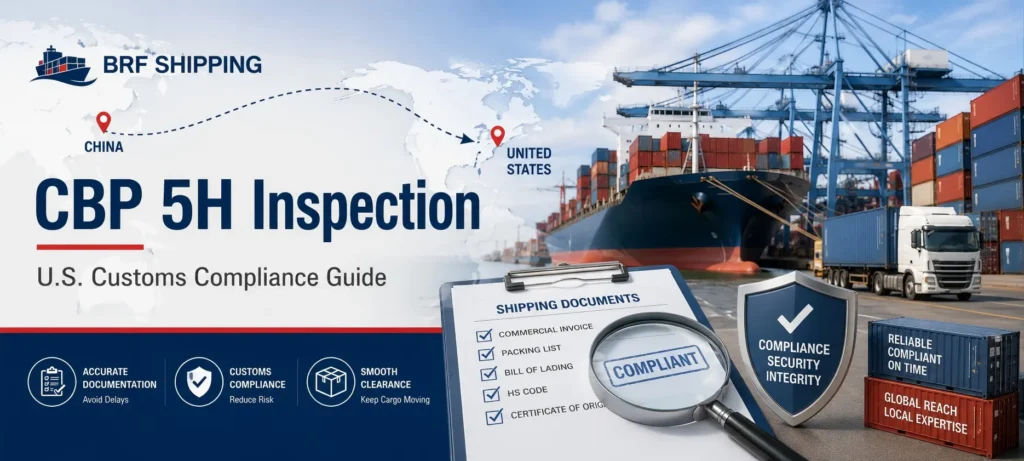
What Is a CBP 5H Inspection?
Although many freight forwarders and importers call it a “5H inspection,” the official CBP description is a 5H Entry Processing Hold.
The status indicates that CBP has identified a potential documentation discrepancy requiring further review before the cargo can be released.
This distinction is important.
A 5H hold does not necessarily mean officers have opened the container or physically inspected the cargo. The first issue may simply involve information provided in customs entry documents.
CBP’s disposition-code documentation specifically states that a 5H status means the previous entry posting has been targeted for a document discrepancy exam, the entry status changes to “HELD,” and cargo release is denied until the issue is resolved.
Therefore:
5H = Entry Processing Hold
5I = Entry Processing Hold Removed
This is different from certain other CBP examination, enforcement or seizure codes.
For an importer, however, the practical consequence is clear: the shipment cannot continue normal delivery until CBP releases the hold.
Why Is a 5H Customs Hold Important for B2B Importers?
For a small parcel, several additional days at customs may be inconvenient.
For commercial B2B cargo, the consequences can be considerably greater.
A delayed 40HQ container may affect production schedules, warehouse appointments, project installations, retailer inventory, Amazon replenishment or customer delivery commitments.
Additional costs can also accumulate while the cargo is waiting for customs resolution, including possible terminal storage, demurrage, detention, examination handling, warehouse transfers and additional customs broker services.
This is why companies importing regularly from China should not think only about obtaining the lowest ocean freight rate.
Customs compliance and accurate documentation are equally important components of the total logistics cost.
What Can Trigger a CBP 5H Hold?
There is no public checklist stating that one particular mistake will always generate a 5H status.
CBP uses selectivity and risk-management processes when reviewing entries.
However, because a 5H status is specifically associated with a document discrepancy examination, importers should pay particular attention to consistency across their commercial and customs documentation.
1. Inconsistent Commercial Invoice Information
The commercial invoice is one of the most important documents in international trade.
Problems may arise when information on the invoice does not match the packing list, bill of lading, customs entry or actual cargo.
For example, the invoice might declare 1,000 aluminum fence panels while the packing list shows 1,120 pieces.
The invoice might identify the product as “aluminum accessories,” while the customs declaration describes it as “aluminum fencing.”
The gross weight appearing on the packing list may also differ significantly from transportation documents.
Small clerical differences can sometimes be explained, but repeated inconsistencies create unnecessary customs risk.
Avoid Vague Cargo Descriptions
One of the simplest ways to improve customs documentation is to describe cargo accurately.
Descriptions such as:
“parts”
“accessories”
“samples”
“equipment”
“hardware”
“electronic products”
are often too general to properly identify commercial merchandise.
CBP recommends that importers be able to provide a complete description of the merchandise, including information such as its composition, intended use, country of origin, manufacturer and pricing information. CBP also directs importers to the Harmonized Tariff Schedule when determining classification.
Instead of:
Aluminum Products
a more useful description might be:
Powder-Coated Aluminum Residential Fence Panels
Instead of:
Machine Parts
consider:
Stainless Steel Replacement Gear Components for Industrial Packaging Machinery
The description should accurately reflect the actual product.
Incorrect HS Code or HTS Classification
Tariff classification is another major area of U.S. customs compliance.
Products imported into the United States are classified under the Harmonized Tariff Schedule of the United States (HTSUS).
The classification can determine not only the basic duty rate but also whether additional tariffs, quotas, antidumping duties or Partner Government Agency requirements may apply.
CBP places responsibility on importers to exercise reasonable care when entering, classifying and valuing imported merchandise.
Importers should therefore avoid choosing an HS code simply because it produces a lower duty rate.
If classification is genuinely uncertain, CBP operates a Binding Ruling Program, which allows importers and other interested parties to request a binding pre-entry classification decision.
For frequently imported products, confirming classification before establishing a long-term supply chain can prevent repeated customs problems.
Customs Valuation Must Reflect the Commercial Transaction
Another important compliance issue is customs valuation.
The commercial value declared to CBP should be supported by the transaction and relevant documents.
Artificially reducing invoice values simply to lower import duties creates substantial customs risk.
Businesses should maintain documents supporting the declared value, including purchase contracts, commercial invoices, payment records and related transaction information where applicable.
This is particularly important for related-party transactions, assists, royalties, tooling charges or other situations where customs valuation may be more complicated than simply using the amount printed on one invoice.
The cheapest customs-clearance solution is not always the safest solution.
For long-term importers, accurate valuation is more valuable than short-term duty savings created through aggressive declarations.
Importer of Record Information Must Be Correct
A U.S. commercial import normally requires a clearly identified party responsible for customs entry.
This party is commonly known as the Importer of Record (IOR).
The Importer of Record has important customs responsibilities and should understand the products being imported, their classification, declared value and applicable compliance requirements.
For commercial consumption entries, CBP notes that many formal commercial entries require an Entry Summary and a customs bond.
Problems may occur when shipments use incorrect importer information, outdated company information or arrangements where the consignee does not fully understand that it is acting as importer.
Before shipping from China, BRF SHIPPING recommends confirming the customs-clearance structure with the U.S. importer and licensed customs broker.
Country of Origin Should Be Declared and Marked Correctly
Country-of-origin compliance is another issue importers should not overlook.
Goods imported into the United States generally need to comply with U.S. country-of-origin marking requirements unless a specific exception applies.
CBP explains that merchandise imported for use in the United States generally needs country-of-origin labeling and may also be subject to product-specific requirements from other government agencies.
For goods manufactured in China, marking such as “Made in China” may therefore be required depending on the product and circumstances.
Importers should check country-of-origin requirements before production and packaging are completed.
Correcting labels after a container has reached the United States can be considerably more expensive than handling the issue at the factory.
Do Not Ignore Other U.S. Government Agencies
CBP is not the only authority involved in U.S. imports.
Depending on the commodity, additional regulations may involve agencies such as the FDA, EPA, DOT, FCC, USDA or CPSC.
Examples can include food, cosmetics, medical devices, children’s products, vehicles, engines, radio-frequency equipment, chemicals, plants and wood products.
CBP specifically advises importers to determine whether additional forms or requirements from agencies such as FDA, EPA or DOT apply to the merchandise.
Therefore, having a valid HS code and commercial invoice does not automatically mean a product is ready for U.S. import.
Product compliance should be reviewed before the cargo leaves China.
ISF Compliance for Ocean Freight from China to the USA
For ocean freight, another critical step is the Importer Security Filing, commonly known as ISF or 10+2.
For U.S.-bound ocean cargo, CBP requires specified ISF information to be transmitted before loading.
CBP states that the filing is generally required no later than 24 hours before cargo is loaded aboard the vessel destined for the United States. Inaccurate, incomplete or late filings may result in enforcement consequences, including potential liquidated damages.
Typical information includes the seller, buyer, Importer of Record number, consignee number, manufacturer or supplier, ship-to party, country of origin and HTS information.
Not every ISF error automatically results in a 5H status because CBP uses multiple hold and enforcement mechanisms.
Nevertheless, accurate ISF data forms an important part of a compliant China-to-USA ocean freight shipment.
This is why shippers should provide complete cargo and consignee information to their freight forwarder and customs broker well before vessel cutoff.
What Happens After a Shipment Receives a 5H Status?
When a 5H hold appears, the first priority is to determine exactly what information CBP or the customs broker requires.
Because CBP defines 5H as a document discrepancy hold, the relevant records should be reviewed carefully.
The broker may need to review or provide supporting documents such as the commercial invoice, packing list, bill of lading or air waybill, purchase order, proof of payment, product description, HTS classification information, country-of-origin information or importer details.
If the documentation issue is resolved and CBP removes the hold, the corresponding status may change to 5I — Entry Processing Hold Removed.
Importantly, a customs broker cannot simply “cancel” a CBP hold.
The broker can communicate with CBP, provide information and correct eligible entry data, but CBP ultimately determines whether the shipment is released.
There is also no reliable universal promise such as “5H will always be cleared in three days.”
The actual processing time depends on the shipment, the issue identified, CBP review and whether additional examination or documentation is required.
5H Hold vs. Customs Seizure
A 5H hold should not automatically be described as a seizure.
CBP’s own disposition codes distinguish the two statuses.
5H represents an Entry Processing Hold associated with a document discrepancy examination.
CBP’s published codes separately identify seizure statuses such as 1T — Seized by CBP.
That means receiving a 5H status does not by itself mean the goods have been confiscated.
However, importers should still respond seriously and promptly because further problems discovered during review can potentially create additional enforcement actions.
How to Reduce 5H and U.S. Customs Clearance Risks
The best time to solve customs problems is before the container leaves China.
BRF SHIPPING recommends treating documentation review as part of the booking process rather than waiting until cargo arrives in Los Angeles, Long Beach, New York, Savannah, Houston, Seattle or another U.S. destination.
A practical pre-shipment compliance check can be organized as follows:
| Compliance Item | What to Verify |
|---|---|
| Commercial Invoice | Seller, buyer, product description, quantity, unit price, total value and currency |
| Packing List | Packages, quantity, net weight, gross weight and dimensions |
| HTS Classification | Correct product classification based on actual merchandise |
| Country of Origin | Correct origin declaration and required marking |
| Importer Information | Valid consignee and Importer of Record details |
| Customs Bond | Appropriate bond arrangement where required |
| ISF | Accurate and timely filing for applicable ocean shipments |
| Product Compliance | FDA, EPA, CPSC, DOT, FCC, USDA or other requirements where applicable |
| Shipping Documents | Consistent information across B/L, invoice, packing list and customs entry |
| Supporting Records | Purchase order, payment record, product specifications and certifications if needed |
The objective is not to find ways around customs controls.
The objective is to make the transaction transparent, consistent and easy to verify.
BRF SHIPPING’s China-to-USA Customs Compliance Process
For businesses importing goods from China, transportation and customs clearance should be planned together.
BRF SHIPPING can coordinate the international shipping process from the supplier in China through U.S. arrival and final delivery.
A typical shipment may involve factory pickup in China, export documentation, container loading, ocean or air freight booking, U.S. customs broker coordination, customs clearance and final truck delivery.
Before departure, cargo information can be reviewed so major inconsistencies are identified early.
This is especially useful for first-time importers or businesses shipping products that require additional regulatory documents.
Common China origin ports include:
Shanghai
Ningbo
Qingdao
Tianjin
Shenzhen
Guangzhou
Xiamen
Major U.S. destinations may include Los Angeles/Long Beach, Oakland, Seattle, Houston, Savannah, Charleston, New York/New Jersey and other inland destinations reached through intermodal rail or trucking.
BRF SHIPPING can help coordinate both FCL and LCL ocean freight, as well as air freight for urgent shipments.
Ocean Freight vs. Air Freight: Does 5H Apply to Both?
CBP maintains customs-processing and cargo-status systems across different transportation modes.
The 5H terminology appears within CBP manifest disposition-code documentation, including both ocean/rail and air-import materials.
Therefore, documentation accuracy matters regardless of whether goods arrive by container vessel or aircraft.
However, the operational requirements are not identical.
For example, ISF 10+2 is particularly associated with U.S.-bound ocean cargo, while air shipments follow different advance cargo reporting processes.
Importers should therefore build compliance procedures around the transportation mode being used rather than assuming one customs checklist applies identically to every shipment.
Documentation Consistency Matters More Than Ever
Many customs problems begin with something surprisingly simple.
The supplier prepares one invoice.
The freight forwarder receives another description.
The consignee provides a different company name.
The customs broker receives an outdated packing list.
The HS code used in previous shipments is copied without checking whether it correctly applies to the current product.
Each party may believe its own information is correct.
But CBP evaluates the shipment as a complete transaction.
If the documents tell different stories, the customs risk increases.
A reliable international shipping process therefore requires one accurate set of data shared across the supplier, freight forwarder, importer and customs broker.
Frequently Asked Questions About CBP 5H Inspection
What does 5H mean in U.S. customs?
5H means Entry Processing Hold. CBP states that the code is generated when an entry has been selected for a document discrepancy examination and cargo release is denied while the entry is held.
What does 5I mean?
5I means Entry Processing Hold Removed. It indicates that the 5H processing hold has been removed and the bill status returns to the applicable previous status.
Is a 5H hold the same as a physical customs inspection?
Not necessarily.
A 5H status specifically relates to entry processing and a document discrepancy examination. CBP may separately require other types of examinations depending on the circumstances.
Does 5H mean my cargo has been seized?
No.
A 5H hold is not automatically a seizure. CBP uses separate disposition codes for seized cargo.
How long does a 5H customs hold take?
There is no guaranteed standard processing time.
Some cases may be resolved after documentation is reviewed, while more complicated shipments may require additional information or examination.
Importers should avoid freight providers that guarantee a specific customs-release time after CBP has issued a hold.
Can a freight forwarder remove a 5H hold?
No freight forwarder or customs broker can independently remove a CBP hold.
They can help identify the problem, prepare supporting documents, correct eligible data and communicate with the relevant parties, but CBP decides when the hold is removed.
How can importers reduce the risk?
The most effective approach is accurate pre-shipment preparation.
The commercial invoice, packing list, HTS code, declared value, consignee information, Importer of Record information, country of origin and transportation documents should all be checked for consistency.
Product-specific U.S. regulatory requirements should also be reviewed before shipment.
Do I need a customs broker when importing from China?
Many commercial importers use a licensed U.S. customs broker because commercial entries can involve tariff classification, customs bonds, government-agency requirements and entry filings.
However, using a customs broker does not transfer all compliance responsibility away from the importer.
CBP emphasizes the importer’s responsibility to exercise reasonable care in customs declarations.
Shipping from China to USA with BRF SHIPPING
Successful China-to-USA shipping is not simply about moving a container from one port to another.
A reliable international freight solution should connect:
China pickup → export handling → ocean or air freight → U.S. customs clearance → final delivery
while ensuring that cargo and customs documentation remain consistent throughout the process.
BRF SHIPPING works with importers, distributors and businesses shipping commercial cargo from China to the United States and can coordinate freight arrangements based on cargo type, shipment volume, destination and delivery requirements.
Whether you are shipping:
industrial equipment,
building materials,
aluminum products,
furniture,
machinery parts,
consumer products,
textiles,
packaging products,
or other B2B cargo,
customs preparation should begin before the shipment departs China.
Need Help Shipping from China to the USA?
If you are planning a shipment from China to the United States and are concerned about CBP 5H inspections, U.S. customs clearance, HS codes, customs documentation, ocean freight or door delivery, contact BRF SHIPPING before your cargo is dispatched.
Send us:
cargo description,
pickup city in China,
destination ZIP code in the USA,
number of cartons or pallets,
total weight,
cargo dimensions or CBM,
commercial value,
and preferred shipping method.
Our team can help evaluate the transportation requirements and coordinate a more efficient China-to-USA freight solution.
BRF SHIPPING — China to USA Freight, Customs Coordination & Door Delivery
Compliance note: Customs and regulatory requirements depend on the specific merchandise and transaction. Importers should consult a licensed customs broker, qualified trade professional or the relevant U.S. government agency for commodity-specific compliance advice.