For importers moving furniture, building materials, machinery, aluminum products, consumer goods, solar equipment or other high-volume cargo, a 40ft container from China to Nigeria is often one of the most cost-effective shipping solutions.
Both 40GP and 40HQ containers provide substantially more loading space than a 20ft container, which can reduce the shipping cost per cubic meter when cargo volume is high enough.
In September 2026, public market references show that the 40ft container shipping cost from China to Nigeria can vary significantly according to the Chinese origin port, Nigerian destination, shipping line, equipment type, fuel surcharges and routing.
Current published examples include approximately:
- Ningbo → Apapa: USD 4,680–6,150 per 40ft container
- Shanghai → Tin Can Island: USD 4,980–6,500
- Guangzhou → Onne: USD 4,820–6,300
- Qingdao → Lagos: USD 5,100–6,700
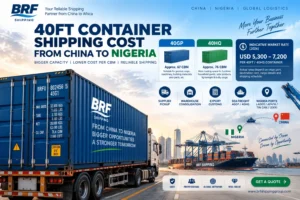
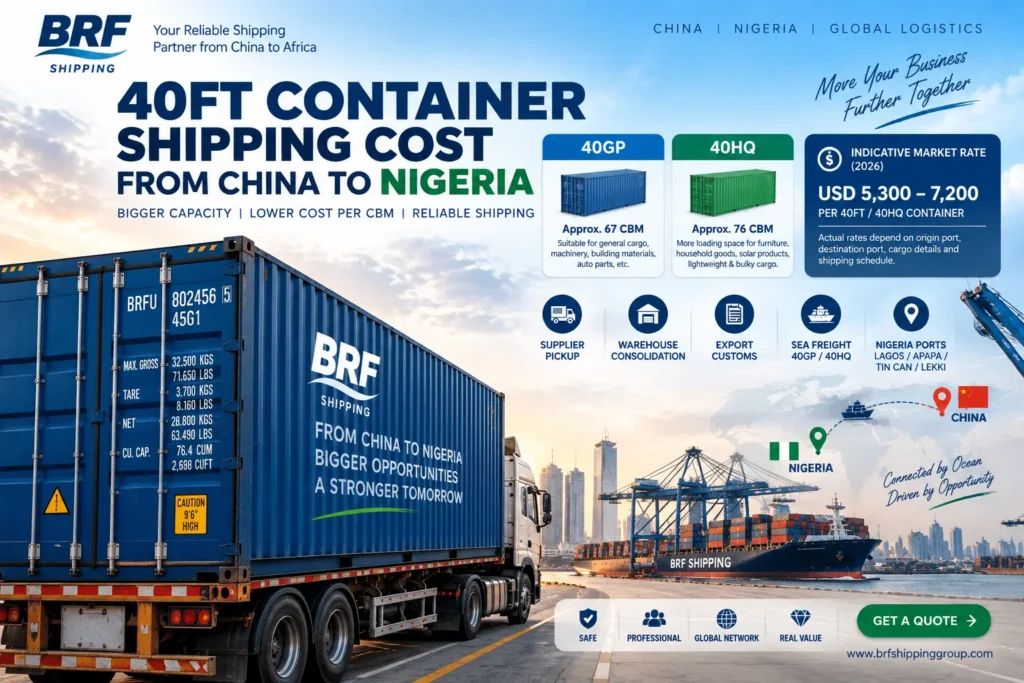
A broader August–September 2026 market reference places China-to-Nigeria 40ft / 40HQ container freight at approximately USD 5,300–7,200 per container. These figures are market references only and are not guaranteed BRF SHIPPING rates. Actual pricing must be confirmed according to the specific shipment and booking date.
BRF SHIPPING can coordinate the China side of your shipment, including supplier pickup, warehouse consolidation, container loading, China export customs declaration, FCL booking and ocean freight to Nigeria.
How Much Does a 40ft Container from China to Nigeria Cost?
For general planning, importers can use the following broad 2026 reference range:
| Route | Indicative 40ft / 40HQ Market Reference |
|---|---|
| Ningbo → Apapa | USD 4,680–6,150 |
| Shanghai → Tin Can Island | USD 4,980–6,500 |
| Guangzhou → Onne | USD 4,820–6,300 |
| Qingdao → Lagos | USD 5,100–6,700 |
| General China → Nigeria planning range | Around USD 5,300–7,200 |
These numbers should not be treated as fixed quotations.
A shipping rate can change because of:
- China origin port
- Nigerian destination port
- Shipping line
- 40GP or 40HQ equipment
- Equipment availability
- Vessel space
- Fuel surcharge
- Port congestion
- Transshipment routing
- Cargo commodity
- Gross cargo weight
- Booking week
- Rate validity
A meaningful quotation should therefore be based on:
Supplier Location + Cargo Details + Container Type + Nigeria Port + Cargo-Ready Date
rather than a generic “China to Nigeria” rate.
40GP vs 40HQ: What Is the Difference?
Importers often use “40ft container” as a general term, but there are two common container types:
40GP Container
A 40GP is a standard-height 40ft general-purpose container.
Typical internal volume is approximately 67 CBM, although actual usable loading volume depends on carton dimensions, pallets and cargo shape.
A 40GP can be suitable for:
- Machinery
- Industrial products
- Building materials
- Packaged commercial goods
- Automotive parts
- Metal products
40HQ Container
A 40HQ, or 40ft High Cube, provides additional internal height.
Typical internal volume is approximately 76 CBM.
This additional space can make a significant difference for bulky but relatively lightweight products.
Common examples include:
- Furniture
- Aluminum fencing
- Gates
- Plastic products
- Household goods
- Packaging materials
- Building panels
- Retail inventory
- Light industrial products
For many China export shipments, a 40HQ is more popular than a 40GP because the ocean freight difference can be relatively small compared with the extra loading volume.
However, the correct choice depends on your actual cargo dimensions and weight.
How Much Cargo Fits in a 40HQ?
The theoretical capacity of a 40HQ is around 76 cubic meters.
In real commercial loading, however, you usually cannot use every cubic meter.
Usable capacity depends on:
- Carton dimensions
- Pallet size
- Product shape
- Packaging
- Loading pattern
- Weight distribution
- Forklift access
- Empty spaces between cargo
For carton cargo, actual loaded volume may be lower than theoretical container capacity.
For example, a shipment with:
68 CBM of regularly packed cartons
may fit efficiently inside a 40HQ.
But:
68 CBM of irregular machinery
may not fit because the equipment dimensions prevent efficient stacking.
BRF SHIPPING can review packing details before container booking and help determine whether a 40GP or 40HQ is appropriate.
China to Lagos 40ft Container Shipping Cost
Lagos is one of the most important gateways for containerized imports into Nigeria.
The Nigerian Ports Authority identifies Lagos Port Complex, Tin Can Island Port Complex and Lekki Deep Sea Port among Nigeria’s major commercial ports.
For China-origin containers, the Nigerian destination may therefore be:
- Lagos Port Complex — Apapa
- Tin Can Island
- Lekki Deep Sea Port
The freight rate can differ by destination terminal and shipping line.
When requesting a quotation, use a specific route such as:
Shanghai → Apapa 40HQ
instead of simply:
China → Nigeria 40ft container
This allows the freight forwarder to compare the correct carrier services.
40ft Container to Apapa Port
Lagos Port Complex at Apapa is one of Nigeria’s main container gateways.
The Nigerian Ports Authority describes Lagos Port Complex as Nigeria’s earliest and largest port and confirms that it includes dedicated container-terminal operations.
A China-to-Apapa quotation may include:
China Origin Trucking
Container Loading
Export Customs
China Port Charges
Ocean Freight
The Nigerian destination charges should be reviewed separately unless specifically included.
40ft Container to Tin Can Island
Tin Can Island is another important Lagos container destination.
The Nigerian Ports Authority lists multiple Tin Can terminals handling container and general cargo operations.
Current public references show Shanghai-to-Tin Can 40ft container rates around USD 4,980–6,500 for selected 2026 market conditions.
Actual rates can change according to the carrier and sailing week.
40ft Container to Lekki Deep Sea Port
Lekki Deep Sea Port provides another option for Lagos-region imports.
The Nigerian Ports Authority describes Lekki as a major deep-sea port development intended to expand Nigeria’s regional and container-handling capacity.
Whether Lekki is the best choice depends on:
- Carrier service
- Cargo type
- Container availability
- Final delivery location
- Inland trucking plan
- Destination costs
Importers should compare the total logistics cost instead of selecting a port based only on the ocean freight rate.
40ft Container from Ningbo to Nigeria
Ningbo is one of the most important export ports for Zhejiang cargo.
Typical supplier locations include:
- Ningbo
- Yiwu
- Hangzhou
- Shaoxing
- Taizhou
- Jinhua
- Wenzhou
Current public 2026 references place a 40ft container from Ningbo to Apapa at approximately USD 4,680–6,150.
Typical cargo includes:
- Furniture
- Hardware
- Household goods
- Auto parts
- Plastic products
- Machinery
- Building materials
- Electrical products
For several Zhejiang suppliers, cargo can also be consolidated before container loading.
40ft Container from Shanghai to Nigeria
Shanghai is an important export gateway for East China.
It serves suppliers in regions such as:
- Shanghai
- Suzhou
- Kunshan
- Wuxi
- Changzhou
- Parts of Jiangsu
A typical shipment can follow:
Supplier
→ Factory Pickup
→ Shanghai Warehouse or Direct Container Loading
→ China Export Customs
→ Shanghai Port
→ Nigeria
Current public 2026 market references place selected Shanghai → Tin Can Island 40ft rates at approximately USD 4,980–6,500.
The total EXW cost will also depend on supplier pickup and origin handling.
40ft Container from Qingdao to Nigeria
Qingdao is particularly suitable for cargo produced in Shandong.
BRF SHIPPING’s Qingdao warehouse coverage can support shipments from:
- Qingdao
- Weifang
- Linyi
- Zibo
- Jinan
- Yantai
- Other Shandong manufacturing areas
BRF’s warehouse operation can receive cargo, consolidate multiple suppliers, remeasure packages and load FCL containers before export.
Typical products include:
- Aluminum fencing
- Gates
- Steel products
- Machinery
- Scaffolding
- Construction materials
- Industrial equipment
- Tyres
- Packaging products
Current public market references place selected Qingdao → Lagos 40ft container rates around USD 5,100–6,700.
For Shandong cargo, using Qingdao may also reduce China inland trucking compared with moving the container to Shanghai or Ningbo.
40ft Container from Shenzhen or Guangzhou to Nigeria
South China is another major sourcing area for Nigerian importers.
Common supplier cities include:
- Shenzhen
- Guangzhou
- Foshan
- Dongguan
- Huizhou
- Zhongshan
Export gateways may include:
- Yantian
- Shekou
- Nansha
Common cargo includes:
- Furniture
- Electronics
- Lighting
- Machinery
- Hardware
- Aluminum products
- Household products
- Retail goods
Current public references place selected Guangzhou → Onne 40ft container rates around USD 4,820–6,300.
The best China port should be selected according to the supplier’s location and total logistics cost.
Factory Pickup for a 40ft Container
When the supplier sells under EXW terms, the ocean freight quotation is only part of the total cost.
A 40ft shipment may require:
- Empty container release
- Container trucking
- Factory loading
- Driver waiting time
- Highway tolls
- Export terminal delivery
- VGM
- Customs declaration
- Shipping documentation
The supplier’s exact address is therefore important.
For example:
Foshan Factory → Nansha Port
may have a very different China inland cost from:
Foshan Factory → Yantian Port
even if both routes eventually ship to Lagos.
Multi-Supplier Consolidation into One 40HQ
A 40HQ is particularly useful when an importer buys products from several Chinese factories.
For example:
Supplier A — 12 CBM
Supplier B — 15 CBM
Supplier C — 18 CBM
Supplier D — 14 CBM
Supplier E — 8 CBM
Total:
67 CBM
Instead of shipping five separate LCL consignments, the cargo could potentially be consolidated into one 40HQ if dimensions and weight permit.
BRF SHIPPING’s China warehouse service supports:
- Cargo receiving
- Short-term storage
- Multi-supplier consolidation
- Relabeling
- Repacking
- Palletizing
- Measurements
- FCL loading
BRF SHIPPING specifically supports warehouse-based 20GP, 40GP and 40HQ loading near major Chinese export gateways.
Direct Factory Loading vs Warehouse Loading
There are two common ways to load a 40ft container.
Direct Factory Loading
The empty container is delivered directly to the supplier.
The factory loads the goods.
This is efficient when:
- One supplier provides most of the cargo
- All products are ready
- The factory has sufficient loading space
- Export packaging is complete
After loading, the container is sealed and delivered to the export port.
Warehouse Consolidation
Cargo from several suppliers can first be delivered to a warehouse.
This is useful when:
- Suppliers have different production schedules
- Package quantities need checking
- Products need relabeling
- Cargo needs repacking
- Loading needs supervision
- Several factories must share one 40HQ
Warehouse consolidation can make the shipment easier to control before export.
40ft Container vs 20ft Container
Choosing between a 20GP and 40HQ should not be based only on freight price.
A 40HQ may cost considerably more per container, but its cost per cubic meter can be lower.
For example:
If a 20GP holds around 28 CBM of your actual cargo and a 40HQ holds around 68 CBM, two separate 20GP containers may cost significantly more than one 40HQ.
However, cargo weight also matters.
A 40HQ filled with dense metal products can exceed allowable payload before the container reaches full cubic capacity.
For very heavy goods, a 20GP may still be the better choice.
40HQ vs LCL Shipping
For smaller cargo, LCL is normally the better option.
But once cargo volume becomes large, importers should compare:
Total LCL Cost
against
One 40GP or 40HQ
LCL involves additional:
- CFS receiving
- Consolidation
- Handling
- Destination deconsolidation
- Release charges
Current public Nigeria freight references suggest FCL becomes increasingly attractive as cargo moves toward larger commercial volumes.
For cargo above approximately 25–30 CBM, it is normally worth comparing a full-container quotation.
The exact break-even point changes with current rates.
China Export Customs for a 40ft Container
Before the container can leave China, commercial cargo must complete export procedures.
BRF SHIPPING can coordinate export declaration together with pickup, warehouse handling and sea freight.
Its current export-customs service includes document review, declaration-data coordination, HS-code information support, inspection follow-up when required and connection with the vessel booking and cutoff schedule.
Typical information includes:
- Commercial invoice
- Packing list
- Product description
- Quantity
- Value
- Gross and net weight
- HS classification information
- Exporter details
- Consignee details
The information should be prepared before the customs and terminal cutoff.
What Affects the 40ft Container Shipping Cost?
Origin Port
Ningbo, Shanghai, Qingdao, Shenzhen, Guangzhou and Tianjin can have different rates.
Nigeria Port
Apapa, Tin Can, Lekki and Onne may have different carrier services.
Shipping Line
Carriers can differ in:
- Freight price
- Equipment availability
- Transit schedule
- Transshipment port
- Free time
- Destination conditions
40GP vs 40HQ
Rates are often similar, but equipment availability can change the difference.
Cargo Weight
Heavy containers may require additional review or trucking arrangements.
Commodity
Dangerous goods and certain regulated commodities can attract surcharges.
Peak Season
Container demand can change rates quickly.
Fuel Surcharges
Fuel-related carrier surcharges can materially affect container pricing.
Sailing Date
A rate valid for one sailing may not apply to the next sailing.
Nigeria Destination Charges
The ocean freight rate is not the same as the final landed cost.
Possible Nigeria-side expenses can include:
- Terminal handling
- Delivery order
- Customs brokerage
- Customs duty
- Taxes and levies
- Inspection
- Storage
- Demurrage
- Detention
- Inland trucking
- Empty-container return
These charges vary by shipment.
For BRF SHIPPING’s Nigeria route, the default planning scope should therefore be clearly defined.
A standard service may cover:
China Pickup
→ China Warehouse
→ Export Customs
→ 40GP / 40HQ Ocean Freight
→ Nigeria Port
Nigeria customs clearance, duties, taxes and final delivery should only be considered included when they are specifically stated in the written quotation.
Nigeria Import Documents
Commercial import procedures in Nigeria can involve several pre-arrival and customs steps, including Form M, PAAR and the Single Goods Declaration, depending on the cargo and importer.
Importers should arrange the destination requirements before the container arrives.
Because product-specific requirements can differ, the Nigerian importer or licensed customs representative should verify the current HS classification, regulatory approvals, tax treatment and documentation for the actual goods.
Demurrage and Detention Risk
A 40ft container can become expensive if customs clearance is delayed.
Potential extra charges include:
Demurrage
Charges when the container remains inside the terminal beyond the agreed free period.
Detention
Charges when the container is removed from the terminal but the empty equipment is not returned within the free period.
To reduce these risks:
- Prepare import documentation early
- Confirm Form M and destination requirements
- Arrange the customs representative before arrival
- Track the vessel ETA
- Prepare funds for destination charges
- Book inland trucking early
- Confirm the unloading location
Freight cost optimization should therefore include destination planning, not just negotiating the ocean rate.
What Cargo Is Suitable for a 40HQ?
Furniture
Large-volume furniture loads frequently use 40HQ equipment.
Aluminum Fencing and Gates
Long panels and bulky fencing systems can make good use of high-cube volume.
Building Materials
Panels, profiles, scaffolding components and other relatively bulky building products.
Consumer Goods
Retail products, household goods and packaging materials.
Machinery
Suitable when weight and dimensions remain within container limits.
Solar Products
Panels and related equipment subject to packing and carrier acceptance.
Plastic Products
Lightweight but bulky products often benefit from 40HQ capacity.
Textiles
Large textile shipments can use the additional volume efficiently.
How to Reduce 40ft Container Shipping Costs
1. Choose the Right Export Port
Use the port that minimizes the total combination of:
China Trucking + Ocean Freight
rather than comparing ocean freight alone.
2. Consolidate Multiple Suppliers
Combine purchase orders into one 40HQ when practical.
3. Improve Container Utilization
Review carton dimensions and loading plans before export.
4. Avoid Shipping Half-Empty Containers
If cargo volume is only 15–20 CBM, compare 20GP or LCL instead.
5. Compare 40GP and 40HQ
If the rate difference is small, 40HQ may provide better cost efficiency.
6. Book Before Cargo Is Urgent
Early planning creates more carrier options.
7. Prepare Documents Before Cutoff
Documentation problems can create storage and rollover costs.
8. Compare Routing
The lowest rate can sometimes use a slower or more complicated transshipment route.
What Information Is Needed for a 40ft Container Quote?
To calculate a reliable 40ft container shipping cost from China to Nigeria, provide:
- Supplier city
- Factory pickup address
- Product name
- HS code if available
- Number of packages
- Dimensions
- Gross weight
- Total CBM
- 40GP or 40HQ
- Nigeria destination port
- Cargo-ready date
- Incoterm
- Loading requirements
For special cargo, also provide:
- Product photographs
- Technical specifications
- SDS/MSDS
- Battery information
- Dangerous-goods classification where applicable
Frequently Asked Questions
How much is a 40ft container from China to Nigeria?
Current September 2026 public market references vary by route. Selected examples range from approximately USD 4,680 to USD 6,700, while broader China-to-Nigeria market references reach approximately USD 5,300–7,200 per 40ft / 40HQ. Final pricing depends on origin, carrier, Nigeria port, cargo and booking date.
How much is a 40HQ from Qingdao to Lagos?
A current public reference places selected Qingdao-to-Lagos 40ft freight around USD 5,100–6,700. This is a market reference rather than a guaranteed BRF SHIPPING quotation.
How much is a 40ft container from Ningbo to Apapa?
Selected public 2026 market references show approximately USD 4,680–6,150 for Ningbo-to-Apapa 40ft container freight.
Is 40HQ more expensive than 40GP?
Sometimes, but the difference may be relatively small. Actual equipment pricing depends on the carrier and sailing.
How many CBM fit in a 40HQ?
The theoretical internal volume is around 76 CBM, but actual usable volume depends on packaging and loading configuration.
Can several Chinese suppliers share one 40HQ?
Yes. BRF SHIPPING can receive cargo from multiple suppliers and consolidate it into one FCL shipment.
Can BRF SHIPPING handle export customs?
Yes. BRF SHIPPING can coordinate China export declaration support together with pickup, warehouse and international freight.
Is Nigerian customs clearance included?
Not automatically. Nigeria clearance, duties, taxes, terminal charges and inland delivery should be treated separately unless specifically included in the quotation.
Get a 40ft Container Shipping Quote from China to Nigeria
For high-volume cargo, a 40GP or 40HQ container from China to Nigeria can provide a lower cost per cubic meter than smaller shipping options.
BRF SHIPPING can coordinate:
China Supplier Pickup
↓
Warehouse Receiving
↓
Multi-Supplier Consolidation
↓
40GP / 40HQ Loading
↓
China Export Customs
↓
Ocean Freight
↓
Apapa / Tin Can / Lekki / Other Agreed Nigeria Port
For an accurate quotation, send:
China supplier location + product name + packages + CBM + gross weight + container type + Nigeria port + cargo-ready date.
BRF SHIPPING
China Pickup · Warehouse · Consolidation · Export Customs · 40GP · 40HQ · China to Nigeria Sea Freight
Request a current quotation before booking because container rates, equipment availability and carrier schedules can change from one sailing to the next.