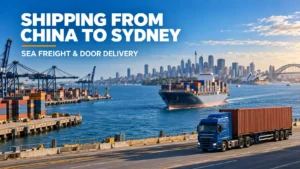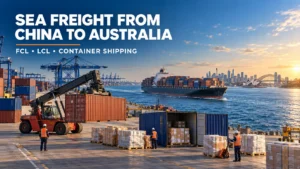
Shipping from China to Sydney can be arranged by FCL container, LCL sea freight, air cargo or a coordinated door-to-door service.
For commercial importers, sea freight is normally the most economical option for machinery, furniture, building materials, aluminium fencing, metal products, equipment and other large or heavy shipments.
BRF Shipping can manage the complete logistics process, including:
- Supplier pickup in China
- Multi-supplier consolidation
- China warehouse storage
- Container loading
- Export customs clearance
- FCL or LCL booking
- Ocean freight to Sydney
- Australian customs coordination
- Biosecurity documentation
- Customs duty and GST payment coordination
- Container or loose-cargo delivery
- Empty-container return planning
Most containerised cargo shipped to Sydney arrives through Port Botany, the largest container port in New South Wales. According to NSW Ports, Port Botany operates 24 hours a day and handles approximately 99.6% of the state’s container volume.
Whether you are shipping one pallet, 10 CBM of consolidated cargo, a 20GP or several 40HQ containers, the correct solution depends on the cargo size, weight, Incoterm, delivery postcode and Australian import requirements.
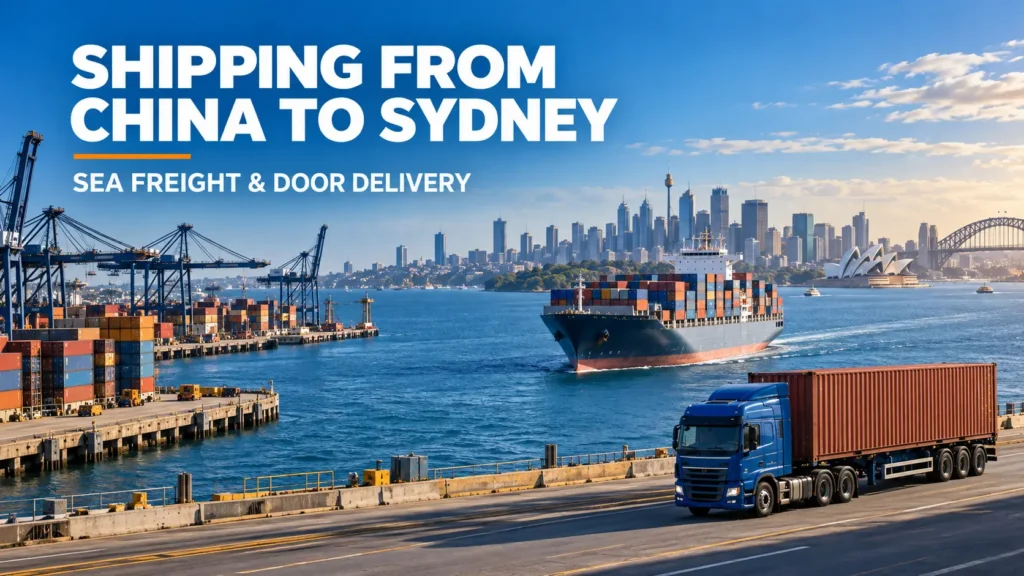
China to Sydney Shipping Overview
| Shipping option | Suitable shipment | Typical planning time |
|---|---|---|
| Express courier | Documents, samples and small parcels | Approximately 3–7 days |
| Air freight | Urgent or high-value commercial cargo | Approximately 5–10 days door to door |
| LCL sea freight | Smaller commercial shipments sharing a container | Approximately 21–31 days port to port |
| FCL sea freight | 20GP, 40GP or 40HQ containers | Approximately 13–27 days port to port |
| Sea freight door delivery | FCL or LCL with pickup, clearance and delivery | Usually longer than port-to-port transit |
Transit times are planning estimates, not guarantees. Actual schedules depend on the Chinese origin, carrier, consolidation cut-off, direct or transshipment service, port conditions and customs or biosecurity processing.
For a comparison of all shipping methods, visit Shipping Cost from China to Australia.
Sea Freight from China to Sydney
Sea freight is the main service covered by this Sydney route page.
Importers can choose:
- FCL shipping
- LCL shipping
- Port-to-port service
- Port-to-door service
- EXW door-to-door service
- FOB shipping
- DAP delivery
- DDP delivery where the commercial and importer arrangements allow it
Sea freight provides a practical balance between cost and cargo capacity. It is commonly used for shipments above the economical range of courier and air freight.
BRF Shipping arranges sea freight from China and coordinates the shipment from the supplier through to Sydney delivery.
FCL Shipping from China to Sydney
FCL means Full Container Load. The shipper books a complete container rather than sharing space with other importers.
Common container options include:
| Container | Approximate nominal capacity | Common application |
|---|---|---|
| 20GP | About 33 CBM | Dense, heavy or medium-volume cargo |
| 40GP | About 67 CBM | Larger standard-height shipments |
| 40HQ | About 76 CBM | Bulky, lightweight or high-volume cargo |
FCL does not mean the container must be completely full. It means that the container is allocated to one shipment.
Benefits of FCL Shipping
FCL may provide:
- Fewer cargo-handling points
- Better protection for fragile or valuable goods
- Easier separation of one importer’s cargo
- More control over loading
- Better economics for larger shipments
- More predictable release than shared-container deconsolidation
- Direct container delivery after release
When to Use a 20GP
A 20GP is often suitable for:
- Machinery
- Steel products
- Tiles
- Scaffolding
- Metal components
- Dense building materials
- Cargo occupying approximately 15–28 CBM
For detailed pricing and capacity information, see 20ft Container Shipping Cost from China to Australia.
When to Use a 40GP or 40HQ
A 40GP or 40HQ may be more suitable for:
- Furniture
- Aluminium fencing
- Metal gates
- Sound-barrier panels
- Fitness equipment
- Consumer products
- Packaging materials
- Lightweight but bulky cargo
A 40HQ provides additional internal height and is often selected when the shipment needs more space but is not excessively heavy.
See 40ft Container Shipping Cost from China to Australia for 40GP and 40HQ capacity, weight and cost information.
LCL Shipping from China to Sydney
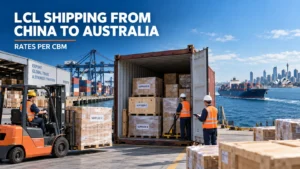
LCL means Less than Container Load. Cargo from several shippers is consolidated into one container.
LCL is suitable when:
- The cargo does not require a full container
- The shipment is generally below the economical FCL crossover point
- The cargo can be safely consolidated
- The importer prefers delivery as pallets, crates or cartons
- The delivery address cannot accept a complete container
LCL freight is normally calculated using cargo volume or weight under a weight-or-measure rule.
A commonly used ocean-freight conversion is:
1 CBM = 1,000 kg
The higher revenue quantity may be used, subject to the consolidator’s quotation.
LCL charges can include:
- China warehouse receiving
- Cargo measurement
- Origin CFS handling
- Export customs clearance
- Ocean freight per CBM
- Sydney deconsolidation
- Destination CFS charges
- Customs and biosecurity
- Final delivery
For detailed calculations, see LCL Shipping Cost from China to Australia.
Major Shipping Routes from China to Sydney
BRF Shipping can arrange cargo from manufacturing regions throughout China.
Major departure ports include:
- Shanghai
- Ningbo
- Shenzhen and Yantian
- Guangzhou and Nansha
- Qingdao
- Tianjin and Xingang
- Xiamen
The most suitable port is not always the geographically closest one. A route should be selected by comparing:
- Factory pickup cost
- Origin port charges
- Carrier schedule
- Direct or transshipment service
- Container availability
- Ocean freight
- Port-to-port transit time
- Rate validity
Shanghai to Sydney Shipping
Shanghai is one of the main departure ports for cargo produced in:
- Shanghai
- Jiangsu
- Zhejiang
- Anhui
- Nearby eastern China regions
Common Shanghai-to-Sydney cargo includes:
- Machinery
- Electrical equipment
- Automotive components
- Furniture
- Household products
- Commercial equipment
- Industrial parts
Depending on the carrier and sailing schedule, Shanghai-to-Sydney FCL transit may commonly be planned at approximately 14–22 days port to port. Consolidation, transshipment or schedule changes can increase the total time.
BRF Shipping can arrange supplier pickup, export declaration, container booking, Sydney customs coordination and final delivery.
Ningbo to Sydney Shipping
Ningbo is a major export gateway for suppliers in Zhejiang and surrounding manufacturing areas.
Typical products include:
- Furniture
- Tools
- Plastic goods
- Household products
- Machinery
- Building materials
- Hardware
- Outdoor products
Importers with suppliers located between Shanghai and Ningbo should compare both ports. The best result depends on domestic trucking, port charges, sailing frequency and available space.
Shenzhen and Yantian to Sydney Shipping
Shenzhen and Yantian serve the Pearl River Delta manufacturing region, including:
- Shenzhen
- Dongguan
- Huizhou
- Foshan
- Guangzhou
- Zhongshan
Typical cargo includes:
- Electronics
- Lighting
- Appliances
- Furniture
- Fitness equipment
- Consumer products
- E-commerce inventory
South China to Sydney services may be direct or may involve regional port calls. The carrier schedule should be checked before booking.
Guangzhou and Nansha to Sydney Shipping
Nansha can be a practical alternative for suppliers in Guangzhou, Foshan and the western Pearl River Delta.
The decision between Nansha and Yantian should consider:
- Supplier location
- Factory pickup cost
- Container availability
- Carrier service
- Terminal cut-off
- Ocean freight
- Transit time
Qingdao to Sydney Shipping
Qingdao is the main container gateway for many exporters in Shandong and northern China.
Typical cargo includes:
- Aluminium fencing
- Metal gates
- Sound barriers
- Machinery
- Rubber products
- Tyres
- Construction materials
- Artificial fishing products
- Industrial equipment
BRF Shipping is based in Qingdao and can coordinate the complete shipment from Shandong factories to Sydney.
Services may include:
- Factory communication
- Pickup in Shandong
- China export customs clearance
- Container loading
- FCL or LCL booking
- Ocean freight
- Sydney customs and biosecurity coordination
- Duty and GST payment coordination
- Delivery to the consignee
Our Shanghai to Sydney metal fence and gate shipping case provides an example of a complete Australia-bound shipment.
Tianjin to Sydney Shipping
Tianjin and Xingang serve suppliers in:
- Beijing
- Tianjin
- Hebei
- Inner Mongolia
- Other northern industrial regions
Typical products include:
- Scaffolding
- Steel products
- Machinery
- Construction materials
- Industrial components
- Equipment
Heavy cargo must be checked before loading because Australian container delivery is subject to road and axle-weight restrictions.
See our Tianjin to Sydney scaffolding shipping case, which involved 20GP and 40HQ containers, Australian customs processing, duty payment coordination and final delivery.
Port Botany: Sydney’s Main Container Port
Port Botany is the principal container gateway for Sydney and New South Wales.
According to NSW Ports, Port Botany has:
- Three container terminals
- Twelve container-vessel berths
- On-dock freight rail at every container terminal
- Connections to metropolitan and regional intermodal terminals
- Nearby container depots, warehouses and transport operations
- Access to major industrial areas across Greater Sydney
The three container terminals are operated by:
- DP World Australia
- Patrick Terminals
- Hutchison Ports
NSW Ports also reports that approximately 80% of import containers travel no further than 40 kilometres from Port Botany. This makes the port particularly important for businesses and warehouses in the Greater Sydney area.
The arrival terminal is selected by the shipping line, not by the importer. The terminal affects:
- Cargo availability
- Container collection
- Truck booking
- Infrastructure charges
- Delivery timing
- Empty-container return arrangements
Shipping Costs from China to Sydney
The cost of shipping from China to Sydney depends on the service scope.
The total can be expressed as:
China pickup + origin handling + export clearance + international freight + Sydney destination charges + customs and biosecurity + taxes + delivery
Main Cost Factors
| Cost factor | Why it matters |
|---|---|
| Supplier location | Determines China pickup and origin-port options |
| Cargo volume | Determines LCL, 20GP, 40GP or 40HQ suitability |
| Cargo weight | Affects LCL chargeable quantity and container transport |
| Incoterm | Determines which party pays each shipping stage |
| Chinese departure port | Affects trucking, schedule and freight |
| FCL or LCL | Changes the pricing and destination-handling structure |
| Cargo type | Affects customs, biosecurity and carrier acceptance |
| Delivery postcode | Determines Sydney and regional transport costs |
| Unloading method | Affects trailer, side-loader, crane or tail-lift requirements |
| Shipping date | Influences carrier space and market freight levels |
A low port-to-port rate does not necessarily produce a low door-to-door cost.
For current planning information covering sea freight, air cargo and delivery, use our China to Australia Shipping Cost page.
Port-to-Port Shipping to Sydney
Port-to-port service generally covers international transport from the Chinese port to Sydney.
Depending on the quotation, it may exclude:
- China factory pickup
- Export customs clearance
- Origin charges
- Sydney destination charges
- Customs brokerage
- Biosecurity fees
- Duty and GST
- Container delivery
- Empty-container return
Port-to-port shipping may suit experienced importers with their own Australian customs broker, transport company and delivery arrangements.
Door-to-Door Shipping from China to Sydney
Door-to-door shipping combines the origin, international and Australian delivery stages under one coordinated service.
A typical door-to-door process includes:
- Cargo details and quotation
- Supplier pickup in China
- China warehouse handling
- Export customs clearance
- FCL or LCL booking
- Ocean freight to Port Botany
- Australian customs declaration
- Biosecurity assessment
- Duty and GST payment
- Cargo release
- Sydney delivery
- Empty-container return for FCL shipments
Door-to-door does not automatically mean that every possible charge is included.
The quotation should state whether it includes:
- Customs duty
- GST
- Customs inspection
- Biosecurity inspection
- Treatment
- Port storage
- Container detention
- Truck waiting time
- Special unloading
- Regional delivery
BRF Shipping can coordinate door-to-door shipping from China based on the selected Incoterm and importer arrangement.
EXW Shipping from China to Sydney
Under EXW terms, the buyer is generally responsible for transportation from the supplier’s premises.
BRF Shipping can arrange:
- Supplier pickup
- Warehouse delivery
- Cargo consolidation
- Export declaration
- Ocean booking
- Australian customs coordination
- Final delivery
EXW service is useful when:
- The supplier only provides a factory price
- The supplier cannot arrange export clearance
- Cargo comes from multiple suppliers
- The buyer wants one logistics provider to manage the route
- The importer wants visibility over origin charges
FOB Shipping from China to Sydney
Under FOB terms, the supplier normally handles the cargo through the agreed Chinese port and export process.
BRF Shipping can take responsibility from the agreed FOB point and arrange:
- Ocean freight
- Sydney destination handling
- Customs and biosecurity coordination
- Container or LCL cargo delivery
FOB quotations should identify the named Chinese port, such as:
- FOB Shanghai
- FOB Ningbo
- FOB Qingdao
- FOB Shenzhen
- FOB Tianjin
“FOB China” is not sufficiently specific because origin ports and local charges differ.
China Supplier Pickup and Warehouse Consolidation
BRF Shipping can collect goods from one or several Chinese suppliers.
The consolidation process may include:
- Coordinating cargo-ready dates
- Arranging domestic trucks
- Receiving goods at the warehouse
- Counting packages
- Measuring cargo
- Checking external packaging
- Taking photographs
- Temporary storage
- Relabelling
- Palletisation
- Preparing a loading plan
- Loading FCL or LCL cargo
This is useful when an Australian importer purchases different products from several Chinese factories.
Learn more about China pickup services and China warehouse storage.
China Export Customs Clearance
Commercial cargo must meet China’s export declaration requirements before departure.
Common documents include:
- Commercial invoice
- Packing list
- Exporter details
- Consignee details
- HS codes
- Accurate product descriptions
- Declared values
- Package quantities
- Gross and net weights
- Country-of-origin information
- Dangerous-goods documents, when applicable
Cargo descriptions should be specific. Descriptions such as “parts,” “equipment,” “accessories” or “samples” may not provide enough information for customs processing.
BRF Shipping can coordinate China export customs clearance when the supplier cannot export or when several suppliers’ goods are consolidated.
Australian Customs Clearance in Sydney
Imported goods remain under customs control until the relevant declaration and release requirements are completed.
According to the Australian Border Force, goods with a combined value above AUD 1,000 and being cleared for home consumption generally require an Import Declaration.
The declaration includes:
- Importer information
- Transport information
- Tariff classification
- Customs value
- Product details
- Country of origin
- Duty and GST calculations
- Relevant permits or approvals
The importer should prepare the customs information before the vessel arrives.
Common documents include:
- Commercial invoice
- Packing list
- Bill of lading
- Packing Declaration
- Origin documentation
- Import permits, where required
- Product specifications
- Treatment certificates, where applicable
BRF Shipping can coordinate the Australia customs clearance and door-delivery process.
Customs Duty and GST
Australian customs duty depends on:
- HS classification
- Customs value
- Product type
- Country of origin
- Applicable tariff
- Trade-agreement eligibility
- Supporting documentation
Some eligible China-origin goods may receive preferential duty treatment under the China–Australia Free Trade Agreement. Eligibility depends on the applicable rules of origin and supporting documents.
Import GST is generally calculated at 10% of the value of the taxable importation.
The calculation generally includes:
- Customs value
- Customs duty
- International freight
- International insurance
- Wine Equalisation Tax, where applicable
Customs duty, GST, customs broker fees and government processing charges should not be confused with the ocean-freight price.
Australian Biosecurity and Quarantine
Australian biosecurity controls apply to both FCL and LCL cargo.
Goods requiring particular attention may include:
- Timber
- Wooden furniture
- Wooden crates or pallets
- Bamboo products
- Food
- Plant materials
- Animal products
- Used machinery
- Outdoor equipment
- Agricultural equipment
- Products contaminated by soil or organic matter
Cargo and packaging should be clean and free from:
- Soil
- Seeds
- Plant material
- Insects
- Animal residue
- Straw
- Bark
- Standing water
Used machinery and outdoor products should be thoroughly cleaned before export.
An import permit, treatment certificate, manufacturer declaration or additional product information may be required depending on the commodity.
Packing Declaration for Sydney-Bound Sea Freight
A Packing Declaration is commonly required for containerised sea freight entering Australia.
The document provides information about:
- Timber packing
- Bamboo packing
- Straw and other prohibited materials
- Container cleanliness
- Packing location
- Exposure to contamination
The document should be completed accurately and consistently with the packing list and shipment details.
Incorrect information can cause:
- Document queries
- Biosecurity inspection
- Treatment
- Container examination
- Port storage
- Cargo release delays
Read How to Complete an Australia Packing Declaration Form before the cargo departs China.
FCL Container Delivery in Sydney
After customs and biosecurity release, an FCL container can be collected from the Port Botany terminal.
The delivery method depends on the site.
Standard Trailer Delivery
The container remains on the trailer while the consignee unloads it.
Suitable sites normally require:
- Truck access
- Safe parking or loading area
- Forklift or unloading labour
- Sufficient overhead clearance
- Fast unloading
- Compliance with the driver’s waiting-time allowance
Side-Loader Delivery
A side-loader can place the container on the ground for unloading.
It may be suitable when:
- Ground-level access is required
- Unloading will take longer
- The consignee does not have a loading dock
- Site conditions can safely accept the container
The site must have suitable access, stable ground and sufficient space.
Unpack Depot Service
When the final address cannot accept a container truck, the container can be unpacked at a depot.
The cargo can then be delivered using:
- Flatbed truck
- Curtain-side truck
- Tail-lift truck
- Crane truck
- Smaller local delivery vehicle
Depot unpacking creates additional handling and cost, but it can solve difficult delivery-site restrictions.
LCL Delivery in Sydney
LCL cargo is normally deconsolidated at an approved warehouse before delivery.
After release, the cargo may be delivered as:
- Cartons
- Pallets
- Plywood crates
- Machinery
- Long packages
- Irregular commercial cargo
The delivery quotation depends on:
- Number of packages
- Package dimensions
- Gross weight
- Longest piece
- Delivery postcode
- Forklift availability
- Tail-lift requirement
- Commercial or residential address
Delivery Areas in Greater Sydney
BRF Shipping can coordinate delivery from the Sydney arrival facility to locations across Greater Sydney, subject to cargo and site requirements.
Common areas include:
- Sydney CBD
- Eastern Suburbs
- South Sydney
- Inner West
- North Sydney
- Northern Beaches
- Parramatta
- Auburn
- Bankstown
- Liverpool
- Wetherill Park
- Smithfield
- Eastern Creek
- Blacktown
- Penrith
- Campbelltown
- Sutherland Shire
Western Sydney is a major distribution and warehousing area. Delivery to warehouses in locations such as Wetherill Park, Smithfield and Eastern Creek may be suitable for both container and loose-cargo transport.
Regional New South Wales Delivery
Cargo arriving through Port Botany can also be delivered to regional destinations, including:
- Newcastle
- Wollongong
- Central Coast
- Blue Mountains
- Bathurst
- Orange
- Dubbo
- Wagga Wagga
- Albury
- Tamworth
Regional delivery costs depend on distance, cargo size, container weight, return equipment and transport availability.
For FCL cargo, the empty-container return location can significantly affect the total transport cost.
Cargo Commonly Shipped from China to Sydney
BRF Shipping can coordinate commercial shipments including:
- Aluminium fencing
- Aluminium gates
- Scaffolding
- Sound-barrier panels
- Machinery
- Fitness equipment
- Furniture
- Building materials
- Steel components
- Plastic products
- Packaging materials
- Electrical equipment
- Auto parts
- Commercial display equipment
- Outdoor products
- Consumer goods
Restricted, dangerous, temperature-controlled or biosecurity-sensitive cargo requires separate assessment before booking.
Heavy Cargo Shipping to Sydney
Heavy cargo requires planning at both origin and destination.
Before loading, confirm:
- Cargo weight
- Weight of each pallet or crate
- Container tare weight
- Maximum gross weight
- Verified Gross Mass
- Weight distribution
- Shipping-line limitations
- Port handling requirements
- Australian axle limits
- Delivery-site unloading capacity
A container may have sufficient internal space but still be unsuitable for road delivery because of weight restrictions.
Dense cargo should not be loaded into a 40HQ simply because more space is available. A 20GP or split-container solution may be safer and more practical.
Cargo Insurance
International transport involves risks such as:
- Physical damage
- Water damage
- Theft
- Handling damage
- Container incidents
- General average
- Vessel accidents
Carrier liability is limited and is not the same as cargo insurance.
Insurance should be considered for:
- High-value cargo
- Fragile products
- Custom machinery
- Commercial project materials
- Goods with long replacement lead times
The insured value and coverage terms should be confirmed before departure.
Common Reasons for Sydney Shipping Delays
Shipping delays can happen even after the vessel reaches Port Botany.
Common causes include:
- Customs document queries
- Incorrect HS codes
- Customs valuation questions
- Missing Packing Declaration
- Biosecurity inspection
- Treatment requirements
- Cargo contamination
- Port congestion
- Terminal storage
- Delayed container collection
- Truck availability
- Delivery-site restrictions
- Empty-container return problems
Pre-arrival customs preparation can reduce risk, but it cannot guarantee that a shipment will not be inspected.
See Why Cargo Problems Still Happen After Arriving in Australia for detailed information about inspections, quarantine, storage, detention and final-mile delays.
Storage, Demurrage and Detention
These charges are different.
- Terminal storage may apply when a container remains at the terminal beyond the allowed period.
- Demurrage generally relates to use of shipping-line equipment beyond the applicable free period while it remains within the port or terminal process.
- Detention generally applies when a released container is not returned to the shipping line’s nominated depot within the allowed time.
- LCL storage may apply when deconsolidated cargo is not collected from the destination warehouse within its free-storage period.
Importers should confirm:
- Cargo availability date
- Last free day
- Container collection deadline
- Empty-return deadline
- Empty-return depot
- Weekend availability
- Delivery-site schedule
How BRF Shipping Handles China-to-Sydney Cargo
Step 1: Cargo Review
We collect:
- Product information
- Supplier location
- Package dimensions
- Gross weight
- Cargo value
- Incoterm
- Australian delivery postcode
Step 2: Shipping-Method Selection
We compare:
- LCL
- 20GP
- 40GP
- 40HQ
- Air freight where urgency requires it
Step 3: China Pickup and Warehouse Handling
We coordinate supplier collection, receiving, consolidation, storage and loading.
Step 4: Export Clearance and Booking
We arrange the China export declaration and book the selected sailing to Sydney.
Step 5: Ocean Transportation
The shipment moves from the selected Chinese port to Port Botany or the nominated Sydney LCL facility.
Step 6: Australian Customs and Biosecurity
Required documents are prepared for customs and biosecurity assessment. Inspection or treatment is arranged when directed.
Step 7: Duty and GST
Applicable customs duty, GST and government charges are confirmed and paid under the agreed importer arrangement.
Step 8: Sydney Delivery
After release, the container or loose cargo is delivered to the nominated Sydney or New South Wales address.
Information Needed for a Shipping Quote
To receive an accurate China-to-Sydney quotation, provide:
- Chinese supplier address
- Incoterm
- Product name
- Product material and use
- HS code, if available
- Cargo value
- Number of packages
- Dimensions of each package
- Gross weight of each package
- Total CBM
- Total gross weight
- Wooden packaging details
- Stackable or non-stackable status
- Dangerous-goods status
- Cargo-ready date
- Sydney delivery postcode
- Commercial or residential address
- Forklift availability
- Tail-lift, side-loader or crane requirement
For heavy, long or irregular cargo, include package photographs and drawings.
Frequently Asked Questions
How much does shipping from China to Sydney cost?
The cost depends on cargo volume, weight, Chinese origin, FCL or LCL service, Incoterm, destination charges, customs requirements and delivery postcode. Use the dedicated container and LCL cost pages for detailed pricing structures.
What is the cheapest way to ship from China to Sydney?
LCL sea freight is commonly economical for smaller commercial shipments. A 20GP or 40ft container may offer a lower unit cost for larger volumes. The correct choice should be based on the complete origin-to-destination cost.
How long does sea freight from China to Sydney take?
FCL port-to-port transit commonly takes approximately 13–27 days, depending on origin and service. LCL may take approximately 21–31 days because consolidation and deconsolidation require additional time.
Which port handles containers for Sydney?
Most Sydney container cargo arrives through Port Botany, the main container port for New South Wales.
Can BRF Shipping collect cargo from several Chinese suppliers?
Yes. Goods can be collected from several factories, consolidated in a China warehouse and shipped as one LCL or FCL consignment.
Can BRF Shipping arrange Sydney customs clearance?
BRF Shipping can coordinate Australian customs clearance through the appropriate customs-broker arrangement and manage the required shipping documents.
Does door-to-door shipping include duty and GST?
Only when the quotation specifically states that duty and GST are included. DAP, DDU-style and DDP commercial arrangements allocate taxes differently.
Do I need an Australian customs broker?
Goods valued above AUD 1,000 generally require an Import Declaration. Many importers use a licensed customs broker to lodge the declaration and coordinate cargo release.
Do I need a Packing Declaration?
A Packing Declaration is commonly required for containerised sea freight. The correct form and supporting information depend on the packing materials and shipment.
Can BRF Shipping deliver outside Sydney?
Yes. Delivery can be coordinated to Greater Sydney and regional New South Wales, subject to cargo size, access and transport availability.
Can a container be delivered to a residential address?
Sometimes. The road, turning area, overhead clearance, unloading method and empty-container arrangements must be assessed before booking.
Is LCL or FCL faster?
FCL is generally more direct because it does not require cargo deconsolidation for several consignees. LCL can require additional time at both the origin and destination warehouses.
Can heavy machinery be shipped to Sydney?
Yes. Package weight, container payload, securing, Australian road limits and unloading equipment must be reviewed before shipment.
Get a Shipping Quote from China to Sydney
BRF Shipping provides coordinated sea freight and door-delivery services from China to Sydney.
Our services can include:
- Factory pickup in China
- Multi-supplier consolidation
- China warehouse storage
- Export packing
- Container loading
- China export customs clearance
- FCL and LCL sea freight
- Port Botany arrival coordination
- Australian customs and biosecurity support
- Duty and GST payment coordination
- Greater Sydney delivery
- Regional New South Wales delivery
- Empty-container return planning
Send us the supplier address, cargo description, package dimensions, total weight, Incoterm and Sydney delivery postcode.
We will compare the suitable Chinese loading port, shipping method, sailing schedule and delivery arrangement for your shipment.