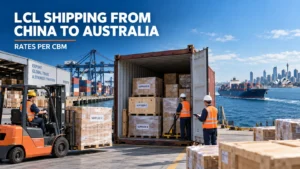
The LCL shipping cost from China to Australia is normally calculated according to cargo volume in cubic metres, cargo weight and the services included in the quotation.
LCL means Less than Container Load. Instead of booking an entire 20ft or 40ft container, your goods share container space with cargo belonging to other importers.
This makes LCL sea freight suitable for shipments that are too large for courier or air freight but do not require a full container.
As an indicative September 2026 market reference, advertised basic LCL ocean freight on common China–Australia routes may start from approximately USD 35 per CBM. This is only a base ocean-freight reference. It does not include every origin, destination, customs, biosecurity or delivery charge.
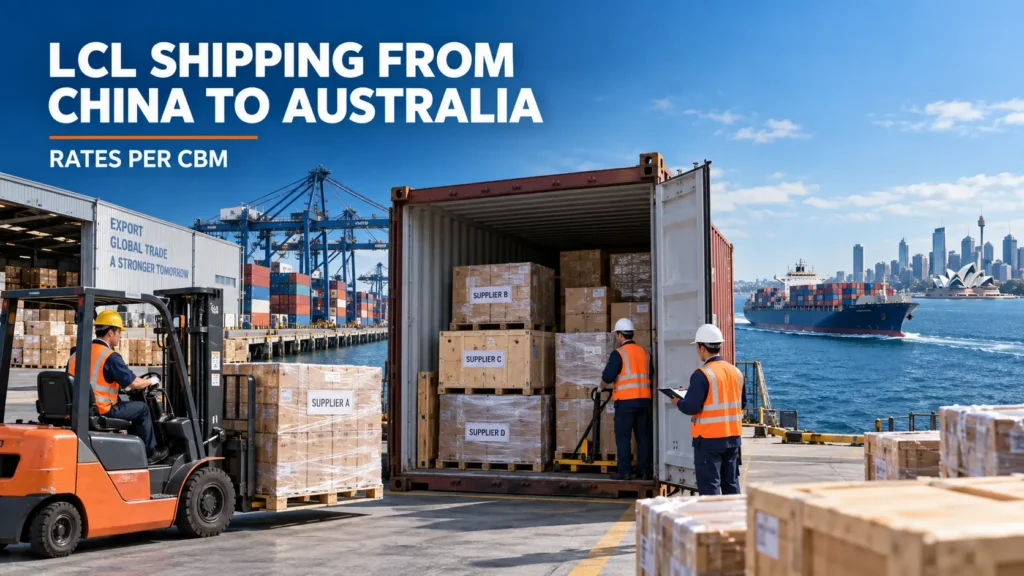
The complete LCL shipping cost may include:
- Supplier pickup in China
- Origin warehouse receiving
- Export packing or palletisation
- China customs clearance
- Origin CFS charges
- LCL ocean freight
- Australian CFS and deconsolidation charges
- Customs clearance
- Biosecurity processing
- Customs duty and GST
- Destination storage
- Final delivery
BRF Shipping can coordinate LCL shipments from factories across China to Sydney, Melbourne, Brisbane, Fremantle, Adelaide and other Australian destinations.
For a comparison with air freight, FCL and door delivery, visit our complete Shipping Cost from China to Australia guide.
How Much Is LCL Shipping from China to Australia per CBM?
A basic LCL ocean-freight rate may be quoted per cubic metre. However, the final price is not calculated by simply multiplying the shipment volume by the advertised ocean rate.
A complete calculation normally looks like this:
China pickup + origin CFS charges + export customs clearance + ocean freight per CBM + Australian destination charges + customs and biosecurity + duty and GST + final delivery
An indicative planning structure is shown below.
| Cost item | Typical pricing basis |
|---|---|
| Basic LCL ocean freight | Per CBM or revenue ton |
| China supplier pickup | Distance, weight and truck type |
| Origin CFS handling | Per CBM, per ton or minimum charge |
| Export customs clearance | Per shipment |
| Documentation | Per bill of lading |
| Australian deconsolidation | Per CBM, per ton or minimum charge |
| Australian port and CFS charges | Per shipment plus variable handling |
| Customs clearance | Per declaration |
| Biosecurity charges | Per declaration, inspection or treatment |
| Final delivery | Weight, volume, pallets and postcode |
| Duty and GST | Customs classification and taxable import value |
The actual cost per CBM becomes lower as the shipment size increases because fixed documentation and customs charges are spread across more cargo.
A 1 CBM shipment therefore usually has a higher effective cost per CBM than an 8 CBM shipment.
September 2026 LCL Rate Reference
The following rates are for preliminary planning only.
| LCL shipping option | Indicative reference |
|---|---|
| Basic port-to-port ocean freight | From approximately USD 35 per CBM |
| China origin charges | Quotation required |
| Australian destination CFS charges | Quotation required |
| Customs clearance | Based on cargo value and declaration type |
| Biosecurity charges | Based on commodity and intervention |
| Customs duty and GST | Based on classification, value and origin |
| Door delivery | Based on destination postcode and cargo details |
The advertised base freight should not be interpreted as an all-inclusive rate.
For example, if a shipment measures 5 CBM and the basic ocean rate is USD 35 per CBM:
5 CBM × USD 35 = USD 175 basic ocean freight
The USD 175 calculation does not include supplier pickup, CFS handling, documentation, Australian destination charges, customs clearance, taxes or delivery.
This explains why a very low advertised LCL rate can produce a much higher final invoice.
How LCL Shipping Is Charged
LCL sea freight is commonly charged using a weight-or-measure calculation, also called W/M or revenue ton.
The consolidator compares:
- Cargo volume in cubic metres
- Cargo gross weight in metric tons
The higher chargeable quantity is used.
A commonly used ocean-freight conversion is:
1 CBM = 1,000 kg
However, the exact conversion, rounding rule and minimum charge depend on the consolidator and quotation.
Example 1: Volume-Based Cargo
Cargo details:
- Volume: 4.5 CBM
- Gross weight: 1,200 kg
- Weight equivalent: 1.2 revenue tons
The chargeable quantity would normally be:
4.5 revenue tons
The cargo occupies more space relative to its weight, so the shipment is charged by volume.
Example 2: Heavy Cargo
Cargo details:
- Volume: 2.8 CBM
- Gross weight: 4,000 kg
- Weight equivalent: 4 revenue tons
The chargeable quantity may be:
4 revenue tons
Although the cargo occupies only 2.8 CBM, its weight produces the higher chargeable quantity.
Example 3: Light but Bulky Cargo
Cargo details:
- Volume: 7 CBM
- Gross weight: 900 kg
- Weight equivalent: 0.9 revenue tons
The chargeable quantity would normally be:
7 revenue tons
Furniture, plastic products, aluminium fencing and lightweight display equipment are commonly charged according to volume.
How to Calculate CBM for LCL Shipping
Cargo volume is calculated using the external packed dimensions.
The formula is:
Length × Width × Height × Number of packages
When measurements are provided in metres:
CBM = length in metres × width in metres × height in metres × quantity
Example
A shipment has ten crates. Each crate measures:
- Length: 1.20 m
- Width: 0.80 m
- Height: 1.00 m
Volume per crate:
1.20 × 0.80 × 1.00 = 0.96 CBM
Total volume:
0.96 × 10 = 9.6 CBM
The declared volume would therefore be approximately 9.6 CBM before any warehouse remeasurement or rounding.
Why Accurate Measurements Matter
The origin warehouse and destination warehouse may remeasure the cargo. If the actual dimensions are larger than the supplier’s figures, additional freight and handling charges may apply.
Always measure:
- Outer packaging
- Pallets
- Crate bases
- Protective frames
- Protruding parts
- Straps or supports
- Non-stackable space, when chargeable
The product dimensions alone are not sufficient. Freight is charged using the completed shipping package.
Minimum LCL Charges
Many LCL quotations have a minimum chargeable volume.
A shipment measuring 0.4 CBM may still be billed as:
- 1 CBM
- One revenue ton
- One minimum shipment
- A specified minimum handling amount
Minimum charges may apply separately to:
- Ocean freight
- Origin CFS handling
- Destination CFS handling
- Documentation
- Customs clearance
- Pickup
- Delivery
This is why LCL may not be economical for a very small shipment.
For small, lightweight or urgent goods, compare LCL against air freight from China.
Complete LCL Cost Breakdown
1. Supplier Pickup in China
Under EXW terms, the cargo must be collected from the supplier and transported to the consolidator’s warehouse.
Pickup cost depends on:
- Supplier address
- Distance to the consolidation warehouse
- Number of packages
- Cargo dimensions
- Gross weight
- Truck type
- Residential or industrial pickup
- Loading assistance
- Waiting time
- Dangerous or restricted goods
BRF Shipping can arrange pickup in China from one or multiple suppliers.
2. Origin Warehouse and CFS Charges
LCL cargo is delivered to a Container Freight Station or consolidation warehouse.
Origin charges may include:
- Warehouse receiving
- Unloading
- Measurement and weighing
- CFS handling
- Palletisation
- Repacking
- Labelling
- Storage
- Loading into the shared container
- Documentation
- Security charges
Some charges are calculated per CBM, while others are fixed per shipment.
3. Multi-Supplier Consolidation
Importers purchasing from multiple Chinese factories can send the products to one warehouse.
BRF Shipping can coordinate:
- Supplier communication
- Domestic pickup
- Cargo receiving
- Package counting
- Cargo photographs
- Storage
- Labelling
- Combined packing list
- Export documentation
- LCL consolidation
Combining several small supplier shipments may reduce duplicated export and international freight costs.
Learn more about our China warehouse and storage services.
4. China Export Customs Clearance
Commercial LCL cargo must be properly declared for export.
The required documents commonly include:
- Commercial invoice
- Packing list
- Exporter details
- Consignee details
- Product descriptions
- HS codes
- Declared values
- Package quantities
- Gross and net weight
- Country of origin
- Dangerous-goods declaration, when applicable
Goods from several suppliers may require additional coordination because the export documentation must match the consolidated shipment.
BRF Shipping can arrange China export customs clearance when the supplier cannot export directly or when several orders are consolidated.
5. Basic LCL Ocean Freight
The ocean-freight portion covers the shared-container movement between the origin and destination CFS locations.
The rate may be affected by:
- Chinese origin port
- Australian destination
- Cargo volume
- Cargo weight
- Commodity
- Direct or transshipment service
- Consolidation schedule
- Shipping line
- Peak season
- Fuel and security surcharges
The lowest base ocean rate does not always produce the lowest total cost. A consolidator offering a low freight rate may apply higher origin or destination charges.
6. Australian Deconsolidation Charges
After the container arrives in Australia, it is transported to a bonded or approved facility for unpacking.
The individual shipments must be separated before they can be released.
Destination charges may include:
- Container deconsolidation
- CFS handling
- Cargo availability fees
- Depot fees
- Documentation
- Port service charges
- Infrastructure charges
- Security charges
- Cargo release fees
- Forklift handling
- Pallet handling
- Storage
Australian destination charges can be a significant part of the LCL total. These charges should be requested before booking.
7. Customs Clearance
Goods with a combined value above AUD 1,000 generally require an Import Declaration before they can be released into Australian commerce.
The declaration includes information about:
- Importer
- Supplier
- Cargo
- Customs value
- HS classification
- Country of origin
- Customs duty
- GST
- Permits or restrictions
The Australian Border Force recommends that first-time or occasional importers consider using a licensed customs broker. Current declaration requirements are available on the official Australian Border Force Import Declarations page.
8. Import Processing and Biosecurity Charges
Government charges may apply when an import declaration is lodged.
At the time of publication, the Australian Border Force lists the following electronic Import Processing Charges:
| Consignment value | Electronic Import Processing Charge |
|---|---|
| AUD 1,000 or less | AUD 0 |
| More than AUD 1,000 but less than AUD 10,000 | AUD 50 |
| AUD 10,000 or more | AUD 152 |
For sea cargo above AUD 1,000, a separate biosecurity cost-recovery charge may also apply. The published sea Full Import Declaration biosecurity charge is AUD 71 at the time of writing.
These figures can change. Confirm current amounts on the official ABF Import Processing Charges page.
Customs broker fees, cargo inspections, depot positioning, treatment and storage are additional costs.
9. Customs Duty and GST
Customs duty depends on:
- HS code
- Product description
- Customs value
- Country of origin
- Applicable tariff
- Trade-agreement eligibility
- Origin documents
Some goods of Chinese origin may qualify for preferential duty treatment under the China–Australia Free Trade Agreement. Eligibility depends on the product and applicable rules of origin.
Australian import GST is generally calculated at 10% of the value of the taxable importation.
The GST base generally includes:
- Customs value
- Customs duty
- International freight
- International insurance
- Wine Equalisation Tax, where applicable
The Australian Taxation Office provides the official explanation of GST and imported goods.
Simplified GST Example
Assume:
- Customs value: AUD 15,000
- Customs duty: AUD 750
- International freight and insurance: AUD 2,500
Estimated taxable value:
AUD 15,000 + AUD 750 + AUD 2,500 = AUD 18,250
Estimated GST:
AUD 18,250 × 10% = AUD 1,825
This is a simplified example. Actual duty and GST depend on the product classification, valuation and origin eligibility.
10. Final Delivery in Australia
After customs and biosecurity release, the loose cargo can be collected from the destination warehouse and delivered to the consignee.
Delivery cost depends on:
- Destination warehouse
- Delivery postcode
- Cargo volume
- Gross weight
- Number of pallets or crates
- Longest package
- Forklift availability
- Tail-lift requirement
- Commercial or residential address
- Delivery appointment
- Regional or remote location
LCL delivery is different from full-container delivery. The cargo normally arrives as pallets, crates or cartons rather than inside the original container.
BRF Shipping can coordinate door-to-door shipping from China based on the shipment size and Australian delivery requirements.
Main LCL Routes from China to Australia
BRF Shipping can arrange LCL consolidation from major Chinese manufacturing and port regions.
Common origin ports include:
- Qingdao
- Shanghai
- Ningbo
- Shenzhen and Yantian
- Guangzhou and Nansha
- Tianjin and Xingang
- Xiamen
Major Australian destinations include:
- Sydney
- Melbourne
- Brisbane
- Fremantle
- Adelaide
LCL Shipping from Shanghai to Australia
Shanghai serves suppliers throughout Shanghai, Jiangsu, Zhejiang and neighbouring industrial regions.
Typical cargo includes:
- Machinery parts
- Electrical products
- Furniture
- Tools
- Auto parts
- Commercial equipment
- Packaging materials
Frequent consolidation services may be available to Sydney, Melbourne and Brisbane.
LCL Shipping from Ningbo to Australia
Ningbo is commonly used for cargo manufactured in Zhejiang and nearby provinces.
Typical products include:
- Furniture
- Household products
- Hardware
- Tools
- Plastic goods
- Machinery
- Building products
When Shanghai and Ningbo are both practical, compare the supplier pickup cost, consolidation schedule and Australian destination charges.
LCL Shipping from Shenzhen or Guangzhou to Australia
South China consolidation services are suitable for suppliers in Shenzhen, Dongguan, Foshan, Guangzhou and surrounding manufacturing areas.
Common cargo includes:
- Electronics
- Lighting
- Furniture
- Appliances
- Fitness products
- Consumer goods
- E-commerce inventory
LCL Shipping from Qingdao to Australia
Qingdao is a practical origin for cargo from Shandong and northern China.
Common products include:
- Aluminium fencing
- Metal gates
- Machinery
- Artificial fishing products
- Rubber products
- Building materials
- Industrial components
BRF Shipping can collect cargo from Shandong factories, arrange export clearance and consolidate the shipment for delivery to Australian ports.
LCL Shipping from Tianjin to Australia
Tianjin serves Beijing, Hebei and other northern production regions.
Typical cargo includes:
- Machinery
- Equipment parts
- Construction materials
- Metal products
- Industrial components
Heavy cargo must be checked carefully because LCL charges may be calculated according to weight rather than physical CBM.
LCL Shipping Cost to Sydney
Sydney is a major LCL gateway for cargo serving New South Wales.
The total cost may include:
- Ocean freight per CBM
- Sydney deconsolidation
- CFS handling
- Customs clearance
- Biosecurity charges
- Duty and GST
- Metropolitan or regional delivery
A Sydney CFS-to-CFS price should not be treated as a quotation for delivery to the consignee’s address.
LCL Shipping Cost to Melbourne
Melbourne is commonly used for cargo destined for Victoria.
When comparing Sydney and Melbourne, consider the final delivery postcode. Shipping directly to Melbourne may be more economical than importing through Sydney and arranging interstate transport.
LCL Shipping Cost to Brisbane
Brisbane is suitable for cargo serving Queensland.
Delivery outside metropolitan Brisbane may attract:
- Regional freight
- Fuel surcharges
- Tail-lift charges
- Appointment fees
- Remote-area surcharges
LCL Shipping Cost to Fremantle and Perth
Fremantle serves Perth and Western Australia.
LCL schedules, transshipment arrangements and destination charges may differ from east-coast services. A separate Fremantle quotation should be obtained.
LCL Shipping Cost to Adelaide
Adelaide-bound cargo may move through a direct consolidation, transshipment service or another Australian gateway.
The best option should be selected according to:
- Sailing schedule
- Total transit time
- Deconsolidation location
- Destination charges
- Final delivery cost
How Long Does LCL Shipping Take?
LCL sea freight commonly takes longer than FCL because cargo must be consolidated at origin and deconsolidated at destination.
| Shipping stage | Typical activity |
|---|---|
| Supplier pickup | Cargo collected from the Chinese factory |
| Origin consolidation | Measurement, customs and container loading |
| Ocean transport | Vessel movement to Australia |
| Destination deconsolidation | Shared container unpacked at the CFS |
| Customs and biosecurity | Shipment assessed and released |
| Final delivery | Loose cargo delivered to the consignee |
A typical port-to-port LCL transit may be approximately 21–31 days on common services. Door-to-door lead time may be longer.
Delays may be caused by:
- Missed consolidation cut-off
- Incomplete supplier documents
- Customs inspection
- Biosecurity referral
- Vessel rollover
- Transshipment
- Port congestion
- Delayed deconsolidation
- Destination storage
- Delivery appointment problems
Australian Biosecurity Requirements for LCL Cargo
LCL cargo is subject to the same Australian biosecurity controls as full-container cargo.
Particular attention should be given to:
- Wooden packaging
- Timber products
- Bamboo
- Food
- Plant material
- Animal products
- Used machinery
- Outdoor equipment
- Soil contamination
- Straw or natural packing materials
Cargo packaging should be clean, dry and free from insects, soil, seeds and plant residue.
Because several shipments share one container, a problem involving another consignee’s cargo can sometimes delay container deconsolidation or cargo availability.
Packing Declaration Requirements
An appropriate Packing Declaration may be required for LCL sea freight entering Australia.
The declaration provides information about:
- Timber packing
- Bamboo packing
- Straw or prohibited material
- Cargo preparation
- Container cleanliness
- Packing location
The document should match the commercial invoice, packing list and shipment details.
Incomplete or incorrect declarations can result in:
- Document queries
- Biosecurity inspection
- Treatment
- Warehouse storage
- Delivery delays
- Additional handling
Read our detailed guide on How to Complete an Australia Packing Declaration Form before shipping.
LCL Cargo Packing Requirements
LCL cargo receives more handling than FCL cargo.
The shipment may be:
- Loaded onto a pickup truck
- Unloaded at the China warehouse
- Moved within the CFS
- Loaded into a shared container
- Unloaded at the Australian CFS
- Stored temporarily
- Loaded onto a delivery vehicle
- Unloaded at the final address
The packaging should therefore withstand multiple handling points.
Recommended packaging may include:
- Export cartons
- Pallets
- Plywood crates
- Protective foam
- Corner guards
- Waterproof wrapping
- Steel or plastic strapping
- Internal bracing
Fragile, irregular or high-value products should not rely on light retail packaging.
Non-Stackable Cargo
Non-stackable cargo may occupy both its physical space and the unusable space above it.
A consolidator may apply:
- Additional volume
- Non-stackable surcharge
- Special handling fee
- Increased chargeable CBM
Tell the freight forwarder before booking if other cargo cannot be placed on top of the shipment.
Long Cargo
Long packages such as fence panels, pipes, profiles and machinery components may generate:
- Overlength charges
- Special warehouse handling
- Forklift restrictions
- Delivery-vehicle restrictions
- Additional labour
- Limited consolidation options
Provide the length of the longest package—not only the total CBM.
When Should You Choose LCL?
LCL is usually suitable when:
- The shipment does not fill a container
- Cargo volume is relatively small
- Delivery is not extremely urgent
- The goods can be safely consolidated
- The shipment is properly packaged
- The importer wants to avoid paying for unused container space
LCL is commonly considered for shipments from approximately 1 CBM up to the point where FCL becomes more economical.
There is no universal crossover volume. The correct decision depends on:
- Chargeable weight
- Origin charges
- Destination charges
- Cargo value
- Packaging
- Product sensitivity
- FCL market rate
- Final delivery cost
When Should You Switch from LCL to a 20GP?
Importers should normally compare LCL against a 20GP when the shipment reaches approximately 12–18 CBM.
The crossover may occur earlier when:
- Cargo is heavy
- Australian CFS charges are high
- The products are fragile
- The cargo is non-stackable
- Packages are unusually long
- Several suppliers are shipping together
- The importer wants fewer handling points
- The FCL rate is temporarily low
The crossover may occur later when:
- Cargo is lightweight
- LCL destination charges are competitive
- A full container would contain substantial unused space
- The delivery address cannot accept a container
- The importer prefers loose-cargo delivery
Use the complete landed logistics cost—not only the ocean rate—to make the decision.
Compare the options in our 20ft Container Shipping Cost from China to Australia guide.
For larger shipments, see 40ft Container Shipping Cost from China to Australia.
LCL vs FCL Shipping
| Factor | LCL | FCL |
|---|---|---|
| Container use | Shared with other shipments | Dedicated to one shipment |
| Pricing | Per CBM or revenue ton | Per container |
| Handling | More handling points | Fewer cargo-handling points |
| Origin process | Consolidation required | Container loaded for one shipment |
| Destination process | Deconsolidation required | Container released as a complete unit |
| Suitable volume | Small and medium shipments | Larger shipments |
| Transit predictability | May take longer | Usually more direct |
| Final delivery | Pallets, crates or cartons | Complete container or unpacked cargo |
For a full explanation of both methods, visit Sea Freight from China to Australia.
Port-to-Port vs Door-to-Door LCL
Port-to-Port LCL
A port-to-port or CFS-to-CFS quotation may cover only:
- Origin consolidation
- Ocean freight
- Movement to the destination CFS
The importer may still need to arrange:
- Supplier pickup
- Export documentation
- Australian customs clearance
- Biosecurity processing
- Destination warehouse charges
- Duty and GST
- Final delivery
Door-to-Door LCL
A door-to-door service may combine:
- Collection from the Chinese supplier
- Origin warehouse handling
- Export customs declaration
- LCL consolidation
- Ocean freight
- Australian deconsolidation
- Customs and biosecurity coordination
- Duty and GST payment coordination
- Final delivery
The quotation should clearly state whether taxes, inspections, treatment, storage and tail-lift delivery are included.
Learn more about Australia customs clearance and door-to-door delivery.
Common LCL Additional Charges
Additional charges may include:
- Cargo remeasurement
- Weight adjustment
- Non-stackable surcharge
- Overlength handling
- Origin storage
- Destination storage
- Document amendment
- Customs inspection
- Biosecurity inspection
- Treatment
- Fumigation
- Cargo washing or cleaning
- Pallet handling
- Tail-lift delivery
- Residential delivery
- Delivery appointment
- Failed delivery
- Regional surcharge
Unlike FCL, LCL cargo does not normally create container detention for the individual importer after deconsolidation. However, warehouse storage can accumulate when the loose cargo is not collected after release.
Our guide to Australian inspections, quarantine, storage and final-mile delays explains these risks in more detail.
How to Reduce LCL Shipping Costs
Provide Accurate Dimensions
Measure the complete export packaging and include pallets, bases and protruding parts.
Compare Weight and Volume
Heavy cargo may be charged by weight even when the physical CBM is small.
Consolidate Multiple Orders
Combining goods from several suppliers can reduce duplicated pickup, documentation and minimum charges.
Improve Packaging Efficiency
Oversized pallets and unnecessary empty space increase chargeable volume.
Make Cargo Stackable
Safe stackable packaging may reduce non-stackable surcharges and wasted space.
Check Destination Charges
Ask for Australian CFS and deconsolidation charges before confirming the shipment.
Prepare Customs Documents Early
Confirm HS codes, values, product descriptions and origin documents before departure.
Check Biosecurity Requirements
Determine whether the goods or packaging require permits, declarations, cleaning or treatment.
Compare LCL and FCL
Once cargo reaches approximately 12–18 CBM, request both LCL and 20GP quotations.
Arrange Delivery Before Cargo Release
Confirm the Australian delivery postcode, unloading equipment and access conditions before arrival.
Information Required for an LCL Quote
To calculate an accurate LCL shipping cost from China to Australia, provide:
- Supplier address
- Chinese origin port, if known
- Incoterm
- Product name
- Product material
- Intended use
- HS code, if available
- Number of packages
- Packing type
- Dimensions of each package
- Gross weight of each package
- Total CBM
- Total gross weight
- Cargo value
- Stackable or non-stackable status
- Longest package
- Wooden packaging details
- Dangerous-goods status
- Cargo-ready date
- Australian destination
- Final delivery postcode
- Commercial or residential address
- Forklift or tail-lift requirements
Photographs are recommended for irregular, fragile, heavy or long cargo.
Frequently Asked Questions
How much is LCL shipping from China to Australia per CBM?
As a September 2026 market reference, advertised basic ocean freight may start from approximately USD 35 per CBM on common China–Australia routes. This does not include all origin, destination, customs, biosecurity, tax or delivery costs.
Is the USD 35 per CBM rate all-inclusive?
No. It is a basic ocean-freight reference. The total shipment cost may include fixed and variable charges at both origin and destination.
How is LCL freight calculated?
LCL freight is normally calculated using the higher of cargo volume or weight under the quotation’s weight-or-measure rule.
What does W/M mean?
W/M means weight or measurement. The consolidator compares the cargo’s cubic metres with its weight-based revenue tons and charges the higher quantity.
What is the minimum LCL charge?
Many services apply a minimum of 1 CBM or one revenue ton. Separate minimum charges may also apply to handling, pickup, customs and delivery.
How many CBM should I ship by LCL?
LCL is commonly suitable for small and medium shipments. Once the cargo reaches approximately 12–18 CBM, compare the complete LCL cost with a 20GP container.
Is LCL cheaper than a 20ft container?
LCL is usually cheaper for smaller shipments. At higher volumes, fixed destination charges and per-CBM handling can make a 20GP more economical.
How long does LCL shipping take from China to Australia?
Port-to-port LCL transport commonly takes approximately 21–31 days. Door-to-door transit is longer because it includes pickup, consolidation, deconsolidation, customs and delivery.
Can BRF Shipping collect goods from multiple suppliers?
Yes. BRF Shipping can collect goods from several Chinese suppliers, consolidate them in one warehouse and arrange one LCL shipment to Australia.
Can long cargo be shipped by LCL?
Yes, subject to warehouse, consolidation and delivery restrictions. Long cargo may attract overlength and special-handling charges.
Does LCL shipping include customs duty and GST?
Not unless the quotation specifically includes them. Standard port-to-port rates normally exclude Australian import duty and GST.
Do LCL shipments need a Packing Declaration?
A Packing Declaration may be required for Australian sea freight. The document should accurately describe the packing materials and relevant container-packing conditions.
Is LCL suitable for fragile cargo?
It can be, but strong export packaging is essential because LCL cargo passes through more handling points than FCL cargo.
Can LCL cargo be delivered to a residential address?
Sometimes. Residential access, tail-lift requirements, package weight and unloading arrangements must be confirmed before delivery.
Get an LCL Shipping Quote from China to Australia
BRF Shipping provides LCL sea freight services from major Chinese manufacturing regions to Australia.
Our services can include:
- Supplier pickup in China
- Multi-supplier consolidation
- Warehouse storage
- Cargo measurement
- Export packaging
- China customs clearance
- LCL ocean freight
- Australian customs coordination
- Biosecurity support
- Duty and GST payment coordination
- CFS cargo collection
- Commercial or residential delivery
Send us the supplier address, package dimensions, gross weight, cargo value and Australian delivery postcode.
BRF Shipping will calculate the chargeable CBM, compare available consolidation routes and determine whether LCL or a full container offers the better total cost.