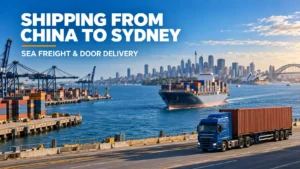
The shipping cost from China to Australia depends on much more than the ocean freight or air freight rate.
A complete quotation may include factory pickup in China, export customs declaration, warehouse handling, FCL or LCL freight, Australian destination charges, customs-broker fees, import duty, GST, biosecurity services and delivery to the final postcode.
For this reason, two quotations for the same shipment may show very different totals even when the basic international freight rate looks similar.
BRF SHIPPING provides coordinated shipping services from China to Australia, covering Chinese supplier pickup, warehousing, FCL and LCL booking, air freight, export documentation, Australian customs support and door delivery.
This guide explains:
- Current China-to-Australia freight cost ranges
- FCL, LCL and air freight pricing
- 20ft, 40ft and 40HQ container costs
- Port-to-port versus door-to-door prices
- Australian customs duty and GST
- Destination charges
- DAP and DDP shipping costs
- The information needed for an accurate quotation
China to Australia Shipping Cost Overview
The following figures are indicative market-planning ranges for general commercial cargo in September 2026.
They are not fixed BRF SHIPPING quotations. Actual prices depend on the departure port, Australian destination, carrier, cargo date, equipment availability, commodity and service scope.
| Shipping Method | Indicative Cost | Typical Transit Time | Suitable Cargo |
|---|---|---|---|
| 20GP FCL sea freight | USD 2,160–2,640 port-to-port | About 15–30 days | Dense or heavy cargo |
| 40GP FCL sea freight | USD 4,275–5,225 port-to-port | About 15–30 days | General-volume commercial cargo |
| 40HQ FCL sea freight | Quote required; normally close to or above 40GP | About 15–30 days | Lightweight and bulky cargo |
| LCL sea freight | Base freight sometimes quoted from approximately USD 35 per CBM | About 20–38+ days | Smaller commercial shipments |
| Standard air freight | From approximately USD 3.70 per kg in current public benchmarks | About 3–8 days | Urgent cargo, commonly above 100 kg |
| Express air service | From approximately USD 5.90 per kg in current public benchmarks | About 2–6 days | Small, urgent or high-value cargo |
| Sea freight door to door | Customized quotation | About 22–45+ days | FCL or LCL requiring final delivery |
| Air freight door to door | Customized quotation | About 5–12 days | Urgent warehouse or business delivery |
These figures should only be used for early planning. Published market information also confirms that freight prices change regularly and vary widely between service providers. Current China–Australia market reference.
A very low advertised rate may include only the basic ocean freight and exclude origin charges, destination handling, customs, inspection, taxes and delivery.
What Is Included in the Shipping Cost from China to Australia?
A complete China-to-Australia logistics cost can be divided into five parts.
1. China Origin Charges
Origin costs may include:
- Factory pickup
- Trucking to the warehouse or port
- Warehouse receiving
- Cargo measurement and weighing
- Multi-supplier consolidation
- Repacking and palletizing
- Container loading
- Export customs declaration
- Terminal handling
- Documentation
- VGM submission
- Bill of lading charges
- Special-cargo handling
BRF SHIPPING can arrange factory pickup in China and collect cargo from one or multiple suppliers.
2. International Freight
This is the main sea freight or air freight charge.
It may be calculated by:
- Container type for FCL
- Chargeable CBM or weight for LCL
- Chargeable weight for air freight
- Cargo type
- Origin and destination
- Carrier or airline
- Direct or transshipment service
- Seasonal capacity
- Fuel and security surcharges
3. Australian Destination Charges
Destination charges can include:
- Terminal handling
- Port service charges
- Delivery order
- Shipping-line documentation
- LCL deconsolidation
- Container freight station handling
- Customs-broker fees
- Biosecurity-document assessment
- Inspection-facility charges
- Container transport
- Storage
- Demurrage
- Detention
These charges vary considerably between FCL and LCL shipments.
4. Import Duty and GST
Commercial cargo may be subject to:
- Customs duty
- Import GST
- Import Processing Charge
- Biosecurity cost-recovery charges
- Anti-dumping duty
- Wine Equalisation Tax where applicable
- Luxury Car Tax where applicable
The applicable duty depends on the HS code, customs value, country of origin and whether valid preferential treatment is available.
5. Final Delivery
Australian delivery costs depend on:
- Port or airport of arrival
- Final postcode
- Distance from the gateway
- FCL or loose cargo
- Container weight
- Package dimensions
- Delivery appointment
- Tailgate requirements
- Side-loader requirements
- Residential or commercial location
- Unloading equipment
- Empty-container return
Sydney, Melbourne, Brisbane, Perth, Adelaide, Canberra and regional Australian destinations have different trucking and handling costs.
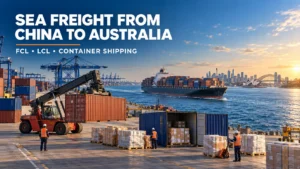
Sea Freight Cost from China to Australia
Sea freight from China is generally the most cost-effective method for large, heavy or non-urgent commercial cargo.
It is commonly used for:
- Building materials
- Aluminum fences and gates
- Scaffolding
- Machinery
- Furniture
- Solar equipment
- Industrial products
- Wholesale inventory
- Outdoor products
- Construction materials
Sea freight is available as FCL or LCL.
FCL Shipping Cost from China to Australia
With FCL shipping, one shipper books the complete container.
Common equipment includes:
| Container | Approximate Internal Capacity | Typical Use |
|---|---|---|
| 20GP | About 33 CBM | Heavy or dense products |
| 40GP | About 67 CBM | General-volume cargo |
| 40HQ | About 76 CBM | Lightweight or bulky products |
These are nominal capacities. Actual loading volume depends on carton sizes, pallets, packaging, weight distribution and container specifications.
FCL quotations are usually based on the container type rather than the exact CBM loaded.
A 20GP container that is only half full may still incur the same basic ocean freight as a fully utilized 20GP container. Improving the loading plan can therefore reduce the effective shipping cost per unit.
20ft Container Shipping Cost from China to Australia
A 20GP container is often selected for:
- Heavy machinery
- Metal products
- Tiles and stone
- Scaffolding
- Dense building materials
- Cargo with high weight but limited volume
The total 20ft container shipping cost can include:
- Empty-container pickup
- Factory loading or warehouse loading
- China trucking
- Export declaration
- Terminal handling
- Ocean freight
- Australian terminal charges
- Customs and biosecurity fees
- Container delivery
- Empty return
40ft and 40HQ Container Shipping Cost
A 40GP or 40HQ is more suitable for:
- Aluminum fence panels
- Metal gates
- Furniture
- Acoustic barrier panels
- Lightweight machinery
- WPC products
- Retail inventory
- Other bulky commercial goods
A 40HQ usually provides more internal height and volume than a 40GP.
Although the basic freight cost is higher than a 20GP, a well-loaded 40HQ may provide a lower cost per CBM or per product.
Importers should compare:
- 20GP total cost
- 40GP total cost
- 40HQ total cost
- Number of units loaded
- Weight restrictions
- Inland trucking
- Unloading requirements
Choosing the cheapest container rate without checking loading efficiency can increase the final cost per unit.
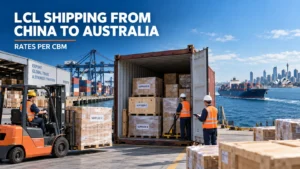
LCL Shipping Cost from China to Australia
LCL shipping allows the importer to share container space with other consignments.
It is commonly suitable for:
- One or several pallets
- Trial orders
- Small wholesale shipments
- Replacement parts
- Cargo below a practical FCL volume
- Shipments from multiple suppliers
LCL sea freight is normally calculated by chargeable volume or weight.
A common ocean LCL calculation is based on:
Chargeable volume = the greater of actual CBM or the applicable weight-to-measurement conversion
The exact conversion and minimum charge depend on the consolidator and tariff.
Why LCL Costs More Than the Advertised CBM Rate
An advertised LCL ocean rate may represent only the basic port-to-port line-haul charge.
A complete LCL quotation may also include:
- China warehouse receiving
- Export handling
- Documentation
- Customs declaration
- Consolidation
- Origin CFS charges
- Destination deconsolidation
- Australian depot charges
- Customs-broker fees
- Biosecurity charges
- Storage
- Loose-cargo delivery
For a small shipment, Australian destination and delivery charges may be higher than the basic international ocean freight.
Importers should therefore compare the complete door-delivery cost—not only the rate per CBM.
When Does FCL Become Cheaper Than LCL?
There is no universal volume at which FCL becomes cheaper.
The decision depends on:
- Total CBM
- Gross weight
- Cargo density
- Package dimensions
- Australian destination
- LCL destination charges
- Container trucking cost
- Loading and unloading ability
- Risk of cargo damage
- Delivery deadline
LCL may be suitable for a 3 CBM commercial shipment, while FCL may become more competitive as volume increases.
For cargo approaching approximately 12–15 CBM, requesting both LCL and 20GP quotations is a practical approach. However, the actual break-even point can be lower or higher.
Air Freight Cost from China to Australia
Air freight from China is suitable for urgent, valuable or time-sensitive cargo.
Common air freight products include:
- Industrial spare parts
- Electronic components
- Samples
- Medical products
- Replacement equipment
- Urgent project materials
- High-value commercial cargo
Air freight is normally charged according to chargeable weight.
Chargeable weight = the greater of actual gross weight or volumetric weight
A commonly used volumetric formula is:
Volumetric weight in kilograms = Length × Width × Height in centimetres ÷ 6,000
The applicable divisor can vary by airline and service.
Air Freight Cost Example
Suppose one shipment has:
- Actual weight: 300 kg
- Dimensions: 120 × 100 × 150 cm
- Number of pallets: 2
Volumetric weight per pallet:
120 × 100 × 150 ÷ 6,000 = 300 kg
For two pallets:
300 × 2 = 600 kg volumetric weight
Although the cargo physically weighs 300 kg, the airline may charge 600 kg because the volumetric weight is higher.
This is why dimensions are essential for an accurate air freight quotation.
Air Freight Versus Sea Freight
| Factor | Sea Freight | Air Freight |
|---|---|---|
| Best for | Large, heavy and non-urgent cargo | Urgent, valuable or smaller cargo |
| Pricing basis | Container, CBM or weight/measurement | Chargeable weight |
| Transit time | Usually longer | Usually faster |
| Cost | Lower for large shipments | Higher per kilogram |
| Handling | More suitable for bulky cargo | Airport and aircraft restrictions apply |
| Typical delivery | Port, warehouse or door | Airport or door |
A shipment above approximately 500 kg may often be more economical by sea, but density, urgency and destination can change the result.
Shipping Cost by China Origin
BRF SHIPPING arranges shipments from major Chinese manufacturing and export regions.
Qingdao to Australia
Suitable for suppliers in Shandong and northern China.
Common cargo includes:
- Aluminum products
- Fencing
- Machinery
- Tyres
- Building materials
- Agricultural equipment
Common destinations include Sydney, Melbourne, Brisbane and Fremantle.
Shanghai to Australia
Shanghai provides frequent services for cargo from Shanghai, Jiangsu, Zhejiang and surrounding manufacturing regions.
Common cargo includes:
- Machinery
- Industrial products
- Metal fences and gates
- Furniture
- Retail inventory
Ningbo to Australia
Ningbo is commonly used for cargo manufactured in Zhejiang and nearby areas.
It offers FCL and LCL connections to major Australian ports.
Shenzhen and Yantian to Australia
Shenzhen and Yantian serve exporters across Guangdong and southern China.
Common cargo includes:
- Electronics
- Furniture
- Lighting
- Consumer goods
- Smart-home products
- Commercial equipment
Tianjin to Australia
Tianjin is a practical gateway for cargo from northern China, including Hebei and Beijing-area suppliers.
It is frequently used for steel products, scaffolding, machinery and industrial cargo.
Shipping Cost by Australian Destination
Shipping to Sydney
Sydney and Port Botany serve New South Wales and many inland destinations.
The final cost may include:
- Port Botany terminal charges
- Customs and biosecurity fees
- Sydney metro delivery
- Regional NSW trucking
- Container unloading
- Empty-container return
Shipping to Melbourne
Melbourne is a major gateway for Victoria and southern Australia.
Importers should compare the ocean route and the final inland cost rather than selecting a port based only on the sea freight rate.
Shipping to Brisbane
Brisbane serves Queensland and South East Queensland destinations, including the Gold Coast and surrounding commercial areas.
Long or oversized construction products may need special truck and unloading arrangements.
Shipping to Fremantle and Perth
Fremantle is the principal container gateway for Perth and Western Australia.
China-to-Fremantle ocean freight and Western Australia delivery should be calculated together, especially for industrial, construction and mining-related cargo.
Shipping to Adelaide
Adelaide may be served directly or through another Australian gateway, depending on carrier schedules and cargo requirements.
A transshipment or inland-routing option with a lower sea freight rate may not always provide the lowest total cost.
Australia Import Duty
Australian customs duty depends on:
- HS tariff classification
- Customs value
- Country of origin
- Applicable tariff rate
- Available concession
- Free Trade Agreement eligibility
- Anti-dumping measures
- Product-specific rules
Not every product attracts the same duty rate.
Importers should not assume that all Chinese products have a standard 5% duty. Some goods may be duty-free, while others may attract different rates or additional measures.
A valid origin claim and supporting documentation may reduce duty for eligible goods under the China–Australia Free Trade Agreement.
The importer and licensed customs broker should confirm the applicable tariff treatment before shipment.
How Is Australian Import GST Calculated?
The Australian import GST rate is generally 10% of the Value of the Taxable Importation.
According to the Australian Taxation Office, the taxable value generally includes:
- Customs value of the goods
- Customs duty payable
- International transport
- Insurance
- Wine Equalisation Tax where applicable
The general formula is:
Import GST = 10% × (Customs value + customs duty + international transport and insurance + applicable wine tax)
GST Calculation Example
Assume:
- Customs value: AUD 40,000
- Customs duty: AUD 2,000
- International freight and insurance: AUD 3,000
- No Wine Equalisation Tax
Value of the Taxable Importation:
AUD 40,000 + AUD 2,000 + AUD 3,000 = AUD 45,000
Import GST:
AUD 45,000 × 10% = AUD 4,500
This example is for explanation only. Actual customs valuation, duty and tax treatment should be confirmed by the importer or appointed customs broker.
Australian Import Processing Charges
The Australian Border Force applies Import Processing Charges when an import declaration or warehouse declaration is lodged.
For commercial consignments with a value over AUD 1,000, an Import Declaration is generally required before the goods can be released into home consumption. Relevant duties, taxes and government charges must also be paid.
Current government charges should be checked on the Australian Border Force import-cost page.
These government charges are separate from:
- Customs-broker service fees
- Terminal charges
- Shipping-line charges
- Biosecurity inspection
- Storage
- Delivery
Australia Biosecurity Costs
Australia’s biosecurity requirements can affect the landed shipping cost.
Potential charges include:
- Document assessment
- Container inspection
- Rural tailgate inspection
- Commodity inspection
- Treatment
- Cleaning
- Fumigation
- Approved Arrangement facility
- Transport to an inspection location
- Unpack and repack labour
Products containing timber, bamboo, plant material, food, animal products, used machinery or outdoor contamination risks require particular attention.
An accurate Australia Packing Declaration can reduce avoidable documentation problems.
However, no forwarder can guarantee that a shipment will not be selected for inspection.
Port-to-Port Shipping Cost
A port-to-port quotation normally covers the international freight between the agreed Chinese and Australian ports.
It may exclude:
- China pickup
- Export warehouse handling
- Export customs declaration
- Australian terminal charges
- Customs clearance
- Duty and GST
- Biosecurity fees
- Delivery
- Container return
Port-to-port shipping may suit experienced importers with their own customs broker and transport arrangements.
Door-to-Door Shipping Cost from China to Australia
Door-to-door shipping from China combines several logistics stages under one coordinated plan.
A door-delivery quotation can include:
- Supplier pickup in China
- Warehouse receiving
- Consolidation or container loading
- China export customs declaration
- Sea or air freight
- Australian customs-broker coordination
- Biosecurity-document support
- Port or airport collection
- Delivery to the final address
- Empty-container return for FCL
The total price depends heavily on the final Australian postcode and unloading conditions.
DAP, DDP and DDU Shipping Costs
DAP Shipping to Australia
Under DAP, the seller arranges transportation to the agreed destination, while the buyer normally handles import clearance, customs duty and GST.
DAP quotations should clearly explain whether destination terminal charges and final unloading are included.
DDP Shipping to Australia
Under DDP, the seller assumes broader responsibility for import formalities, duty and taxes under the agreed arrangement.
A valid DDP plan requires confirmation of:
- Importer-of-record structure
- Customs-broker arrangement
- HS code
- Product eligibility
- Customs duty
- GST
- Biosecurity conditions
- Delivery postcode
- Documentation
- Australian compliance responsibilities
DDP is not suitable for every product or importer arrangement.
What About DDU?
DDU is a legacy term and is not part of Incoterms 2020. Some customers still use “DDU” informally, but DAP is normally the more appropriate current term when the buyer handles import duty and taxes.
Why Door-to-Door Quotations Can Look Expensive
A door-to-door price includes more than international freight.
For example, an LCL door-delivery quotation may include:
- Pickup from a Chinese factory
- Warehouse receiving
- Export handling
- LCL ocean freight
- Australian deconsolidation
- Customs-broker fees
- Depot handling
- Truck delivery
- Tailgate service
A low port-to-port offer may exclude most of these items.
The correct comparison is not:
Ocean freight rate versus door-to-door rate
The correct comparison is:
Total cost from supplier pickup to final delivery under the same service scope
Hidden Costs to Check Before Booking
Ask whether the quotation includes or excludes:
- Fuel surcharges
- Peak-season surcharge
- Terminal handling
- Documentation
- Telex release
- Warehouse receiving
- Customs declaration
- VGM
- LCL minimum charges
- Australian deconsolidation
- Customs-broker fees
- Import Processing Charge
- Biosecurity charges
- Inspection
- Storage
- Demurrage
- Detention
- Truck waiting time
- Tailgate truck
- Residential delivery
- Redelivery
- Empty-container return
For more information, read our guide to cargo inspections, storage and delivery delays after arrival in Australia.
How to Reduce Shipping Costs from China to Australia
Consolidate Multiple Suppliers
Collecting products from several Chinese suppliers into one warehouse can reduce repeated export and freight charges.
BRF SHIPPING provides China warehouse and consolidation services.
Compare FCL and LCL
When cargo volume approaches the practical FCL range, compare:
- LCL total destination cost
- 20GP all-in cost
- Loading efficiency
- Damage risk
- Transit time
- Delivery requirements
Improve Packaging
Reduce unused space without weakening cargo protection.
For air freight, reducing carton dimensions may lower chargeable weight. For sea freight, better carton sizing can improve container utilization.
Select the Best Chinese Port
The closest port is not always the cheapest total option.
Compare:
- Factory-to-port trucking
- Sailing frequency
- Ocean freight
- Transit time
- Equipment availability
- Export handling
Select the Best Australian Gateway
The lowest ocean rate may lead to a higher inland-delivery cost.
Compare Sydney, Melbourne, Brisbane, Fremantle and Adelaide based on the final delivery postcode.
Prepare Documents Before Departure
Incorrect documents can cause storage, inspection and correction costs.
Prepare:
- Commercial invoice
- Packing list
- Bill of lading instructions
- Packing Declaration
- Certificate of Origin where applicable
- Treatment certificates
- Import permits
- Product declarations
Book Before Peak Periods
Rates and equipment availability may change around:
- Chinese New Year
- Golden Week
- Australian retail seasons
- Year-end shipping peaks
- Carrier blank sailings
- Capacity reductions
Information Required for an Accurate Quote
Send BRF SHIPPING:
- Chinese pickup address
- Australian delivery postcode
- Cargo description
- HS code if available
- Number of packages
- Package dimensions
- Gross weight
- Total CBM
- Container type if FCL
- Commercial value
- Packaging materials
- Cargo-ready date
- Required delivery date
- Incoterm
- Dangerous-goods status
- Product and loading photographs
For air freight and LCL cargo, individual package dimensions are essential. Total weight alone is not enough.
Frequently Asked Questions
How much does shipping from China to Australia cost?
The cost depends on the shipping method, cargo size, origin, Australian destination, season and service scope. Public September 2026 planning benchmarks show approximately USD 2,160–2,640 for a 20GP and USD 4,275–5,225 for a 40GP port-to-port, but current quotations can differ.
What is the cheapest way to ship from China to Australia?
Sea freight is usually the cheapest option for large or heavy cargo. LCL can be suitable for small shipments, while FCL may become more economical as volume increases.
Is LCL charged by weight or CBM?
LCL is usually charged according to the greater of the cargo’s volume or the applicable weight-to-measurement calculation. Origin, destination and minimum charges also apply.
How is air freight from China to Australia calculated?
Air freight is calculated using chargeable weight, which is the greater of actual gross weight and volumetric weight.
Does a shipping quotation include Australian GST?
Port-to-port and standard freight quotations normally exclude Australian import GST unless clearly stated. DDP quotations may include duty and GST under an agreed importer structure.
Is Australian GST charged on freight?
For taxable importations, international transport and insurance are generally included when calculating the Value of the Taxable Importation on which the 10% GST is calculated.
Does free trade between China and Australia mean no tax?
Not necessarily. Eligible goods may receive a preferential customs-duty rate when origin requirements are met, but import GST and other applicable charges may still apply.
Is door-to-door shipping more expensive than port-to-port?
The quoted amount is higher because it includes more services. Door-to-door shipping may reduce coordination work and the risk of unplanned local costs.
Can BRF SHIPPING provide DDP delivery to Australia?
DDP may be available after checking the cargo, HS code, importer arrangement, customs requirements, GST, biosecurity conditions and final delivery address.
How long does shipping from China to Australia take?
Sea freight commonly takes approximately 15–38+ days port-to-port, depending on the route. Air freight often takes approximately 3–8 days. Pickup, customs, inspection and final delivery add time.
Request a China-to-Australia Shipping Quote
BRF SHIPPING provides FCL, LCL, air freight and door-to-door shipping from major Chinese manufacturing areas to Sydney, Melbourne, Brisbane, Fremantle, Perth, Adelaide and regional Australian destinations.
Our service can include:
- Supplier pickup
- China warehousing
- Multi-supplier consolidation
- Container loading
- Export customs declaration
- Sea or air freight
- Australian customs coordination
- Biosecurity-document support
- Duty and GST planning
- Port collection
- Final truck delivery
Contact BRF SHIPPING and send your cargo dimensions, gross weight, total CBM, Chinese pickup location and Australian delivery postcode.
We will compare practical FCL, LCL, air freight and door-delivery options for your shipment.
Rates in this guide are indicative market-planning figures, not binding quotations. Freight prices, surcharges, government charges and local costs change according to carrier, date, cargo, port, importer requirements and service scope. Request a current written quotation before booking.