What Is the Port of Los Angeles?
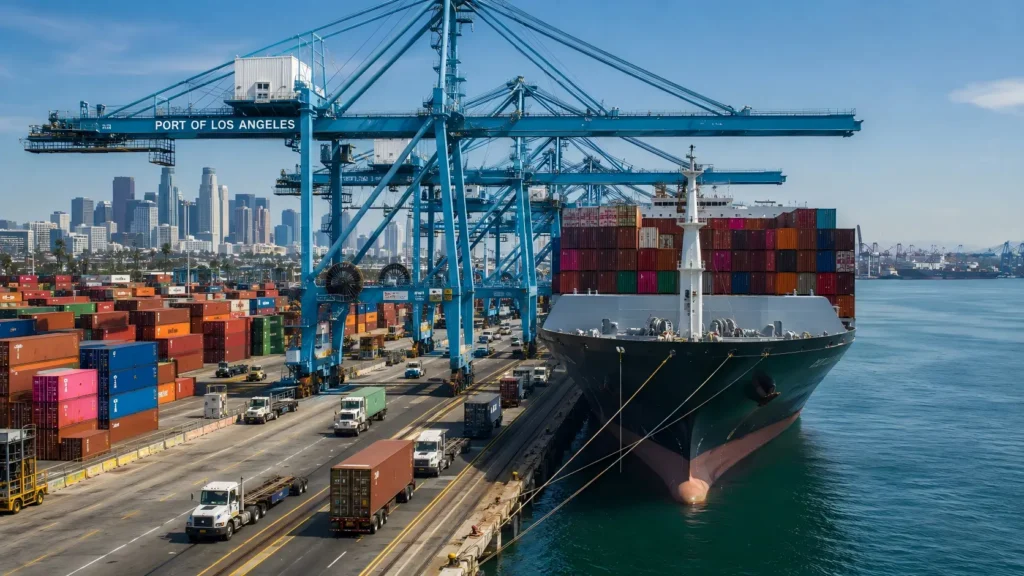
The Port of Los Angeles is located in San Pedro Bay in Southern California and is one of the most important international container gateways in the United States.
Together with the neighboring Port of Long Beach, it forms the massive San Pedro Bay port complex, one of the most important logistics hubs connecting Asia with the U.S. market.
However, it is important to understand that:
Port of Los Angeles ≠ Port of Long Beach
Although the two ports are located next to each other and share many transportation, rail, trucking, and warehousing resources, they are independently operated ports.
The Port of Los Angeles is managed by the Los Angeles Harbor Department, a department of the City of Los Angeles.
For Chinese exporters and U.S. importers, Los Angeles is especially important because it is one of the primary gateways for trans-Pacific container trade between Asia and the United States.
Port of Los Angeles Basic Information
| Item | Details |
|---|---|
| Port Name | Port of Los Angeles |
| Country | United States |
| State | California |
| Location | San Pedro Bay |
| City | Los Angeles |
| Main Cargo | Containers, automobiles, breakbulk, dry bulk, liquid bulk |
| Core Business | International Container Shipping |
| Main Trade Region | Asia |
| China Trade | Extremely Important |
| Main Container Terminals | 7 Major Terminals |
| Intermodal Rail Yards | 6 |
| U.S. Customs Authority | U.S. Customs and Border Protection |
| Inland Transportation | Truck + Rail |
| Common Port Code | USLAX |
For most importers shipping containers from China, the most important parts of the port are its container terminals, rail facilities, trucking gates, and customs clearance network.
Why Is the Port of Los Angeles So Important for China-to-USA Shipping?
The Port of Los Angeles can be considered one of the most important gateways for Chinese manufactured goods entering the United States.
Major Chinese ports such as:
- Qingdao
- Shanghai
- Ningbo
- Shenzhen
- Yantian
- Xiamen
are connected to Southern California through trans-Pacific container services.
Once containers arrive in Los Angeles, they do not necessarily remain in California.
Cargo can continue inland by:
Truck
Rail
Warehouse Distribution
Intermodal Transport
to destinations such as:
- Phoenix
- Las Vegas
- Dallas
- Chicago
- Denver
- Kansas City
- Memphis
and many other U.S. inland markets.
This means the Port of Los Angeles is not simply a California port.
It is a major national import gateway for the United States.
Port of Los Angeles vs. Port of Long Beach
Many first-time importers from China confuse Los Angeles and Long Beach.
Port of Los Angeles
Managed by:
City of Los Angeles
Port of Long Beach
Managed by:
City of Long Beach
Although both ports:
- are located in San Pedro Bay
- handle large volumes of Asian cargo
- share trucking and rail infrastructure
- serve similar shipping lines
- support the same Southern California warehouse market
they remain separate ports.
Therefore, your booking must clearly state whether the destination port is:
Los Angeles
or
Long Beach
This can affect:
- terminal location
- container pickup
- trucking
- appointment systems
- destination charges
- empty container return
- terminal procedures
Major Container Terminals at the Port of Los Angeles
The Port of Los Angeles operates several major container terminals.
For importers, knowing the exact terminal is extremely important.
It is not enough to know:
My container is arriving at Los Angeles.
You must also know:
Which terminal is handling the container?
1. APM Terminals Pacific – Pier 400
APM Terminals Pacific operates one of the largest container terminals at the Port of Los Angeles.
It is located at:
Berths 401–406
Pier 400 handles large container vessels and is an important gateway for trans-Pacific cargo.
Facilities include:
- container berths
- container yards
- ship-to-shore cranes
- truck gates
- rail connections
- intermodal facilities
Many China-to-USA FCL shipments may be discharged through large terminals such as Pier 400.
2. Fenix Marine Services – Pier 300
Fenix Marine Services, commonly known as:
FMS
operates Pier 300.
It is one of the largest container terminals at the Port of Los Angeles.
FMS provides services including:
- container handling
- stevedoring
- intermodal service
- trucking support
- storage
- equipment maintenance
It is an important terminal for international container imports.
3. TraPac Container Terminal
TraPac operates container facilities at:
Berths 134–147
The terminal is known for advanced automation and digital container handling systems.
For importers, the key information to confirm includes:
- container number
- terminal
- customs status
- container availability
- truck appointment
- shipping line release
4. Everport Terminal Services
Everport operates container facilities around:
Berths 226–236
The terminal also has on-dock rail capabilities.
This allows containers to move directly from the port into the U.S. rail network for inland transportation.
5. Yusen Terminals – YTI
Yusen Terminals is commonly known as:
YTI
and operates facilities around:
Berths 212–225
YTI is another important container terminal serving international shipping lines and importers.
6. WBCT China Shipping
WBCT stands for:
West Basin Container Terminal
and operates part of the container handling facilities at the Port of Los Angeles.
Some China-to-USA container services may use West Basin terminals.
7. WBCT LA TiL
WBCT LA TiL operates around:
Berths 121–127
and is another major terminal supporting international container shipping.
Why Must Importers Know the Exact Terminal?
Every terminal has its own operating procedures.
These may include:
- gate hours
- truck appointment systems
- container availability
- free time
- empty return instructions
- terminal holds
- storage rules
Therefore, a freight forwarder or trucking company needs the exact terminal information before arranging container pickup.
Shipping from China to the Port of Los Angeles
Los Angeles is one of the most important destination ports for Chinese exports.
Common routes include:
Qingdao to Los Angeles
Qingdao Port → Pacific Ocean → Port of Los Angeles
This route is particularly suitable for exporters in Shandong Province.
Cargo can originate from:
- Qingdao
- Dezhou
- Jinan
- Weifang
- Linyi
- Zibo
- Yantai
- Weihai
A typical logistics route may be:
Dezhou → Qingdao Port → Los Angeles → Door Delivery
Suitable cargo may include:
- fitness equipment
- machinery
- building materials
- industrial products
Shanghai to Los Angeles
Factories in the Yangtze River Delta can use:
Shanghai → Los Angeles
Typical origin areas include:
- Shanghai
- Suzhou
- Kunshan
- Wuxi
- Changzhou
- Nantong
Ningbo to Los Angeles
Manufacturers in Zhejiang often use:
Ningbo → Los Angeles
Typical cargo includes:
- furniture
- hardware
- plastic products
- machinery
- household goods
- automotive parts
Shenzhen / Yantian to Los Angeles
South China exporters often use:
Yantian → Los Angeles
This route serves manufacturers in:
- Shenzhen
- Dongguan
- Guangzhou
- Huizhou
- Pearl River Delta
Shipping Methods from China to Los Angeles
The main options include:
FCL Shipping
FCL means:
Full Container Load
Common container types include:
20GP
Best suited for:
- heavy cargo
- machinery
- steel products
- fitness equipment
- dense industrial products
40GP
Suitable for standard large-volume cargo.
40HQ
One of the most commonly used containers for China-to-USA shipping.
Suitable for:
- furniture
- aluminum products
- building materials
- consumer products
- bulky industrial cargo
LCL Shipping to Los Angeles
If your shipment is only:
- 2 CBM
- 5 CBM
- 8 CBM
- 10 CBM
- 15 CBM
you may not need a full container.
In this case, you can use:
LCL – Less than Container Load
Typical process:
Factory Pickup
↓
China Warehouse
↓
Cargo Receiving
↓
Export Customs Clearance
↓
Cargo Consolidation
↓
Container Loading
↓
Ocean Freight
↓
Los Angeles CFS
↓
Deconsolidation
↓
U.S. Customs Clearance
↓
Final Delivery
LCL is suitable for importers with smaller shipment volumes.
Complete FCL Shipping Process from China to Los Angeles
For example, consider a shipment of fitness equipment from Dezhou, Shandong.
Step 1
Factory Pickup in Dezhou
↓
Step 2
20GP Empty Container Pickup
↓
Step 3
Factory Container Loading
↓
Step 4
Truck to Qingdao Port
↓
Step 5
China Export Customs Clearance
↓
Step 6
Ocean Freight
Qingdao → Los Angeles
↓
Step 7
ISF Filing
↓
Step 8
Arrival at Port of Los Angeles
↓
Step 9
U.S. Customs Clearance
↓
Step 10
Terminal Release
↓
Step 11
Container Pickup
↓
Step 12
Truck Delivery
↓
Step 13
Customer Warehouse
↓
Step 14
Empty Container Return
This is a complete:
Door-to-Door Shipping from China to Los Angeles
solution.
What Is ISF?
Ocean shipments imported into the United States must pay particular attention to:
Importer Security Filing
commonly known as:
ISF
or:
ISF 10+2
For applicable ocean cargo, the required ISF information must generally be submitted before the cargo is loaded onto the vessel destined for the United States.
This means U.S. import documentation should be prepared before the container departs China.
Importers should coordinate with:
- importer
- customs broker
- freight forwarder
- supplier
- shipping line
before vessel loading.
What Information Is Required for ISF?
Depending on the transaction structure, information may include:
- Seller
- Buyer
- Importer of Record
- Consignee
- Manufacturer
- Ship-to Party
- Country of Origin
- HTSUS Information
- Container Stuffing Location
- Consolidator
Before shipment, the importer should clearly determine:
Who Will File the ISF?
Failing to arrange ISF correctly can cause compliance issues or delays.
U.S. Customs Clearance at the Port of Los Angeles
When cargo arrives in Los Angeles, the importer must complete U.S. customs clearance.
The primary federal customs authority is:
U.S. Customs and Border Protection – CBP
Typical customs documents may include:
- Commercial Invoice
- Packing List
- Bill of Lading
- Arrival Notice
- Importer of Record information
- EIN or Importer Number
- HTS Classification
- Country of Origin
- Customs Bond
- Product Description
- Manufacturer Information
Depending on the product, other federal agencies may also be involved.
Examples include:
- FDA
- EPA
- FCC
- USDA
- DOT
- CPSC
Therefore, regulatory requirements should be checked before shipment.
What Is a Customs Bond?
Commercial imports into the United States frequently require a:
Customs Bond
The two most common types are:
Single Entry Bond
Suitable for occasional importers.
Continuous Bond
Usually more suitable for companies importing regularly.
The correct bond type should be determined with a licensed U.S. customs broker.
How Are U.S. Import Duties Calculated?
Import duties cannot be determined using only the product name.
The final duty may depend on:
HTS Code
Country of Origin
Customs Value
Base Duty Rate
Additional Tariffs
Product-Specific Regulations
Therefore, importers should verify the correct:
HTSUS Classification
before shipment.
For Chinese-origin products, importers should also check whether any current additional tariffs or trade measures apply.
What Is CBP Form 7501?
Another important U.S. import document is:
important U.S. import document is:
CBP Form 7501
also known as:
Entry Summary
This document contains key import information such as:
- product classification
- customs value
- duty calculation
- importer details
- country of origin
In most cases, a licensed customs broker files the entry through the U.S. ACE system.
Does Customs Clearance Mean the Container Can Be Picked Up Immediately?
No.
This is extremely important.
A container usually needs several releases before it can leave the terminal.
These may include:
Customs Release
CBP has released the shipment.
Terminal Availability
The container has been discharged and is available.
Shipping Line Release
The carrier has released the container.
Freight Payment
All required freight charges have been settled.
No Terminal Holds
The terminal has no outstanding hold.
Truck Appointment
The trucking company has secured a pickup appointment.
Therefore:
Customs Cleared ≠ Container Ready for Pickup
This is one of the most common misunderstandings among first-time importers.
Los Angeles Port Drayage
Short-distance container trucking from the port is generally known as:
Drayage
Typical routes include:
Port of Los Angeles → Los Angeles Warehouse
or:
Port of Los Angeles → Ontario, CA
Port of Los Angeles → Fontana, CA
Port of Los Angeles → Rancho Cucamonga
Port of Los Angeles → Riverside
Port of Los Angeles → San Bernardino
Many imported containers are delivered to warehouses in Southern California’s:
Inland Empire
because this area contains a very large concentration of:
- distribution centers
- import warehouses
- fulfillment centers
- e-commerce warehouses
- logistics facilities
Why Are Ontario and Fontana Important Logistics Markets?
Many importers assume that cargo arriving at Los Angeles Port will be delivered to downtown Los Angeles.
In reality, a large percentage of imported cargo moves inland to cities such as:
- Ontario
- Fontana
- Rancho Cucamonga
- Chino
- City of Industry
- Riverside
- San Bernardino
These areas have extensive warehouse and distribution infrastructure.
Therefore, when requesting a door-to-door quote, do not provide only:
Los Angeles
Instead, provide the:
Final ZIP Code
This is essential for accurate trucking pricing.
Rail Transportation from the Port of Los Angeles
Another major advantage of the Port of Los Angeles is its extensive rail network.
Containers can move from the port to inland U.S. markets by intermodal rail.
Potential destinations include:
- Chicago
- Dallas
- Memphis
- Kansas City
- Denver
and other major logistics hubs.
What Is the Alameda Corridor?
The Alameda Corridor is an important freight rail connection between the Los Angeles/Long Beach port complex and the national U.S. rail network.
It helps move containers efficiently from the port area into inland rail systems.
For example:
China → Los Angeles → Rail → Chicago
or:
China → Los Angeles → Rail → Dallas → Truck Delivery
Therefore, the Port of Los Angeles can serve destinations far beyond California.
Truck vs. Rail from Los Angeles
For nearby Southern California destinations:
Truck / Drayage
is usually the most direct solution.
For long-distance inland transportation:
Rail + Truck
may be more suitable.
The correct solution depends on:
- final ZIP code
- cargo weight
- container size
- rail schedule
- free time
- warehouse appointment
- transportation cost
Common Charges at the Port of Los Angeles
Importers should not calculate total logistics cost based only on ocean freight.
Destination costs may include several additional charges.
1. Destination Charges
Possible charges include:
- terminal-related fees
- documentation fees
- handling charges
- destination service fees
The exact charges depend on:
- shipping line
- freight contract
- shipment type
- terminal
- Incoterm
2. Customs Clearance Fee
A customs broker may charge:
- Customs Entry Fee
- ISF Filing Fee
- Bond Fee
- Filing Charges
3. Import Duty
Import duties depend on:
- HTS Code
- country of origin
- customs value
- additional tariffs
4. Drayage
Drayage is the trucking cost from the port terminal to the consignee’s warehouse.
Cost factors may include:
- distance
- ZIP code
- container size
- cargo weight
- chassis
- appointment
- waiting time
5. Chassis Fee
In the United States, container drayage commonly requires a:
Container Chassis
Therefore, trucking quotations may include a:
Chassis Fee
6. Pre-Pull
If the container must be picked up before free time expires but the consignee cannot receive it immediately, the trucker may arrange:
Pre-Pull
The container is removed from the terminal and temporarily stored at a yard before final delivery.
7. Yard Storage
If a pre-pulled container remains at a trucking yard or container yard, additional:
Storage Fees
may apply.
8. Demurrage
If the container remains inside the marine terminal beyond the allowed free time, the importer may incur:
Demurrage
9. Detention
If the container has already left the terminal but the empty container is not returned within the carrier’s permitted free time, the importer may incur:
Detention
Therefore:
Demurrage ≠ Detention
They are two different types of container charges.
10. Truck Waiting Time
If the consignee takes too long to unload the container, additional truck waiting charges may apply.
Before delivery, confirm:
- unloading appointment
- labor availability
- forklift
- loading dock
- unloading equipment
- warehouse receiving hours
11. Overweight Charges
20GP containers frequently carry heavy cargo.
Examples include:
- steel products
- machinery
- fitness equipment
- stone
- tiles
- industrial materials
Even if the cargo fits within the container’s technical payload capacity, U.S. road transportation is still subject to:
- axle weight limits
- state regulations
- chassis configuration
- route restrictions
Therefore:
A container can be legally loaded for ocean transport but still be overweight for U.S. road delivery.
Heavy containers should be evaluated before shipment.
20GP vs. 40HQ for Los Angeles Shipping
20GP
Best suited for:
- heavy cargo
- machinery
- fitness equipment
- steel products
- dense industrial cargo
40GP
Suitable for standard general cargo.
40HQ
Best suited for:
- furniture
- aluminum fencing
- construction products
- plastic products
- household goods
- high-volume, low-density cargo
The correct container should be selected based on:
CBM + Gross Weight + Package Dimensions
What Types of Cargo Are Commonly Shipped from China to Los Angeles?
The range of products is extremely broad.
Examples include:
Fitness Equipment
Commercial gym machines, racks, benches, and exercise equipment.
Machinery
Industrial equipment and machinery.
Aluminum Products
Aluminum fencing, gates, profiles, and fabricated products.
Furniture
Residential and commercial furniture.
Building Materials
Construction materials and components.
Auto Parts
Automotive components and accessories.
Plastic Products
Industrial and consumer plastic products.
Hardware
Tools and metal hardware.
Consumer Goods
Retail and household products.
Industrial Products
General manufacturing and industrial cargo.
Special attention should be given to:
- dangerous goods
- batteries
- food
- medical devices
- chemicals
- branded products
- wooden products
because these products may require additional shipping or U.S. import compliance.
Qingdao to Los Angeles Shipping Case
For example:
Commodity
Fitness Equipment
Container
1 × 20GP
Origin
Dezhou, Shandong, China
Port of Loading
Qingdao Port
Port of Discharge
Port of Los Angeles
Service
Door-to-Door
The logistics chain is:
Dezhou Factory
↓
20GP Container Loading
↓
Truck to Qingdao Port
↓
China Export Customs Clearance
↓
Ocean Freight
↓
Port of Los Angeles
↓
U.S. Customs Clearance
↓
Container Pickup
↓
Final Delivery
↓
Empty Container Return
This type of service is suitable for importers purchasing directly from Chinese manufacturers.
Information Required for a China-to-Los Angeles Door-to-Door Quote
For an accurate quotation, provide the following:
1. Pickup Address
Example:
Dezhou, Shandong, China
2. Product Name
Example:
- Fitness Equipment
- Aluminum Fence
- Machinery
- Furniture
3. HS Code
Provide it if available.
4. Cargo Value
Required for customs evaluation.
5. Number of Packages
Example:
25 pallets
6. Gross Weight
Example:
15,000 KG
7. CBM
Example:
28 CBM
8. Container Type
Example:
1 × 20GP
or:
1 × 40HQ
9. Destination ZIP Code
For example:
91761 – Ontario, California
This is much more useful than simply writing:
Los Angeles
10. Cargo Ready Date
This helps confirm:
- vessel schedule
- equipment availability
- space
- ocean freight
- cutoff dates
Port-to-Port vs. Door-to-Door Shipping
Port-to-Port Shipping
Example:
Qingdao Port → Port of Los Angeles
This generally covers the international ocean freight portion only.
The importer may still need to arrange:
- China factory pickup
- export customs clearance
- ISF
- U.S. customs broker
- terminal release
- drayage
- warehouse delivery
- empty container return
Door-to-Door Shipping
Example:
Dezhou Factory → Qingdao → Los Angeles → Ontario Warehouse
A full door-to-door solution can combine multiple logistics stages under one coordinated shipment.
This is particularly useful for importers without their own logistics team in the United States.
BRF SHIPPING China-to-Los Angeles Logistics Services
BRF SHIPPING can coordinate a complete China-to-Los Angeles logistics solution.
Services may include:
China Factory Pickup
Pickup directly from suppliers or factories.
China Warehouse
Cargo receiving, storage, and handling.
Cargo Consolidation
Combine goods from multiple Chinese suppliers.
FCL Shipping
Available for:
- 20GP
- 40GP
- 40HQ
LCL Shipping
Suitable for smaller shipments.
China Export Customs Clearance
Coordination of export declaration and shipping documents.
Ocean Freight
Shipping from major Chinese ports to Los Angeles.
ISF Coordination
Coordinate ISF information with the importer and U.S. customs broker.
U.S. Customs Clearance Coordination
Work with licensed customs brokers in the United States.
Port Pickup
Arrange container pickup from the Los Angeles terminal.
Drayage
Truck delivery throughout Southern California.
Rail + Truck
Intermodal transportation to inland U.S. markets.
Door Delivery
Delivery to:
- warehouse
- distribution center
- commercial address
- fulfillment center
- project site
Major China Ports for Shipping to Los Angeles
BRF SHIPPING can arrange shipments from major Chinese ports, including:
Qingdao Port
Best suited for Shandong and surrounding regions.
Shanghai Port
Suitable for Shanghai and Jiangsu manufacturers.
Ningbo Port
Suitable for Zhejiang exporters.
Shenzhen / Yantian
Suitable for Shenzhen, Dongguan, Guangzhou, Huizhou, and South China.
Xiamen Port
Suitable for Fujian exporters.
The correct port should be selected based on:
Factory Location + Cargo Type + Vessel Schedule + Freight Cost
Port of Los Angeles FAQ
Is the Port of Los Angeles one of the largest container ports in the United States?
Yes. It is one of the most important container gateways in the United States and a key hub for trans-Pacific trade.
Are Los Angeles and Long Beach the same port?
No.
The Port of Los Angeles and Port of Long Beach are separate ports, although they are located next to each other in San Pedro Bay.
Can I ship a 20GP container from China to Los Angeles?
Yes.
20GP containers are especially suitable for relatively heavy cargo.
Can I ship a 40HQ container from China to Los Angeles?
Yes.
40HQ is one of the most commonly used container types for China-to-USA shipping.
Is ISF required for ocean freight to the United States?
Applicable vessel shipments entering the United States are subject to Importer Security Filing requirements.
Can I pick up the container immediately after customs clearance?
Not necessarily.
You must also confirm:
Terminal Availability + Carrier Release + No Holds + Truck Appointment
Can containers be delivered from Los Angeles Port to Ontario, California?
Yes.
Ontario and the surrounding Inland Empire region are major logistics and warehousing markets.
Can a container move from Los Angeles to Chicago by rail?
Yes.
Intermodal rail can be used to move containers from Southern California to inland U.S. destinations, depending on the shipping line, terminal, rail service, and routing.
Can BRF SHIPPING arrange door-to-door delivery in the USA?
Yes.
A complete solution can include:
China Pickup → Export Customs → Ocean Freight → U.S. Customs Clearance → Port Pickup → Truck / Rail → Final Delivery
Shipping from China to the Port of Los Angeles with BRF SHIPPING
The Port of Los Angeles is more than a West Coast seaport.
It is one of the most important logistics gateways connecting:
Chinese and Asian Supply Chains with the U.S. Market
A complete China-to-USA shipping solution should consider:
Factory Pickup
China Export Customs Clearance
Ocean Freight
ISF
U.S. Customs Clearance
Terminal Release
Drayage
Rail Transportation
Warehouse Delivery
Empty Container Return
Therefore, importers should not focus only on:
Qingdao to Los Angeles Ocean Freight Rate
The more important calculation is:
Total Logistics Cost from the China Factory to the U.S. Warehouse
If your suppliers are located in:
Qingdao, Dezhou, Jinan, Weifang, Linyi, Shanghai, Ningbo, Shenzhen, Guangzhou, or other manufacturing regions in China
provide:
Pickup Address + Commodity + HS Code + Weight + CBM + Container Type + Cargo Value + Destination ZIP Code + Cargo Ready Date
BRF SHIPPING can design a complete logistics solution covering:
China Factory → Port of Los Angeles → U.S. Customs → Final Door Delivery
China → Los Angeles
Port-to-Port | FCL | LCL | Customs Clearance | Trucking | Rail | Door-to-Door
BRF SHIPPING