When purchasing goods from China or another overseas supplier, buyers frequently encounter quotations such as:
- 7 days ARO
- 15 days ARO
- Delivery: 30 days ARO
- Production lead time: 20–25 days ARO
At first glance, the term appears simple.
However, misunderstanding ARO shipping terms can create serious problems when planning international transportation.
Does “15 days ARO” mean the cargo arrives at your warehouse in 15 days?
Does the countdown begin when the buyer sends the purchase order?
Does it start after the supplier confirms the order?
Does payment need to be completed first?
And does ARO include ocean freight or air freight transit time?
Usually, ARO means “After Receipt of Order.” It establishes a starting point for a supplier’s production, processing, payment or delivery timeline after an order has been received or confirmed. It should not automatically be interpreted as international transportation time.
For importers, the most important lesson is simple:
ARO lead time and international shipping transit time are usually two separate parts of the supply chain.
Understanding this distinction can help importers plan freight more accurately, reduce missed vessel bookings and create more realistic delivery schedules.
What Does ARO Mean in Shipping?
ARO stands for:
After Receipt of Order
It generally identifies the point from which an agreed time period begins.
For example:
“Production: 20 days ARO”
usually means that the supplier expects approximately 20 days to complete the agreed production or order-processing stage after the order has been received or confirmed.
But ARO wording is not automatically standardized across every supplier.
One manufacturer may begin counting after receiving the purchase order.
Another may begin only after:
- deposit payment is received,
- technical drawings are approved,
- packaging requirements are confirmed,
- samples are approved,
- artwork is finalized,
- or the supplier issues a formal order confirmation.
This is why importers should never rely only on the abbreviation.
The ARO trigger should be confirmed in writing.
Does ARO Mean Shipping Time?
Not necessarily.
This is one of the most common misunderstandings surrounding ARO.
If a Chinese manufacturer quotes:
“15 days ARO”
that does not automatically mean your goods will arrive in the United States, Canada, Australia or Europe 15 days after placing the order.
In many cases, those 15 days only represent the supplier’s internal lead time.
After the cargo becomes ready, additional logistics stages may still include:
Factory completion → pickup → export customs → port handling → international freight → destination customs clearance → final delivery
Therefore:
ARO time + freight preparation + international transit + customs clearance + inland delivery = approximate total supply-chain lead time.
A recent logistics explanation of ARO similarly emphasizes that a quoted ARO period should not automatically be treated as carrier transit time and recommends confirming the cargo-ready date before planning transportation.
ARO vs Cargo Ready Date: An Important Difference
For a freight forwarder such as BRF SHIPPING, one of the most useful dates is not simply the ARO date.
It is the:
Cargo Ready Date — CRD
The Cargo Ready Date is the date when the supplier expects the goods to be:
- fully manufactured,
- inspected,
- packed,
- labeled,
- export-ready,
- and available for pickup.
This date allows the freight forwarder to begin coordinating the actual shipment.
For example:
A buyer places an order with a Qingdao supplier on September 1.
The supplier offers:
Production Lead Time: 20 Days ARO
Assuming the ARO clock begins September 1, production may finish around September 21.
But if packaging requires another two days, the actual Cargo Ready Date may be September 23.
The freight forwarder should therefore plan transportation based on approximately September 23, rather than simply assuming the shipment can depart September 21.
That small difference can determine whether the cargo catches the planned vessel.
ARO Shipping Example: China to USA
Consider a U.S. importer purchasing aluminum products from a supplier in China.
The supplier quote states:
Lead Time: 20 Days ARO
The order is confirmed on August 10.
A simplified logistics timeline could look like this:
| Stage | Example Timing |
|---|---|
| Purchase Order Confirmed | August 10 |
| Supplier Lead Time | 20 Days ARO |
| Production Completion | Around August 30 |
| Packing / Inspection | 1–3 Days |
| Cargo Ready Date | September 1 |
| Factory Pickup | September 1–3 |
| Export / Port Handling | Several Days |
| Ocean Freight | Depends on route/service |
| U.S. Customs Clearance | Depends on shipment |
| Final Truck Delivery | After cargo release |
This example demonstrates why 20 days ARO is not the same as 20 days door-to-door delivery.
International freight must be planned separately.
Why ARO Matters for International Freight Booking
A clear ARO timeline directly affects freight planning.
Freight forwarders normally need advance information such as:
- cargo ready date,
- origin city,
- destination,
- number of packages,
- gross weight,
- cargo dimensions,
- total CBM,
- container requirement,
- commodity description,
- shipping urgency.
If the buyer provides an incorrect Cargo Ready Date because the ARO term was misunderstood, several logistics problems can occur.
1. Missed Vessel Departures
Ocean freight bookings are connected to specific vessel schedules and cutoff dates.
If a supplier says cargo will be ready on Friday but production is delayed until the following Wednesday, the container may miss the planned vessel.
The shipment then needs to be transferred to a later sailing.
This may extend the total delivery time by several days or longer depending on the route and available capacity.
2. Unnecessary Booking Changes
Freight space should ideally be booked around a realistic production schedule.
Repeatedly changing bookings because the supplier’s production date is uncertain can create unnecessary work and may sometimes generate cancellation or amendment charges.
Therefore, importers should confirm production progress before the final shipping plan is locked.
3. Container Trucking Problems
For FCL shipments, freight forwarders need to coordinate:
empty container pickup → factory loading → return to port terminal
If the truck and container arrive at the factory before the goods are ready, additional trucking or waiting costs may occur.
Accurate ARO and Cargo Ready Date information helps prevent this.
4. Air Freight Cost Increases
Poor production planning can create another common problem.
An importer originally intends to use ocean freight.
But because the production schedule was misunderstood, the cargo finishes much later than expected.
The buyer then realizes that ocean freight will miss a customer’s deadline.
The only solution may be:
switching part or all of the order to air freight.
This can significantly increase transportation costs.
Good ARO planning therefore helps control logistics expenses.
ARO Is Not an Incoterm
Another important distinction is that ARO should not be confused with Incoterms.
Terms such as:
- EXW
- FCA
- FOB
- CFR
- CIF
- DAP
- DDP
describe responsibilities between buyer and seller relating to transportation, risk, delivery points and certain costs.
ARO has a different purpose.
It normally identifies when a specified timeline begins after the order is received or confirmed.
Therefore, a contract might contain both:
FOB Qingdao
and
Production: 25 days ARO
These two terms perform completely different functions.
The FOB term defines the commercial delivery arrangement.
The 25-day ARO term defines the supplier’s timeline.
ARO vs ARP vs COD
ARO is sometimes discussed together with payment-related terms such as ARP and COD.
However, businesses should be careful because the precise meaning of contractual abbreviations can depend on the agreement.
A simplified comparison is:
| Term | Common Meaning | Main Focus |
|---|---|---|
| ARO | After Receipt of Order | Timeline begins after order receipt |
| ARP | After Receipt of Payment | Activity begins after payment is received |
| COD | Cash on Delivery | Payment occurs upon delivery |
ARO vs ARP
ARO — After Receipt of Order
The relevant production, processing or contractual timeline may begin after the order is received.
ARP — After Receipt of Payment
The supplier waits until the agreed payment has been received before the relevant process begins.
Imagine two suppliers both quote a 20-day production lead time.
Supplier A:
20 days ARO
Supplier B:
20 days after receipt of deposit/payment
If payment to Supplier B takes four business days to clear, Supplier B’s actual production completion could be several days later.
This difference becomes important when planning international freight.
ARO vs COD
COD normally means:
Cash on Delivery
Under a COD arrangement, payment is made when the shipment or goods are delivered according to the agreed arrangement.
COD therefore focuses primarily on the payment point.
ARO focuses on the starting point of an order-related timeline.
They are not interchangeable terms.
Advantages of Using Clear ARO Terms
When defined properly, ARO terminology can make international purchasing easier.
Clear Production Planning
Both buyer and supplier know when the production countdown begins.
This improves scheduling and reduces arguments about delivery expectations.
Better Freight Planning
Importers can estimate the Cargo Ready Date and communicate it to their freight forwarder.
This allows earlier planning of:
- ocean freight,
- air freight,
- container availability,
- warehouse space,
- customs documentation,
- inland delivery.
Improved Inventory Management
Companies importing inventory can connect supplier production schedules with expected warehouse demand.
This is particularly useful for seasonal products and replenishment orders.
Better Customer Commitments
Importers can provide more realistic delivery estimates to distributors, retailers and project customers.
Risks of Poorly Defined ARO Terms
ARO can also create problems if the agreement is vague.
One of the biggest risks is uncertainty about when the clock starts.
For example, a buyer may believe the 30-day timeline started when the purchase order was emailed.
The manufacturer may believe it starts after the deposit is received.
A four-day payment delay therefore immediately creates a four-day disagreement.
Other potential problems include:
- production delays,
- missed vessel departures,
- higher air freight costs,
- inventory shortages,
- missed project deadlines,
- warehouse appointment changes,
- customer complaints.
Most of these problems can be reduced with clearer documentation.
What Importers Should Confirm Before Placing an Order
Before accepting an ARO term, ask the supplier several questions.
1. What Starts the ARO Clock?
Confirm whether the countdown starts after:
- PO receipt,
- order confirmation,
- deposit payment,
- sample approval,
- drawing approval,
- or another event.
2. Are ARO Days Calendar Days or Business Days?
Never assume.
Ask the supplier to specify:
20 calendar days
or
20 working days
The difference can become significant when public holidays or factory shutdowns occur.
3. What Happens at the End of the ARO Period?
Does the quoted date mean:
- production completed,
- goods packed,
- inspection completed,
- cargo ready for pickup,
- or shipment departed?
This is one of the most important questions.
For logistics purposes, BRF SHIPPING recommends obtaining a clearly stated:
Cargo Ready Date.
4. Does the Timeline Include Inspection?
Many B2B importers arrange pre-shipment quality inspections.
If inspection takes place after production, allow sufficient time for:
production completion → inspection → corrections if required → final packing → pickup
Do not schedule the truck before these steps are complete.
How to Build an ARO-Based International Shipping Plan
A practical international logistics strategy can be divided into eight stages.
Step 1 — Confirm the Order
Buyer and supplier agree on:
- product specifications,
- quantities,
- pricing,
- payment terms,
- Incoterm,
- ARO definition,
- production lead time.
Step 2 — Calculate the Estimated Cargo Ready Date
Use the agreed ARO starting point and supplier lead time.
For example:
Order confirmed: October 1
Production: 25 days ARO
Estimated completion: October 26
Then add inspection and packing time where necessary.
Step 3 — Contact the Freight Forwarder Early
Do not wait until production is completely finished.
Provide preliminary shipment information to BRF SHIPPING in advance.
This allows the freight team to review shipping options and schedules.
Step 4 — Compare Ocean and Air Freight
For large commercial shipments, ocean freight is generally the main solution.
Possible options include:
FCL — Full Container Load
20GP, 40GP or 40HQ containers for larger shipments.
LCL — Less than Container Load
Suitable when the cargo does not require a full container.
Air Freight
Suitable for high-value, urgent or relatively lightweight cargo.
Step 5 — Confirm the Final Cargo Ready Date
Several days before production completion, reconfirm the date with the factory.
Do not rely solely on the original estimate.
Ask:
“Is the cargo still expected to be fully packed and ready for pickup on the agreed date?”
This simple confirmation can prevent many booking problems.
Step 6 — Book Freight
After the Cargo Ready Date becomes reliable, BRF SHIPPING can coordinate the appropriate transportation schedule based on:
- departure port,
- destination port,
- shipping line,
- transit requirements,
- cost,
- available capacity.
Step 7 — Arrange Pickup and Export Handling
Depending on the agreed Incoterm and logistics arrangement, the process may include:
factory pickup → warehouse/container loading → export customs declaration → port delivery
Accurate coordination between the supplier and freight forwarder is critical.
Step 8 — International Transportation and Final Delivery
After departure, the supply chain continues through:
ocean or air freight → destination arrival → import customs clearance → truck delivery
This is why ARO should always be considered only one part of the complete delivery timeline.
ARO Planning for Shipping from China
ARO planning becomes especially useful when sourcing products from multiple Chinese manufacturing regions.
BRF SHIPPING can coordinate shipments originating from major industrial and port regions such as:
- Qingdao
- Shanghai
- Ningbo
- Shenzhen
- Guangzhou
- Tianjin
- Xiamen
- and other China manufacturing locations.
The importer should ideally contact the logistics provider before the Cargo Ready Date.
Early planning gives more time to evaluate routing, container type, vessel schedules and shipping cost.
How BRF SHIPPING Helps After the Order Is Received
Once your supplier confirms an international order, logistics planning can begin even before production is completed.
BRF SHIPPING can coordinate the freight process from China to overseas destinations, including:
Factory Pickup
Cargo collection from the supplier after production is completed.
FCL Ocean Freight
20GP, 40GP and 40HQ container transportation for larger shipments.
LCL Shipping
Consolidated ocean freight for smaller commercial shipments.
Air Freight
For urgent or time-sensitive cargo.
Export Handling
Coordination of export documentation and China-side shipping procedures.
Destination Customs Coordination
Support for organizing the customs-clearance process with the appropriate destination partners.
Door Delivery
Transportation from the destination port or terminal to the final business or warehouse address where applicable.
The goal is to connect:
Supplier Production → Cargo Ready Date → Freight Booking → International Shipping → Final Delivery
into one coordinated supply-chain plan.
ARO Shipping Checklist for Importers
Before arranging transportation, confirm the following information:
| Item | Check |
|---|---|
| Purchase Order Confirmed | ✓ |
| ARO Starting Point Confirmed | ✓ |
| Calendar / Working Days Confirmed | ✓ |
| Production Lead Time Confirmed | ✓ |
| Inspection Requirement Confirmed | ✓ |
| Packing Completion Date Confirmed | ✓ |
| Cargo Ready Date Confirmed | ✓ |
| Incoterm Confirmed | ✓ |
| Cargo Weight & CBM Confirmed | ✓ |
| Freight Forwarder Contacted | ✓ |
| Shipping Method Selected | ✓ |
| Destination Delivery Requirements Confirmed | ✓ |
A simple checklist can prevent expensive supply-chain misunderstandings.
Frequently Asked Questions About ARO Shipping
What does ARO mean in shipping?
ARO usually means After Receipt of Order. It identifies when an agreed order, production, processing or delivery-related timeline begins after a supplier receives or confirms an order.
What does “10 days ARO” mean?
It normally means that an agreed activity or deadline occurs 10 days after the defined order-receipt point.
However, buyers should confirm exactly what event starts the countdown and what the supplier promises to complete by day 10.
Does ARO include shipping time?
Usually not unless the contract specifically states that it does.
Supplier lead time and international transportation time should generally be calculated separately.
Is ARO the same as the Cargo Ready Date?
No.
ARO normally defines the start of a timeline.
The Cargo Ready Date is the expected date when goods are fully prepared and available for pickup.
Is ARO an Incoterm?
No.
ARO should not be confused with Incoterms such as EXW, FOB, CIF or DDP.
An order can contain both an Incoterm and an ARO production term.
Are ARO days calendar days or business days?
There is no reason to assume one universally.
The purchase order or supplier contract should specify whether the quoted period uses calendar days or working days.
When should I contact my freight forwarder?
Ideally, contact your freight forwarder before production is completed.
Providing the estimated Cargo Ready Date early gives the logistics provider more time to evaluate transportation options and prepare the booking.
What information does BRF SHIPPING need for a freight quote?
For a more accurate quotation, provide:
- pickup city or port,
- destination port or ZIP/postcode,
- cargo description,
- number of packages,
- gross weight,
- dimensions,
- total CBM,
- estimated Cargo Ready Date,
- preferred shipping method,
- and Incoterm if known.
Final Thoughts: ARO Is the Beginning of the Logistics Timeline
ARO may look like a small abbreviation on a supplier quotation, but it can influence the entire international supply chain.
The most important concept to remember is:
ARO is not automatically your total delivery time.
For international imports, the complete timeline may include:
Order Confirmation
↓
ARO Production Lead Time
↓
Cargo Ready Date
↓
Factory Pickup
↓
Export Handling
↓
Ocean / Air Freight
↓
Customs Clearance
↓
Final Delivery
Importers who clearly define each stage can plan inventory more accurately, reduce missed bookings and avoid unnecessary expedited freight costs.
Planning an International Shipment After Placing Your Order?
If your supplier in China has confirmed an order and provided an ARO production lead time, send the details to BRF SHIPPING before the cargo is finished.
Provide us with:
Cargo Ready Date
Pickup Location
Destination
Cargo Description
Weight & CBM
Number of Packages
Shipping Requirements
BRF SHIPPING can help you plan the next stage—from factory pickup and freight booking to international transportation and destination delivery.
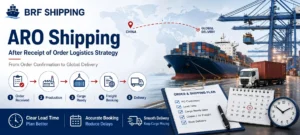
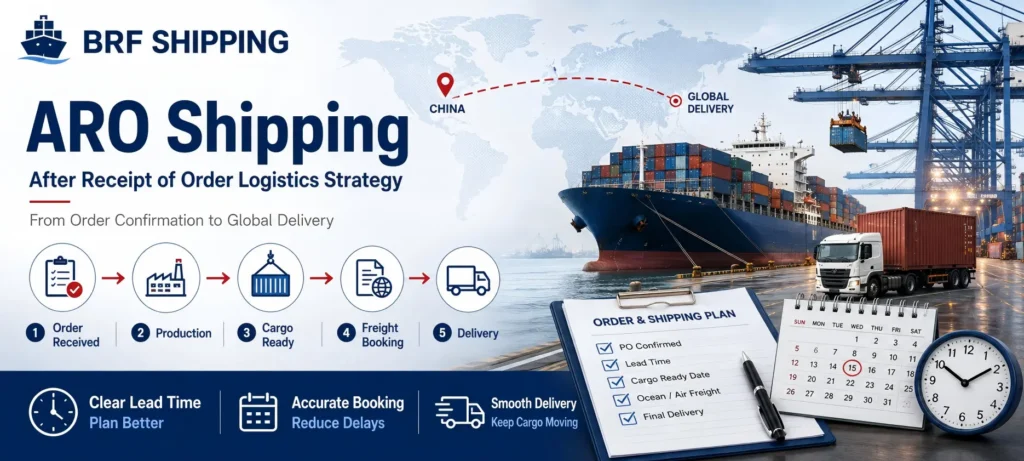
BRF SHIPPING — From Order Confirmation to Global Delivery.
ARO Shipping: What “After Receipt of Order” Means in International Logistics
SEO Title: ARO Shipping: After Receipt of Order Logistics Guide
Meta Description: Learn what ARO means in shipping, how After Receipt of Order affects lead time, freight booking, cargo ready dates and international delivery.
Suggested URL Slug:/aro-shipping-after-receipt-of-order/
Primary Keyword: ARO shipping
Secondary Keywords: After Receipt of Order, ARO meaning in shipping, ARO delivery time, ARO lead time, cargo ready date, international shipping lead time, shipping from China, freight booking, supplier lead time, ARO vs ARP, ARO vs COD
c
When purchasing goods from China or another overseas supplier, buyers frequently encounter quotations such as:
- 7 days ARO
- 15 days ARO
- Delivery: 30 days ARO
- Production lead time: 20–25 days ARO
At first glance, the term appears simple.
However, misunderstanding ARO shipping terms can create serious problems when planning international transportation.
Does “15 days ARO” mean the cargo arrives at your warehouse in 15 days?
Does the countdown begin when the buyer sends the purchase order?
Does it start after the supplier confirms the order?
Does payment need to be completed first?
And does ARO include ocean freight or air freight transit time?
Usually, ARO means “After Receipt of Order.” It establishes a starting point for a supplier’s production, processing, payment or delivery timeline after an order has been received or confirmed. It should not automatically be interpreted as international transportation time.
For importers, the most important lesson is simple:
ARO lead time and international shipping transit time are usually two separate parts of the supply chain.
Understanding this distinction can help importers plan freight more accurately, reduce missed vessel bookings and create more realistic delivery schedules.
What Does ARO Mean in Shipping?
ARO stands for:
After Receipt of Order
It generally identifies the point from which an agreed time period begins.
For example:
“Production: 20 days ARO”
usually means that the supplier expects approximately 20 days to complete the agreed production or order-processing stage after the order has been received or confirmed.
But ARO wording is not automatically standardized across every supplier.
One manufacturer may begin counting after receiving the purchase order.
Another may begin only after:
- deposit payment is received,
- technical drawings are approved,
- packaging requirements are confirmed,
- samples are approved,
- artwork is finalized,
- or the supplier issues a formal order confirmation.
This is why importers should never rely only on the abbreviation.
The ARO trigger should be confirmed in writing.
Does ARO Mean Shipping Time?
Not necessarily.
This is one of the most common misunderstandings surrounding ARO.
If a Chinese manufacturer quotes:
“15 days ARO”
that does not automatically mean your goods will arrive in the United States, Canada, Australia or Europe 15 days after placing the order.
In many cases, those 15 days only represent the supplier’s internal lead time.
After the cargo becomes ready, additional logistics stages may still include:
Factory completion → pickup → export customs → port handling → international freight → destination customs clearance → final delivery
Therefore:
ARO time + freight preparation + international transit + customs clearance + inland delivery = approximate total supply-chain lead time.
A recent logistics explanation of ARO similarly emphasizes that a quoted ARO period should not automatically be treated as carrier transit time and recommends confirming the cargo-ready date before planning transportation.
ARO vs Cargo Ready Date: An Important Difference
For a freight forwarder such as BRF SHIPPING, one of the most useful dates is not simply the ARO date.
It is the:
Cargo Ready Date — CRD
The Cargo Ready Date is the date when the supplier expects the goods to be:
- fully manufactured,
- inspected,
- packed,
- labeled,
- export-ready,
- and available for pickup.
This date allows the freight forwarder to begin coordinating the actual shipment.
For example:
A buyer places an order with a Qingdao supplier on September 1.
The supplier offers:
Production Lead Time: 20 Days ARO
Assuming the ARO clock begins September 1, production may finish around September 21.
But if packaging requires another two days, the actual Cargo Ready Date may be September 23.
The freight forwarder should therefore plan transportation based on approximately September 23, rather than simply assuming the shipment can depart September 21.
That small difference can determine whether the cargo catches the planned vessel.
ARO Shipping Example: China to USA
Consider a U.S. importer purchasing aluminum products from a supplier in China.
The supplier quote states:
Lead Time: 20 Days ARO
The order is confirmed on August 10.
A simplified logistics timeline could look like this:
| Stage | Example Timing |
|---|---|
| Purchase Order Confirmed | August 10 |
| Supplier Lead Time | 20 Days ARO |
| Production Completion | Around August 30 |
| Packing / Inspection | 1–3 Days |
| Cargo Ready Date | September 1 |
| Factory Pickup | September 1–3 |
| Export / Port Handling | Several Days |
| Ocean Freight | Depends on route/service |
| U.S. Customs Clearance | Depends on shipment |
| Final Truck Delivery | After cargo release |
This example demonstrates why 20 days ARO is not the same as 20 days door-to-door delivery.
International freight must be planned separately.
Why ARO Matters for International Freight Booking
A clear ARO timeline directly affects freight planning.
Freight forwarders normally need advance information such as:
- cargo ready date,
- origin city,
- destination,
- number of packages,
- gross weight,
- cargo dimensions,
- total CBM,
- container requirement,
- commodity description,
- shipping urgency.
If the buyer provides an incorrect Cargo Ready Date because the ARO term was misunderstood, several logistics problems can occur.
1. Missed Vessel Departures
Ocean freight bookings are connected to specific vessel schedules and cutoff dates.
If a supplier says cargo will be ready on Friday but production is delayed until the following Wednesday, the container may miss the planned vessel.
The shipment then needs to be transferred to a later sailing.
This may extend the total delivery time by several days or longer depending on the route and available capacity.
2. Unnecessary Booking Changes
Freight space should ideally be booked around a realistic production schedule.
Repeatedly changing bookings because the supplier’s production date is uncertain can create unnecessary work and may sometimes generate cancellation or amendment charges.
Therefore, importers should confirm production progress before the final shipping plan is locked.
3. Container Trucking Problems
For FCL shipments, freight forwarders need to coordinate:
empty container pickup → factory loading → return to port terminal
If the truck and container arrive at the factory before the goods are ready, additional trucking or waiting costs may occur.
Accurate ARO and Cargo Ready Date information helps prevent this.
4. Air Freight Cost Increases
Poor production planning can create another common problem.
An importer originally intends to use ocean freight.
But because the production schedule was misunderstood, the cargo finishes much later than expected.
The buyer then realizes that ocean freight will miss a customer’s deadline.
The only solution may be:
switching part or all of the order to air freight.
This can significantly increase transportation costs.
Good ARO planning therefore helps control logistics expenses.
ARO Is Not an Incoterm
Another important distinction is that ARO should not be confused with Incoterms.
Terms such as:
- EXW
- FCA
- FOB
- CFR
- CIF
- DAP
- DDP
describe responsibilities between buyer and seller relating to transportation, risk, delivery points and certain costs.
ARO has a different purpose.
It normally identifies when a specified timeline begins after the order is received or confirmed.
Therefore, a contract might contain both:
FOB Qingdao
and
Production: 25 days ARO
These two terms perform completely different functions.
The FOB term defines the commercial delivery arrangement.
The 25-day ARO term defines the supplier’s timeline.
ARO vs ARP vs COD
ARO is sometimes discussed together with payment-related terms such as ARP and COD.
However, businesses should be careful because the precise meaning of contractual abbreviations can depend on the agreement.
A simplified comparison is:
| Term | Common Meaning | Main Focus |
|---|---|---|
| ARO | After Receipt of Order | Timeline begins after order receipt |
| ARP | After Receipt of Payment | Activity begins after payment is received |
| COD | Cash on Delivery | Payment occurs upon delivery |
ARO vs ARP
ARO — After Receipt of Order
The relevant production, processing or contractual timeline may begin after the order is received.
ARP — After Receipt of Payment
The supplier waits until the agreed payment has been received before the relevant process begins.
Imagine two suppliers both quote a 20-day production lead time.
Supplier A:
20 days ARO
Supplier B:
20 days after receipt of deposit/payment
If payment to Supplier B takes four business days to clear, Supplier B’s actual production completion could be several days later.
This difference becomes important when planning international freight.
ARO vs COD
COD normally means:
Cash on Delivery
Under a COD arrangement, payment is made when the shipment or goods are delivered according to the agreed arrangement.
COD therefore focuses primarily on the payment point.
ARO focuses on the starting point of an order-related timeline.
They are not interchangeable terms.
Advantages of Using Clear ARO Terms
When defined properly, ARO terminology can make international purchasing easier.
Clear Production Planning
Both buyer and supplier know when the production countdown begins.
This improves scheduling and reduces arguments about delivery expectations.
Better Freight Planning
Importers can estimate the Cargo Ready Date and communicate it to their freight forwarder.
This allows earlier planning of:
- ocean freight,
- air freight,
- container availability,
- warehouse space,
- customs documentation,
- inland delivery.
Improved Inventory Management
Companies importing inventory can connect supplier production schedules with expected warehouse demand.
This is particularly useful for seasonal products and replenishment orders.
Better Customer Commitments
Importers can provide more realistic delivery estimates to distributors, retailers and project customers.
Risks of Poorly Defined ARO Terms
ARO can also create problems if the agreement is vague.
One of the biggest risks is uncertainty about when the clock starts.
For example, a buyer may believe the 30-day timeline started when the purchase order was emailed.
The manufacturer may believe it starts after the deposit is received.
A four-day payment delay therefore immediately creates a four-day disagreement.
Other potential problems include:
- production delays,
- missed vessel departures,
- higher air freight costs,
- inventory shortages,
- missed project deadlines,
- warehouse appointment changes,
- customer complaints.
Most of these problems can be reduced with clearer documentation.
What Importers Should Confirm Before Placing an Order
Before accepting an ARO term, ask the supplier several questions.
1. What Starts the ARO Clock?
Confirm whether the countdown starts after:
- PO receipt,
- order confirmation,
- deposit payment,
- sample approval,
- drawing approval,
- or another event.
2. Are ARO Days Calendar Days or Business Days?
Never assume.
Ask the supplier to specify:
20 calendar days
or
20 working days
The difference can become significant when public holidays or factory shutdowns occur.
3. What Happens at the End of the ARO Period?
Does the quoted date mean:
- production completed,
- goods packed,
- inspection completed,
- cargo ready for pickup,
- or shipment departed?
This is one of the most important questions.
For logistics purposes, BRF SHIPPING recommends obtaining a clearly stated:
Cargo Ready Date.
4. Does the Timeline Include Inspection?
Many B2B importers arrange pre-shipment quality inspections.
If inspection takes place after production, allow sufficient time for:
production completion → inspection → corrections if required → final packing → pickup
Do not schedule the truck before these steps are complete.
How to Build an ARO-Based International Shipping Plan
A practical international logistics strategy can be divided into eight stages.
Step 1 — Confirm the Order
Buyer and supplier agree on:
- product specifications,
- quantities,
- pricing,
- payment terms,
- Incoterm,
- ARO definition,
- production lead time.
Step 2 — Calculate the Estimated Cargo Ready Date
Use the agreed ARO starting point and supplier lead time.
For example:
Order confirmed: October 1
Production: 25 days ARO
Estimated completion: October 26
Then add inspection and packing time where necessary.
Step 3 — Contact the Freight Forwarder Early
Do not wait until production is completely finished.
Provide preliminary shipment information to BRF SHIPPING in advance.
This allows the freight team to review shipping options and schedules.
Step 4 — Compare Ocean and Air Freight
For large commercial shipments, ocean freight is generally the main solution.
Possible options include:
FCL — Full Container Load
20GP, 40GP or 40HQ containers for larger shipments.
LCL — Less than Container Load
Suitable when the cargo does not require a full container.
Air Freight
Suitable for high-value, urgent or relatively lightweight cargo.
Step 5 — Confirm the Final Cargo Ready Date
Several days before production completion, reconfirm the date with the factory.
Do not rely solely on the original estimate.
Ask:
“Is the cargo still expected to be fully packed and ready for pickup on the agreed date?”
This simple confirmation can prevent many booking problems.
Step 6 — Book Freight
After the Cargo Ready Date becomes reliable, BRF SHIPPING can coordinate the appropriate transportation schedule based on:
- departure port,
- destination port,
- shipping line,
- transit requirements,
- cost,
- available capacity.
Step 7 — Arrange Pickup and Export Handling
Depending on the agreed Incoterm and logistics arrangement, the process may include:
factory pickup → warehouse/container loading → export customs declaration → port delivery
Accurate coordination between the supplier and freight forwarder is critical.
Step 8 — International Transportation and Final Delivery
After departure, the supply chain continues through:
ocean or air freight → destination arrival → import customs clearance → truck delivery
This is why ARO should always be considered only one part of the complete delivery timeline.
ARO Planning for Shipping from China
ARO planning becomes especially useful when sourcing products from multiple Chinese manufacturing regions.
BRF SHIPPING can coordinate shipments originating from major industrial and port regions such as:
- Qingdao
- Shanghai
- Ningbo
- Shenzhen
- Guangzhou
- Tianjin
- Xiamen
- and other China manufacturing locations.
The importer should ideally contact the logistics provider before the Cargo Ready Date.
Early planning gives more time to evaluate routing, container type, vessel schedules and shipping cost.
How BRF SHIPPING Helps After the Order Is Received
Once your supplier confirms an international order, logistics planning can begin even before production is completed.
BRF SHIPPING can coordinate the freight process from China to overseas destinations, including:
Factory Pickup
Cargo collection from the supplier after production is completed.
FCL Ocean Freight
20GP, 40GP and 40HQ container transportation for larger shipments.
LCL Shipping
Consolidated ocean freight for smaller commercial shipments.
Air Freight
For urgent or time-sensitive cargo.
Export Handling
Coordination of export documentation and China-side shipping procedures.
Destination Customs Coordination
Support for organizing the customs-clearance process with the appropriate destination partners.
Door Delivery
Transportation from the destination port or terminal to the final business or warehouse address where applicable.
The goal is to connect:
Supplier Production → Cargo Ready Date → Freight Booking → International Shipping → Final Delivery
into one coordinated supply-chain plan.
ARO Shipping Checklist for Importers
Before arranging transportation, confirm the following information:
| Item | Check |
|---|---|
| Purchase Order Confirmed | ✓ |
| ARO Starting Point Confirmed | ✓ |
| Calendar / Working Days Confirmed | ✓ |
| Production Lead Time Confirmed | ✓ |
| Inspection Requirement Confirmed | ✓ |
| Packing Completion Date Confirmed | ✓ |
| Cargo Ready Date Confirmed | ✓ |
| Incoterm Confirmed | ✓ |
| Cargo Weight & CBM Confirmed | ✓ |
| Freight Forwarder Contacted | ✓ |
| Shipping Method Selected | ✓ |
| Destination Delivery Requirements Confirmed | ✓ |
A simple checklist can prevent expensive supply-chain misunderstandings.
Frequently Asked Questions About ARO Shipping
What does ARO mean in shipping?
ARO usually means After Receipt of Order. It identifies when an agreed order, production, processing or delivery-related timeline begins after a supplier receives or confirms an order.
What does “10 days ARO” mean?
It normally means that an agreed activity or deadline occurs 10 days after the defined order-receipt point.
However, buyers should confirm exactly what event starts the countdown and what the supplier promises to complete by day 10.
Does ARO include shipping time?
Usually not unless the contract specifically states that it does.
Supplier lead time and international transportation time should generally be calculated separately.
Is ARO the same as the Cargo Ready Date?
No.
ARO normally defines the start of a timeline.
The Cargo Ready Date is the expected date when goods are fully prepared and available for pickup.
Is ARO an Incoterm?
No.
ARO should not be confused with Incoterms such as EXW, FOB, CIF or DDP.
An order can contain both an Incoterm and an ARO production term.
Are ARO days calendar days or business days?
There is no reason to assume one universally.
The purchase order or supplier contract should specify whether the quoted period uses calendar days or working days.
When should I contact my freight forwarder?
Ideally, contact your freight forwarder before production is completed.
Providing the estimated Cargo Ready Date early gives the logistics provider more time to evaluate transportation options and prepare the booking.
What information does BRF SHIPPING need for a freight quote?
For a more accurate quotation, provide:
- pickup city or port,
- destination port or ZIP/postcode,
- cargo description,
- number of packages,
- gross weight,
- dimensions,
- total CBM,
- estimated Cargo Ready Date,
- preferred shipping method,
- and Incoterm if known.
Final Thoughts: ARO Is the Beginning of the Logistics Timeline
ARO may look like a small abbreviation on a supplier quotation, but it can influence the entire international supply chain.
The most important concept to remember is:
ARO is not automatically your total delivery time.
For international imports, the complete timeline may include:
Order Confirmation
↓
ARO Production Lead Time
↓
Cargo Ready Date
↓
Factory Pickup
↓
Export Handling
↓
Ocean / Air Freight
↓
Customs Clearance
↓
Final Delivery
Importers who clearly define each stage can plan inventory more accurately, reduce missed bookings and avoid unnecessary expedited freight costs.
Planning an International Shipment After Placing Your Order?
If your supplier in China has confirmed an order and provided an ARO production lead time, send the details to BRF SHIPPING before the cargo is finished.
Provide us with:
Cargo Ready Date
Pickup Location
Destination
Cargo Description
Weight & CBM
Number of Packages
Shipping Requirements
BRF SHIPPING can help you plan the next stage—from factory pickup and freight booking to international transportation and destination delivery.
BRF SHIPPING — From Order Confirmation to Global Delivery.