The United Kingdom is one of the world’s most important maritime trading nations. As an island economy, the UK depends heavily on seaports to move containers, vehicles, machinery, energy products, raw materials, consumer goods and industrial cargo.
According to the latest annual statistics published by the UK Department for Transport, UK ports handled approximately 428.3 million tonnes of freight in 2025. Major ports accounted for 419.5 million tonnes, while container cargo increased by 10% compared with the previous year. London represented 13% of major-port tonnage, followed by Grimsby and Immingham at 11% and Milford Haven at 9%. The ten largest ports together handled approximately 73% of traffic passing through UK major ports.
However, determining the largest port in the UK depends on the measurement used. A port may rank highly by:
- Total cargo tonnage
- Container throughput measured in TEUs
- Roll-on/roll-off traffic
- Liquid or dry bulk volume
- Vehicle handling
- Number of vessel calls
This guide introduces ten of the largest and most commercially important ports in the UK and explains how importers can select the right arrival port when shipping goods from China.
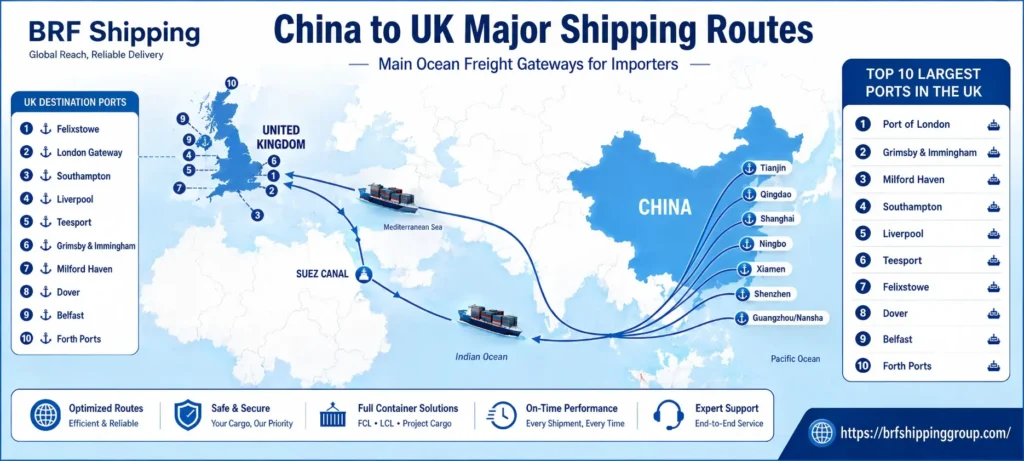
Overview of the Largest Ports in the UK
| Port | Region | Main Cargo Strengths | Suitable UK Market |
|---|---|---|---|
| Port of London | Southeast England | Containers, aggregates, oil, Ro-Ro | London and Southeast England |
| Grimsby and Immingham | Humber | Bulk, energy, vehicles, Ro-Ro | Midlands and Northern England |
| Milford Haven | Wales | LNG, petroleum and liquid bulk | Wales and UK energy industries |
| Southampton | South England | Containers, vehicles and project cargo | Southern England and Midlands |
| Liverpool | Northwest England | Containers, Ro-Ro, bulk and project cargo | Northwest England and North Wales |
| Teesport | Northeast England | Bulk, steel, chemicals and containers | Northeast England |
| Felixstowe | East England | Deep-sea container traffic | Midlands, London and nationwide |
| Dover | Southeast England | Ro-Ro and European ferry freight | UK–EU road freight |
| Belfast | Northern Ireland | Ro-Ro, containers and bulk cargo | Northern Ireland |
| Forth Ports | Scotland | Containers, bulk and industrial cargo | Central Scotland |
The first three ports follow the UK Department for Transport’s 2025 total-tonnage order. Positions among the remaining ports can change depending on whether the comparison uses total tonnage, container units, Ro-Ro units or a specific cargo category.
1. Port of London
The Port of London was the largest UK port by total freight tonnage in 2025. It accounted for approximately 13% of all cargo handled by UK major ports.
The Port of London is not a single terminal. It covers a large group of facilities located along the River Thames, including London Gateway, Tilbury and a variety of specialist terminals handling containers, construction materials, petroleum products, grain and general cargo.
London’s container business has expanded rapidly. In 2025, container freight handled within the London port area increased to approximately 19.6 million tonnes, following the opening of an additional berth at London Gateway. This placed London’s container tonnage at a similar level to Felixstowe.
Why importers choose the Port of London
The port is particularly suitable for cargo being delivered to:
- Greater London
- Essex
- Kent
- Southeast England
- Distribution centres around the M25
- Warehouses and fulfilment centres near London
London Gateway and Tilbury can handle FCL containers, Ro-Ro cargo, breakbulk shipments and many types of industrial freight.
For importers shipping from China to London, selecting a Thames terminal can reduce the distance between the port and the final delivery address. However, the final decision should also consider the shipping line’s service, ocean freight rate, port charges and container haulage availability.
2. Grimsby and Immingham
Grimsby and Immingham form part of the Humber port complex on the east coast of England. Together, they accounted for approximately 11% of UK major-port tonnage in 2025.
Immingham is particularly strong in bulk cargo, energy products, liquid bulk, vehicles, Ro-Ro freight and industrial materials. ABP describes Immingham as the UK’s largest individual port by tonnage, handling around 46 million tonnes of cargo annually.
Grimsby is an important automotive and offshore wind port, while the broader Humber complex also includes Hull and Goole.
Main advantages
Grimsby and Immingham provide convenient access to:
- Yorkshire
- Lincolnshire
- Sheffield
- Leeds
- Manchester
- The East Midlands
- Industrial areas across Northern England
The Humber is especially suitable for bulk commodities, machinery, steel products, vehicles, energy cargo and European short-sea services.
For regular containerised imports from China, importers should compare Humber services with Felixstowe, Liverpool, Southampton and London Gateway. Not every deep-sea Asia service calls directly at Immingham, so some containers may arrive through a feeder or European transshipment port.
3. Port of Milford Haven
Milford Haven is located in southwest Wales and is one of the UK’s most important energy ports.
In 2025, Milford Haven overtook Southampton to become the UK’s third-largest port by total tonnage. It handled approximately 37.5 million tonnes of liquid bulk cargo, driven partly by increased liquefied natural gas movements.
The port specialises in:
- Liquefied natural gas
- Crude oil
- Petroleum products
- Liquid bulk
- Renewable energy projects
- Breakbulk and project cargo
Milford Haven is not normally the first choice for standard consumer-goods containers from China. Its importance is primarily connected to energy, large industrial projects and specialist cargo.
Pembroke Port, located within the Milford Haven Waterway, can also support breakbulk, project cargo and renewable-energy operations.
4. Port of Southampton
Southampton is one of the UK’s leading deep-sea container, automotive and cruise ports. It is strategically positioned on the south coast, close to major international shipping routes.
The port handles containers, vehicles, general cargo, project shipments and cruise traffic. ABP identifies Southampton as the UK’s leading vehicle-handling port and its second-largest container port. Approximately two million containers and vehicles pass through Southampton each year.
Why Southampton is important for China–UK shipping
Southampton receives services operated by major international shipping lines and can accommodate very large container vessels. It also has road and rail connections to inland distribution centres.
The port is a practical option for deliveries to:
- Southampton
- Portsmouth
- Bournemouth
- Bristol
- Reading
- Oxford
- Birmingham
- Southwest England
- Parts of South Wales
Cargo commonly imported through Southampton includes furniture, automotive components, machinery, aluminium products, building materials, electronics and retail goods.
5. Port of Liverpool
The Port of Liverpool is a major maritime gateway for Northwest England, North Wales, the Midlands, Ireland and transatlantic trade.
Liverpool handles a wide range of cargo, including:
- Containers
- Ro-Ro freight
- Biomass
- Dry bulk
- Liquid bulk
- Project cargo
- Forest products
- Agricultural commodities
The Liverpool2 deep-water container terminal was developed to allow larger vessels to call directly at the port. Liverpool also offers warehousing, rail freight, container depot and port-centric distribution services.
When should importers use Liverpool?
Liverpool may reduce inland delivery costs when the consignee is located in:
- Liverpool
- Manchester
- Lancashire
- Cheshire
- North Wales
- Yorkshire
- The West Midlands
- Scotland via inland connections
Importers should compare the direct ocean service and total landed cost against routing through Felixstowe, Southampton or London Gateway.
A lower ocean freight rate does not always produce the lowest final cost. Container detention, port storage, customs delays and long-distance haulage can substantially affect the total amount paid.
6. Teesport
Teesport is located on the River Tees in Northeast England. It serves industries across Teesside, County Durham, Yorkshire and Northern England.
The port handles containers, chemicals, steel products, liquid bulk, dry bulk, project cargo and offshore-related equipment. The surrounding Teesport estate includes storage, manufacturing, logistics and industrial facilities.
Suitable cargo
Teesport can be suitable for:
- Steel and metal products
- Chemicals
- Construction materials
- Heavy machinery
- Renewable-energy equipment
- Industrial components
- Regional container cargo
For importers delivering to Middlesbrough, Newcastle, Durham or Northeast industrial areas, Teesport may offer lower inland transportation costs than a southern UK port.
The shipping route must still be checked carefully. Some international containers may move through a feeder network instead of arriving on a direct Asia–UK vessel.
7. Port of Felixstowe
Felixstowe is one of the most recognised container ports in the United Kingdom and remains a primary gateway for deep-sea cargo from Asia.
The port operates nine berths across two container terminals and has been the UK’s leading container port for decades.
In 2025, Felixstowe handled approximately 19.3 million tonnes of containerised cargo, placing it close to London’s 19.6 million tonnes when measured by container tonnage.
Why Felixstowe is popular for Chinese imports
Felixstowe is frequently used for cargo shipped from:
- Shanghai
- Ningbo
- Qingdao
- Tianjin
- Shenzhen and Yantian
- Xiamen
- Guangzhou and Nansha
Many major shipping alliances include Felixstowe in their Asia–Europe networks. The port is also connected to inland terminals and distribution centres by road and rail.
Felixstowe is commonly selected for deliveries to the Midlands, East Anglia, London and nationwide distribution centres. It is especially suitable for high-volume FCL imports, retail goods, machinery, furniture, building materials and e-commerce inventory.
8. Port of Dover
Dover is different from Felixstowe, Southampton and London Gateway because its main strength is short-sea Ro-Ro freight rather than deep-sea container shipping.
It is the UK’s busiest international ferry port and an important gateway for trucks and trailers moving between the UK and continental Europe. The Port of Dover states that it handles approximately one-third of UK trade with the European Union.
In 2025, Dover remained the UK’s largest Ro-Ro port, handling approximately 18.5 million tonnes of Ro-Ro cargo.
Is Dover suitable for cargo from China?
China-origin cargo does not usually arrive directly at Dover on a deep-sea container vessel. However, Dover may be involved when:
- Cargo is unloaded at a European port
- Goods move to the UK by truck
- A trailer travels from France to the UK
- The shipment uses a multimodal sea-road service
- Goods are consolidated in a European warehouse
Dover is therefore highly important for European distribution and final-mile supply chains connected to international imports.
9. Belfast Harbour
Belfast Harbour is the main commercial port serving Northern Ireland. It handles around 24 million tonnes of trade annually and supports containers, Ro-Ro freight, passenger ferries, bulk materials and industrial cargo.
The port provides access to:
- Belfast
- Antrim
- Lisburn
- Derry/Londonderry
- Other Northern Ireland destinations
- Irish Sea trade routes
Cargo from China can reach Belfast through a direct service where available or through feeder and transshipment connections.
Importers should recognise that customs and regulatory arrangements for Northern Ireland can differ from those applying in England, Scotland and Wales. The correct EORI registration, commodity code and customs procedure should be confirmed before shipping.
10. Forth Ports
Forth Ports operates several strategically located ports in Scotland, including Grangemouth, Leith, Rosyth, Dundee and other facilities.
The group handles approximately 16 million tonnes of cargo annually and provides access to a large proportion of the Scottish population. Its ports support containers, dry bulk, liquid bulk, project cargo, renewable energy, agricultural products and industrial freight.
Grangemouth is particularly important for containerised cargo serving central Scotland.
Main delivery areas
Using a Scottish arrival port may be advantageous for cargo destined for:
- Edinburgh
- Glasgow
- Stirling
- Dundee
- Aberdeen
- Central Scotland
- Scottish distribution centres
Importers should compare the feeder cost and sailing frequency with the cost of unloading at Felixstowe, Liverpool or Southampton and transporting the container north by road or rail.
Which UK Port Is Best for Shipping from China?
There is no single UK port that is best for every shipment. The right port depends on the consignee’s delivery address, cargo type, shipping line, available sailing and total landed cost.
London Gateway or Tilbury
Best suited to London, Essex, Kent and Southeast England.
Felixstowe
Suitable for high-volume deep-sea container imports and deliveries to the Midlands, East Anglia, London and nationwide distribution networks.
Southampton
Suitable for Southern England, Southwest England, the Midlands and some South Wales destinations.
Liverpool
Suitable for Northwest England, Manchester, North Wales and certain Midlands destinations.
Teesport or Humber ports
Suitable for industrial cargo and customers based in Northeast and Northern England.
Belfast or a Scottish port
Suitable when the cargo’s final destination is Northern Ireland or Scotland and a competitive direct or feeder service is available.
The correct comparison should include:
- Ocean freight
- Origin charges in China
- UK destination charges
- Customs-clearance fees
- Import duty and VAT
- Port storage and demurrage risk
- Container haulage
- Empty-container return cost
- Delivery appointment requirements
- Total transit time
Shipping Process from China to a UK Port
A typical China-to-UK shipment follows these stages:
1. Factory pickup in China
Cargo is collected from the supplier and delivered to a warehouse, consolidation facility or container-loading location.
2. Container loading
For FCL shipments, a 20GP, 40GP or 40HQ container can be delivered to the factory for loading. Alternatively, several suppliers’ goods can be consolidated at a Chinese warehouse.
3. China export customs clearance
The exporter or freight forwarder prepares the export declaration and supporting documents.
4. Ocean freight booking
The shipment is booked with a suitable shipping line based on the origin port, UK destination port, sailing schedule and available space.
5. Arrival at the UK port
The carrier issues an arrival notice and destination charges become payable.
6. UK customs clearance
The importer or appointed customs agent submits the import declaration and deals with applicable duty, import VAT and regulatory controls.
7. Port collection
Once customs and port requirements are completed, the container is collected by truck or transferred to an inland rail terminal.
8. Final delivery
The cargo can be delivered to a business address, construction site, warehouse, retail distribution centre or Amazon fulfilment facility.
UK Import Customs Requirements
Businesses importing goods into Great Britain normally need to confirm the correct EORI number, commodity code, customs value and import declaration procedure.
The commodity code determines the applicable duty rate, import VAT treatment, licensing requirements and whether any trade measures apply. The importer should not automatically rely on a code supplied by an overseas factory without checking its treatment under the UK tariff.
Common shipping and customs documents include:
- Commercial invoice
- Packing list
- Bill of lading or sea waybill
- Commodity code
- Importer’s EORI details
- Cargo description
- Country of origin
- Customs value
- Product licences or certificates where required
- Insurance documentation where applicable
A commercial invoice provides essential information for customs valuation, while the bill of lading confirms the carrier’s receipt of the goods and the terms of carriage.
How BRF Logistics Supports China-to-UK Shipping
BRF Logistics provides coordinated freight solutions for companies importing cargo from China to the United Kingdom.
Our services can include:
- Supplier coordination
- Factory pickup in China
- Warehouse consolidation
- FCL and LCL shipping
- 20GP, 40GP and 40HQ container booking
- China export customs clearance
- Ocean freight to major UK ports
- UK customs-clearance coordination
- Port collection
- Container trucking
- Warehouse delivery
- Business-address delivery
- Amazon FBA delivery
- DDU and DDP shipping solutions
Before providing a quotation, we normally require the cargo description, HS code, number of packages, weight, volume, Chinese pickup address, UK delivery postcode and preferred Incoterm.
Frequently Asked Questions
What is the largest port in the UK?
By total freight tonnage, the Port of London was the largest UK port in 2025, accounting for approximately 13% of traffic handled by UK major ports. Grimsby and Immingham ranked second, followed by Milford Haven.
What is the largest container port in the UK?
Felixstowe remains one of the UK’s largest and most established container ports. However, London’s container tonnage grew significantly in 2025 and reached a level similar to Felixstowe. Rankings can differ depending on whether containers are measured by weight, units or TEUs.
Which UK ports receive containers from China?
The main ports commonly used for China–UK container shipping include Felixstowe, London Gateway, Southampton and Liverpool. Other ports may be served through direct, feeder or transshipment services.
Is the closest UK port always the cheapest?
No. A nearby port may have a higher ocean freight rate, limited vessel frequency or additional feeder charges. The best option is the port providing the lowest total landed cost and a reliable sailing schedule.
Can a shipment be delivered directly from a UK port to a warehouse?
Yes. After customs clearance and cargo release, the container can be collected and delivered to a warehouse, factory, business address or fulfilment centre.
Can BRF Logistics provide door-to-door shipping?
Yes. BRF Logistics can coordinate factory pickup in China, export customs clearance, ocean freight, UK customs-clearance support and final delivery to the consignee’s address.
Request a China-to-UK Shipping Quote
The largest UK port is not automatically the best port for every shipment. Your ideal arrival port should be selected according to the final delivery postcode, cargo type, container size, shipping line schedule and total transportation cost.
Send BRF Logistics the following information for a detailed quotation:
- Product name
- HS code
- Number of cartons or pallets
- Gross weight
- Total volume
- Chinese pickup address
- UK delivery address and postcode
- FCL or LCL requirement
- Preferred shipping date
- DDU or DDP requirement
BRF Logistics can compare suitable UK ports and provide a complete shipping solution from the supplier’s factory in China to the final destination in the United Kingdom.