Shipping goods from China to the United States does not end when the container reaches Los Angeles, Houston, Savannah or New York.
Before commercial cargo can normally enter U.S. commerce, the shipment must pass through the applicable U.S. customs-clearance process.
For importers sourcing machinery, aluminum products, building materials, furniture, fitness equipment, automotive parts, electronics, consumer products or other commercial cargo from China, customs preparation should begin before the goods leave the Chinese supplier.
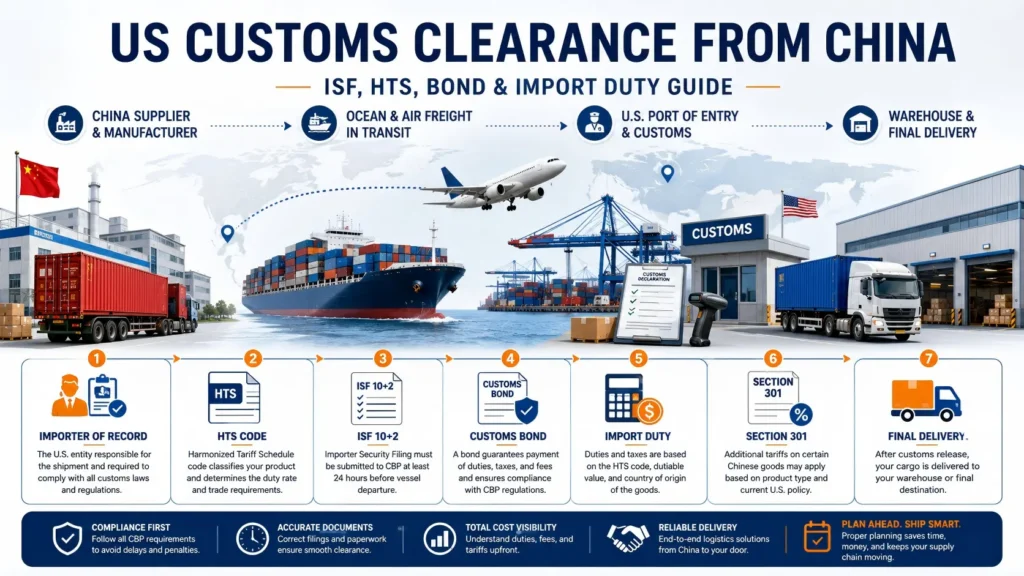
A typical China-to-USA import process can involve:
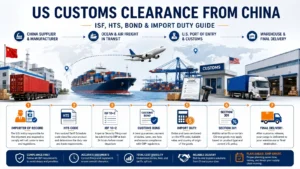
China Supplier → Export Customs → Ocean / Air Freight → U.S. Arrival → CBP Entry → Duty & Tariff Assessment → Partner Government Agency Review if Applicable → Cargo Release → Final Delivery
BRF SHIPPING can coordinate the transportation and customs-broker workflow from China pickup through U.S. arrival and final delivery, while the importer and licensed customs broker remain responsible for the applicable customs entry and compliance structure.
US Customs Clearance from China: Quick Overview
| Customs Item | What Importers Should Confirm |
|---|---|
| Importer of Record | Correct importer entity and importer number |
| HTS Classification | Correct U.S. tariff classification |
| Commercial Invoice | Accurate description, value, quantity and seller/buyer |
| Packing List | Packages, weight and cargo details |
| Customs Bond | Single-entry or continuous where required |
| ISF 10+2 | Required for applicable vessel cargo |
| Country of Origin | Correct origin and marking |
| Import Duty | Based on current HTS treatment |
| Section 301 | May apply to qualifying China-origin goods |
| PGA Requirements | FDA, EPA, FCC, DOT, USDA, CPSC etc. where applicable |
| Final Release | CBP/PGA clearance before delivery |
One important 2026 point is that importers should not rely on old tariff tables. The Harmonized Tariff Schedule is being revised frequently; USITC had already published 2026 HTS Revision 18 on September 2, 2026. Duty calculations should therefore be checked against the current HTS rather than copied from an old quotation or blog.
Who Is Responsible for US Customs Clearance?
One of the first questions is:
Who is the Importer of Record?
The Importer of Record — commonly shortened to IOR — is the party identified in the U.S. customs entry and responsible for important import obligations.
CBP explains that when a U.S. company or individual purchases merchandise from an overseas supplier, that buyer is generally considered the ultimate importer and may clear the merchandise itself or authorize a customs broker to clear it. For a formal entry, the ultimate importer identification number appears on CBP Form 7501.
This is why the importer structure should be confirmed before cargo leaves China.
Do not wait until:
Container arrives at Los Angeles
to ask:
“Who will act as importer?”
What Is a US Importer Number?
For U.S. businesses, the Importer of Record number is commonly based on the company’s:
EIN — Employer Identification Number
CBP also provides a Customs Assigned Importer Number structure for qualifying foreign entities that do not have a U.S. EIN or SSN. CBP Form 5106 is used in connection with importer-number registration or updates.
Typical importer information should therefore be checked before booking:
- Legal company name
- Business address
- EIN / importer number
- Contact information
- Customs broker
- Bond status
Inconsistent importer information is a common source of unnecessary customs problems.
Can a Chinese Company Be the Importer of Record?
A foreign entity may be able to participate in a U.S. import structure, but this is not something that should be assumed automatically.
Depending on the transaction, the parties may need to consider:
- Non-resident importer registration
- Customs-assigned importer number
- U.S. customs broker
- Customs bond
- Power of Attorney
- Tax/commercial implications
- Product-specific regulatory responsibilities
For DDP shipments in particular, the importer structure should be established before shipment.
A freight forwarder should not simply be assumed to become the Importer of Record.
Formal vs Informal Customs Entry
For many commercial shipments from China, a formal consumption entry will be required.
CBP explains that informal entries generally cover eligible merchandise valued at $2,500 or less, while formal entry procedures generally apply to merchandise valued at $2,500 or more and can also apply in other circumstances. Regulated products can have different entry requirements regardless of value.
For normal B2B imports such as:
- One 20GP container
- One 40HQ container
- Machinery
- Commercial inventory
- Building materials
- Furniture
- Industrial goods
the shipment will commonly be processed through a formal entry structure.
CBP Form 7501 — Entry Summary
For formal commercial imports, one of the key customs documents is:
CBP Form 7501 — Entry Summary
It records information such as:
- Importer
- Merchandise classification
- Country of origin
- Entered value
- Duties
- Fees
- Entry information
The accuracy of the underlying commercial documentation therefore matters directly to the customs entry.
Documents Needed for US Customs Clearance from China
A normal commercial shipment may require:
Commercial Invoice
Should accurately show information such as:
- Seller
- Buyer
- Product description
- Quantity
- Unit price
- Total value
- Currency
- Country of origin
- Incoterm where relevant
Packing List
Normally includes:
- Package count
- Gross weight
- Net weight
- Dimensions
- Packing type
Bill of Lading or Air Waybill
For transportation and customs data.
HTS Classification
The correct U.S. tariff classification.
Importer Information
Importer number and related customs details.
Customs Bond
Where required.
Product-Specific Documentation
Depending on the goods.
What Is an HTS Code?
The United States uses the:
Harmonized Tariff Schedule of the United States — HTSUS
for customs classification.
An HTS classification helps determine:
- General customs duty
- Statistical reporting
- Additional tariff measures
- Section 301 treatment
- Section 232 treatment where applicable
- Partner Government Agency flags
- Anti-dumping / countervailing issues
- Other import requirements
Using only a supplier’s generic six-digit HS code is not always enough.
U.S. entry classification normally needs to be reviewed against the current U.S. HTS structure.
Why the HTS Code Is Especially Important in 2026
The tariff environment has continued to change.
USITC’s archive shows frequent revisions to the 2026 Harmonized Tariff Schedule, including changes connected with steel, aluminum, copper and other tariff measures. By September 2, 2026, the schedule had reached Revision 18.
Therefore:
Never calculate U.S. import duty using an outdated HTS screenshot.
Before shipment, confirm:
Product → Current HTS Classification → Country of Origin → Current Chapter 99 / Additional Measures
How Is US Import Duty Calculated?
A simplified calculation is:
Customs Value × Applicable Duty Rate
For example:
Customs value:
USD 50,000
Assume, only for illustration, an applicable ordinary duty rate:
4%
Estimated ordinary duty:
USD 2,000
However, a China-origin product can also be affected by additional tariff measures.
Therefore the real calculation may be:
Ordinary HTS Duty
Section 301
Section 232
AD/CVD
Other applicable fees or measures
depending on the merchandise.
Do not assume that:
“China duty is always 25%”
or:
“China duty is always 0%.”
Both statements can be wrong.
Section 301 Tariffs on Goods from China
Section 301 remains a major issue for China-to-USA imports.
CBP states that Section 301 duties apply according to country of origin, not simply the country from which the shipment was exported.
This distinction matters.
For example:
Goods manufactured in China
↓
shipped through another Asian port
↓
exported to the United States
do not automatically lose China-origin tariff treatment simply because the final export port is outside mainland China.
Country of origin must be determined under the applicable rules.
Are All Chinese Goods Subject to Section 301?
No.
Whether Section 301 applies depends on the HTS classification and the specific tariff measures.
The customs broker should check:
- HTS code
- Chapter 99 code where applicable
- Country of origin
- Current exclusions
- Current USTR / CBP treatment
CBP also notes that Section 301 duties can be eligible for duty drawback under applicable rules.
Do Not Ignore Anti-Dumping and Countervailing Duty
Some Chinese products can face:
Anti-Dumping Duty — AD
and/or:
Countervailing Duty — CVD
These can be much more financially significant than ordinary customs duty.
Products potentially affected in certain classifications can include categories of:
- Aluminum products
- Steel products
- Industrial components
- Chemicals
- Furniture
- Building products
- Other targeted merchandise
The exact scope is highly product-specific.
An importer should never determine AD/CVD exposure based only on the product’s marketing name.
Classification, physical specifications, manufacturer and scope language can all matter.
Customs Bond for Imports from China
A customs bond is an important part of many formal commercial entries.
CBP describes the bond as a guarantee that applicable duties, taxes and fees will be paid.
Two common options are:
Single-Entry Bond
Used for one import shipment.
Often appropriate for:
- Occasional importers
- First-time importers
- Infrequent shipments
Continuous Customs Bond
Covers qualifying imports over a 12-month period.
Often more practical for companies importing regularly.
CBP currently states that the minimum continuous bond amount is generally:
USD 50,000
or:
10% of duties, taxes and fees paid during the previous 12 months,
whichever is greater.
When Is a Customs Bond Required?
A bond is commonly associated with formal commercial entries.
Certain goods regulated by Partner Government Agencies can also have specific bond or entry considerations.
The importer should confirm the bond requirement with the licensed customs broker before the shipment departs.
ISF 10+2 for Ocean Freight from China
For U.S.-bound cargo arriving by vessel, Importer Security Filing — ISF, commonly called:
ISF 10+2
is one of the most important pre-shipment compliance requirements.
CBP states that the filing is generally due:
No later than 24 hours before the cargo is loaded aboard the vessel destined for the United States.
This means ISF cannot be treated as paperwork that starts after arrival.
What Information Is Required for ISF?
Typical ISF information includes:
- Seller
- Buyer
- Importer of Record number
- Consignee number
- Manufacturer / supplier
- Ship-to party
- Country of origin
- HTSUS number
- Container stuffing location
- Consolidator / stuffer
CBP explains that eight core data elements are generally required before vessel loading, with the remaining applicable data elements following the regulatory timing requirements.
What Happens If ISF Is Late or Incorrect?
CBP states that inaccurate, incomplete or untimely filing can result in:
Liquidated damages of up to USD 5,000 per violation.
Other practical problems can include:
- Holds
- Additional review
- Delayed cargo release
- Extra storage
- Broker corrections
Therefore ISF information should be collected before origin cutoff.
Is ISF Required for Air Freight?
ISF 10+2 is associated with applicable vessel cargo.
Air freight has different advance cargo and customs procedures.
Do not submit an ocean ISF workflow simply because all U.S. imports are being treated the same operationally.
AMS vs ISF
Importers often confuse:
AMS
and:
ISF
They are related to advance cargo information but are not the same filing.
In simplified terms:
AMS
is primarily carrier/NVOCC cargo-manifest information.
ISF
is importer-security information.
For China-to-USA ocean freight, both data streams may be relevant to the shipment.
Do Not Assume Shipments Under $800 Are Duty-Free
This is particularly important for e-commerce and small shipments.
The United States suspended the previous duty-free de minimis treatment under 19 U.S.C. 1321(a)(2)(C) for covered shipments. The February 20, 2026 order continued that suspension regardless of value, country of origin, transportation mode or method of entry, subject to specified exceptions and postal procedures.
CBP likewise explains that goods valued at or below $800 should no longer automatically be assumed to qualify for duty-free de minimis treatment.
For Chinese exporters and U.S. e-commerce sellers, this means old guides saying:
“Under $800 = no duty”
are outdated for current 2026 planning.
Country of Origin Marking
Imported merchandise may be subject to country-of-origin marking requirements.
For China-origin products, the importer should verify whether:
Made in China
or another legally appropriate marking is required and where it must appear.
Incorrect or missing origin marking can lead to customs problems.
The product, packaging and applicable marking rules should be reviewed before export.
Customs Value
Duty calculations depend on correct customs valuation.
Do not automatically assume:
Invoice Value = Correct Customs Value
without understanding the transaction.
Customs valuation issues can involve:
- Transaction value
- Assists
- Royalties
- Related-party transactions
- Packing
- Certain selling commissions
- Discounts
- Other valuation adjustments
Artificially undervaluing merchandise to reduce duty creates substantial compliance risk.
Common Customs Clearance Mistake: Incorrect Product Description
Descriptions such as:
Parts
Accessories
Equipment
Sample
Hardware
are often too vague.
A better commercial description might be:
Powder-coated aluminum fence panels
or:
Steel frame commercial fitness equipment
or:
CNC-machined aluminum mounting bracket
The product description should make it possible for the broker and CBP to understand what is actually being imported.
FDA-Regulated Cargo from China
Some products require more than CBP clearance.
FDA-regulated products can include:
- Food
- Medical devices
- Certain electronics emitting radiation
- Drugs
- Cosmetics
- Other regulated goods
FDA explains that regulated imports are first submitted through CBP and then electronically referred to FDA for review where applicable.
Importing Food from China into the USA
Imported food can require:
- Food facility registration
- Prior Notice
- FSVP responsibilities
- Proper labeling
- Product-specific compliance
FDA states that imported foods are subject to the same basic safety requirements as domestic foods and that facilities involved in producing or handling certain food products must meet applicable registration requirements. Prior Notice is generally required for applicable food imports.
A food shipment should therefore be reviewed before booking ocean or air freight.
Importing Medical Devices from China
Medical-device imports can require:
- Establishment registration
- Device listing
- Premarket requirements where applicable
- Labeling compliance
- U.S. agent arrangements for foreign manufacturers
- FDA entry data
FDA states that medical devices imported into the United States must comply with both CBP and FDA requirements, and a product that does not meet applicable FDA requirements can be detained.
This is especially relevant for Chinese dental, medical and diagnostic-device manufacturers.
Other Partner Government Agencies
Depending on the product, U.S. customs clearance can also involve agencies such as:
EPA
Possible examples:
- Engines
- Vehicles
- Certain chemicals
- Environmental-regulated products
DOT / NHTSA
Possible examples:
- Vehicles
- Vehicle-related equipment
FCC
Possible examples:
- Radio-frequency electronics
- Communication devices
USDA / APHIS
Possible examples:
- Agricultural products
- Wood products
- Plants
- Animal-related commodities
CPSC
Possible examples:
- Consumer products
- Children’s products
The correct agency requirements depend on the actual merchandise and intended use.
FDA Flags and HTS Classification
HTS classification can also indicate possible FDA involvement.
FDA uses FD flags in the tariff/entry system to help entry filers identify whether additional FDA data may be needed.
For example:
- FD1 — may or may not be FDA regulated
- FD2 — FDA-regulated non-food
- FD3 — may or may not be food
- FD4 — food product
The final regulatory treatment still depends on the actual product and intended use.
What Is a CBP Customs Hold?
CBP can place cargo on hold for different reasons.
A hold does not automatically mean the cargo has been seized.
Possible reasons include:
- Documentation discrepancy
- Classification concern
- Value review
- Importer information
- ISF issue
- PGA review
- Physical examination
- Random/risk-based selection
BRF SHIPPING already covers one specific status in its CBP 5H Inspection guide.
What Is a CBP 5H Hold?
CBP’s 5H code means:
Entry Processing Hold
It can indicate that the entry has been targeted for document-discrepancy review and release is temporarily denied.
This does not necessarily mean officers are physically opening the container.
BRF SHIPPING’s current 5H guide explains the distinction and recommends checking importer information, commercial documents, HTS classification, origin and ISF before cargo departs China.
What Can Cause Customs Delays?
Common causes include:
Incorrect HTS Code
Wrong classification can create duty and compliance problems.
Incorrect Customs Value
Declared value does not match transaction records.
Inconsistent Documents
Invoice, packing list and bill of lading contain different information.
Incorrect Importer Information
IOR details are missing or outdated.
ISF Problem
Late or incorrect vessel filing.
Missing Customs Bond
Bond not active when required.
Product Compliance
FDA, EPA, FCC, DOT, USDA or another agency requires additional data.
Country-of-Origin Issues
Origin or marking is incorrect.
US Customs Clearance Process from China
A well-planned shipment can follow this sequence:
Step 1 — Product Review
Confirm:
- Product description
- HTS code
- Origin
- Regulatory status
Step 2 — Importer Review
Confirm:
- Importer of Record
- Importer number
- Customs broker
- Customs bond
Step 3 — Document Review
Check:
- Commercial invoice
- Packing list
- Purchase information
- Freight documents
Step 4 — ISF for Ocean Cargo
Submit within the applicable CBP deadline.
Step 5 — China Export
Cargo leaves China after export customs.
Step 6 — Customs Entry
The licensed customs broker transmits the appropriate entry information through ACE.
Step 7 — Duty / Tariff Assessment
Review:
- Ordinary HTS duty
- Section 301
- Other Chapter 99 measures
- AD/CVD where applicable
Step 8 — PGA Review
If the product is regulated.
Step 9 — CBP Release
Cargo is released when applicable customs and agency requirements have been satisfied.
Step 10 — Final Delivery
BRF SHIPPING can coordinate port, CFS, airport or rail pickup and truck delivery.
Customs Clearance at Major US Ports
BRF SHIPPING can coordinate shipments moving through major U.S. gateways including:
Los Angeles / Long Beach
Major West Coast entry points for China-origin FCL and LCL cargo.
Oakland
Useful for Northern California.
Seattle / Tacoma
Pacific Northwest gateway.
Houston
Major Gulf Coast destination serving Texas and inland markets.
Savannah
Important Southeast gateway.
New York / New Jersey
Major East Coast gateway.
The customs principles are federal, but operational processing, exams and delivery conditions can differ by port and terminal.
Customs Clearance for LCL Cargo
LCL cargo follows the same fundamental customs rules as FCL.
After arrival:
Container → CFS → Deconsolidation → Customs Release → Cargo Pickup
The importer should plan for:
- CFS fees
- Customs broker
- Customs bond
- Duty
- ISF where applicable
- Final trucking
For detailed LCL pricing, use BRF SHIPPING’s LCL Shipping Cost from China to USA guide.
Customs Clearance for 20GP and 40HQ Containers
FCL imports require careful planning because customs delays can create additional:
- Demurrage
- Detention
- Storage
- Chassis
- Trucking rescheduling costs
For this reason, commercial documents and importer information should ideally be reviewed before the vessel departs China.
BRF SHIPPING’s dedicated 20ft and 40ft cost guides cover container-specific transportation and destination costs.
DDP Shipping and US Customs Clearance
DDP does not eliminate customs law.
Even when goods are sold:
Delivered Duty Paid
the shipment still needs a compliant:
- Importer structure
- Customs entry
- HTS classification
- Customs bond where required
- Duty payment
- ISF for applicable vessel cargo
- Regulatory clearance
BRF SHIPPING’s existing DDP Shipping from China to USA guide explains this in detail.
Customs Clearance for Amazon FBA Shipments
Amazon should not simply be assumed to act as the Importer of Record.
Before China-to-Amazon shipping, confirm:
- Importer
- Customs broker
- Bond
- HTS classification
- Duty
- Product compliance
- FBA labels
- Pallet requirements
- Delivery appointment
A compliant customs plan should be established before cargo is sent toward the fulfillment center.
How to Reduce US Customs Clearance Risk
The most effective strategy is:
Solve Customs Issues Before Shipping.
Before the Chinese supplier loads the container, check:
Importer
✓
HTS
✓
Customs Bond
✓
ISF Data
✓
Country of Origin
✓
Commercial Value
✓
Product Compliance
✓
Shipping Documents
✓
This costs much less than solving the same problem while the container is accumulating storage charges at a U.S. terminal.
Why Use a Licensed US Customs Broker?
A licensed customs broker can assist with customs entry and communication with CBP.
Typical broker functions include:
- Entry filing
- HTS review
- Duty calculation
- Customs bond coordination
- CBP communication
- PGA data transmission
- Entry-summary processing
The importer still retains important legal responsibilities and should provide accurate product and transaction information.
How BRF SHIPPING Supports US Customs Clearance
BRF SHIPPING can coordinate the logistics chain surrounding customs clearance, including:
- China supplier pickup
- China warehouse
- Multi-supplier consolidation
- Export customs
- FCL / LCL sea freight
- Air freight
- AMS / ISF data coordination
- U.S. customs-broker coordination
- Customs-document preparation support
- Port / CFS / airport pickup
- Truck delivery
- DAP / DDP planning
The objective is to connect:
China Logistics + U.S. Customs + Final Delivery
rather than treating customs as an isolated event after arrival.
US Customs Clearance from China FAQ
Who clears goods imported from China into the USA?
The Importer of Record can clear the merchandise or authorize a licensed customs broker to handle entry on its behalf.
What is the formal-entry threshold?
CBP generally describes merchandise valued at $2,500 or more as requiring formal entry, although other rules can require formal treatment at lower values depending on the commodity or agency requirements.
Is an EIN required to import from China?
U.S. businesses commonly use their EIN as the importer number. Other importer-number structures are available in appropriate cases.
Is a customs bond required?
Many formal commercial imports require an appropriate customs bond. Importers can use single-entry or continuous bonds depending on their import activity.
How much is a continuous customs bond?
CBP currently states that the minimum is generally $50,000 or 10% of the prior 12 months’ duties, taxes and fees, whichever is greater.
When must ISF be filed?
For applicable U.S.-bound vessel cargo, CBP generally requires the key ISF data no later than 24 hours before vessel loading.
Is ISF required for air freight?
ISF 10+2 applies to applicable vessel cargo, not ordinary air-freight shipments.
Are all Chinese imports subject to 25% Section 301 duty?
No. Section 301 applicability depends on the specific HTS classification and current tariff measures.
Is country of export the same as country of origin?
No. CBP notes that Section 301 treatment is based on country of origin, not merely country of export.
Are shipments under $800 duty-free in 2026?
Do not assume so. Current U.S. policy has suspended the former duty-free de minimis treatment for covered shipments, including low-value shipments.
Does BRF SHIPPING perform the U.S. customs entry itself?
BRF SHIPPING can coordinate U.S. customs-broker clearance as part of the freight workflow. The actual customs-entry structure should use the appropriate importer and licensed customs broker.
Get Help with US Customs Clearance from China
Before shipping, provide BRF SHIPPING with:
Product Description
HTS Code if Known
Commercial Value
China Supplier Location
Packages / Weight / CBM
U.S. Port or ZIP Code
Importer Information
Cargo-Ready Date
BRF SHIPPING can coordinate:
China Pickup → Export Customs → Sea / Air Freight → ISF / Broker Coordination → US Customs Clearance → Final Delivery
BRF SHIPPING
US Customs Clearance Support for Shipments from China
Importer Planning | ISF | Customs Bond | HTS | CBP Coordination | Door Delivery