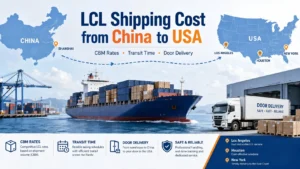
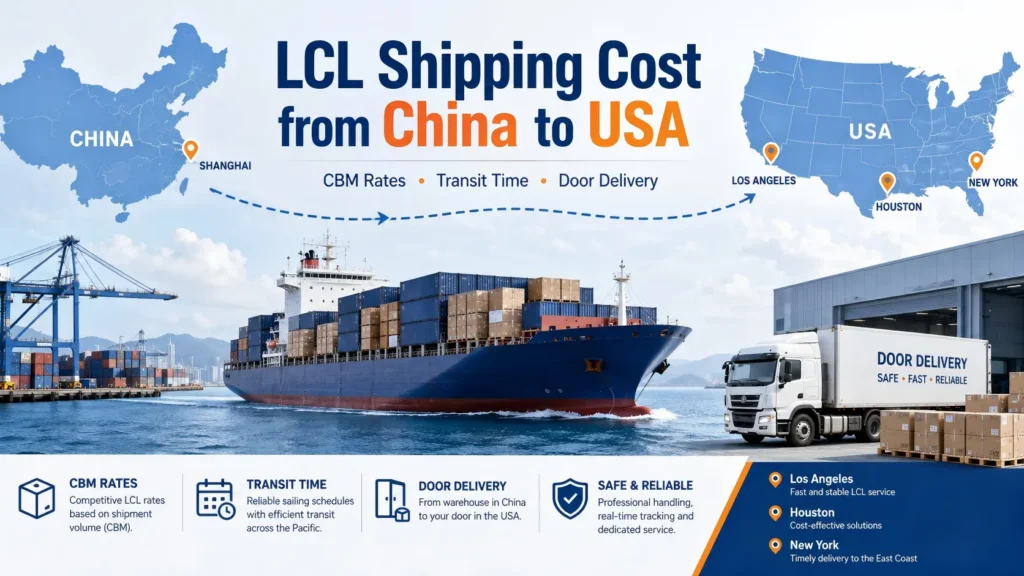
If your shipment from China is too small to justify a full 20ft or 40ft container, LCL shipping from China to USA is often the most practical sea-freight solution.
LCL means:
Less than Container Load
Your cargo shares container space with shipments from other exporters instead of occupying an entire container.
LCL is commonly used for:
- Small commercial orders
- Machinery parts
- Hardware
- Furniture samples
- Automotive components
- Aluminum accessories
- Building-product samples
- E-commerce inventory
- Multi-supplier orders
- Trial shipments from Chinese factories
The most important difference from FCL is pricing.
A 20GP or 40HQ is normally quoted by container.
LCL is generally calculated according to:
CBM / W/M Chargeable Volume
That means the real LCL shipping cost from China to USA depends on cargo volume, weight, China origin, U.S. destination, CFS handling, customs and final delivery.
LCL Shipping Cost from China to USA: September 2026 Snapshot
Current September 2026 public market data shows an indicative China-to-USA LCL rate of approximately:
USD 137.22 per CBM
for selected current U.S.-bound LCL services.
The same market update lists approximately 10–17 days for its quoted port-service transit reference, although actual end-to-end LCL planning is often longer because consolidation, deconsolidation, customs and final delivery add time.
Broader 2026 market references show significant variation by U.S. coast:
| U.S. Destination | Indicative LCL Ocean Freight |
|---|---|
| Los Angeles / Long Beach | USD 80–160 / CBM |
| Seattle / Tacoma | USD 85–155 / CBM |
| Houston | USD 90–170 / CBM |
| New York / New Jersey | USD 100–180 / CBM |
These are ocean-freight market references, not guaranteed BRF SHIPPING quotations and not full door-to-door prices. Origin charges, U.S. CFS/deconsolidation fees, customs and final delivery must still be added.
Why LCL Rates Vary So Much
You may find one website quoting:
USD 45 / CBM
another quoting:
USD 90 / CBM
and another quoting:
USD 137 / CBM
for apparently the same China–USA route.
This does not necessarily mean one quotation is wrong.
The quotations may have completely different inclusions.
One may include only:
Base Ocean Freight
while another may include:
- Origin CFS
- Documentation
- Consolidation
- Freight surcharge
- Destination CFS
- Deconsolidation
This is why importers should never compare LCL quotations using only the advertised $/CBM number.
The correct comparison is:
Total Cost to Final U.S. Destination
How Is LCL Shipping Cost Calculated?
Most LCL sea freight is priced according to:
W/M — Weight or Measurement
The freight forwarder compares:
- Cargo volume in CBM
- Cargo weight in metric tons
and the applicable higher chargeable quantity may be used.
Many 2026 LCL rate structures use this W/M method.
What Does CBM Mean?
CBM means:
Cubic Meter
The formula is:
Length × Width × Height
using meters.
For example:
A wooden crate measures:
1.2 m × 1.0 m × 1.0 m
Volume:
1.2 CBM
If you have five identical crates:
1.2 × 5
=
6 CBM
Your LCL freight would then generally be calculated using approximately 6 CBM, subject to weight and the consolidator’s billing rules.
Example: CBM Calculation
Assume:
10 cartons
Each carton:
80 cm × 60 cm × 50 cm
Convert to meters:
0.8 × 0.6 × 0.5
=
0.24 CBM per carton
10 cartons:
2.4 CBM
If the applicable ocean rate were:
USD 130 / CBM
then the basic ocean freight component would be approximately:
2.4 × 130
=
USD 312
But that is not the final LCL shipping cost.
Additional charges may still apply.
What Charges Are Included in LCL Shipping?
A complete LCL shipment can involve four major cost groups.
1. China Origin Charges
These can include:
- Factory pickup
- China inland trucking
- Warehouse receiving
- CFS handling
- Export documentation
- Export customs
- Consolidation fees
2. Ocean Freight
Usually calculated by:
- CBM
- W/M
- Minimum charge
3. U.S. Destination Charges
These may include:
- CFS handling
- Deconsolidation
- Documentation
- Warehouse handling
- Customs coordination
- Port-related charges
4. Final Delivery
After cargo is released, delivery may include:
- Local trucking
- LTL delivery
- Commercial warehouse delivery
- Appointment fee
- Liftgate where required
- Residential surcharge where applicable
Therefore:
LCL Ocean Freight ≠ LCL Door-to-Door Cost
LCL Shipping Cost to Los Angeles / Long Beach
Los Angeles and Long Beach are among the most important gateways for China-origin LCL shipments.
Typical routing:
China Supplier
↓
Shanghai / Ningbo / Qingdao / Shenzhen Consolidation Warehouse
↓
Container Loading
↓
Los Angeles / Long Beach
↓
CFS Deconsolidation
↓
U.S. Customs
↓
Final Delivery
Mid-2026 market references place base LCL ocean freight to Los Angeles / Long Beach at approximately:
USD 80–160 / CBM
with destination and origin charges added separately.
Another August 2026 market guide gave Shanghai/Ningbo → Los Angeles/Long Beach approximately:
USD 45–75 / CBM
for base port-to-port freight only, illustrating why rate inclusions must be checked carefully.
Example: 5 CBM Qingdao to Los Angeles
Assume:
Cargo volume:
5 CBM
Using a broad market ocean-freight range of:
USD 80–160 / CBM
basic freight may be:
Low:
5 × 80 = USD 400
High:
5 × 160 = USD 800
But a mid-2026 market example estimated the total destination-side shipment cost for a 5 CBM Qingdao → Los Angeles LCL shipment at roughly:
USD 800–1,500
before duty and taxes, depending on the actual service and charges.
This demonstrates why a customer should not expect:
5 CBM × advertised ocean rate
to equal the final invoice.
LCL Shipping Cost to New York / New Jersey
For East Coast importers, New York / New Jersey can avoid cross-country trucking from California.
Typical route:
China
↓
Ocean Freight
↓
New York / New Jersey
↓
CFS
↓
Customs
↓
Northeast U.S. Delivery
Mid-2026 market references show approximately:
USD 100–180 / CBM
for selected China–New York/New Jersey LCL ocean-freight services.
Other 2026 references show higher or lower base-rate ranges depending on origin and service design.
For example, one August reference placed Shenzhen/Guangzhou → New York/New Jersey at approximately:
USD 65–95 / CBM
for the base port-to-port component.
Again, these are not directly comparable unless their inclusions are identical.
LCL Shipping Cost to Houston
Houston is particularly useful for cargo destined for:
- Texas
- Houston
- Dallas
- Austin
- San Antonio
- Gulf Coast distribution
A typical route:
China Supplier
↓
China CFS
↓
Houston
↓
U.S. Customs
↓
Truck / LTL
↓
Texas Warehouse
Mid-2026 market references indicate approximately:
USD 90–170 / CBM
for selected Gulf Coast LCL ocean services.
One August route example placed Xiamen → Houston base LCL freight around:
USD 60–90 / CBM
before local and destination costs.
LCL Shipping Cost to Savannah
Savannah can be useful for:
- Georgia
- Atlanta
- Tennessee
- Carolinas
- Southeast distribution centers
For many southeastern importers, routing to Savannah can reduce inland transportation compared with moving cargo from Los Angeles.
One August 2026 reference placed Shenzhen → Savannah / Charleston LCL base freight at approximately:
USD 70–100 / CBM
with around 30–38 days port-to-port in the cited service.
LCL Shipping to Seattle / Tacoma
Seattle and Tacoma can be useful for cargo destined for:
- Washington
- Oregon
- Pacific Northwest
- Inland northern markets
Current broad market references show approximately:
USD 85–155 / CBM
for selected China-to-Pacific-Northwest LCL services.
LCL Shipping Transit Time from China to USA
LCL is normally slower than FCL on the same trade lane.
Why?
Because LCL requires:
Origin Consolidation
Your cargo must wait for other shipments to be loaded into the same container.
and:
Destination Deconsolidation
After arrival, the container must be unpacked and individual shipments separated.
One 2026 market reference estimates LCL to be around 3–7 days slower than FCL on comparable routes.
A practical LCL planning range is:
| Route | Indicative Warehouse/CFS Planning |
|---|---|
| China → Los Angeles / Long Beach | Approx. 28–38 days |
| China → Houston | Approx. 32–40 days |
| China → New York / East Coast | Approx. 35–45 days |
These ranges include more of the consolidation/deconsolidation process than simple vessel-transit figures.
Why Some Websites Show 10–17 Days
Current September 2026 market listings can show China → USA LCL transit as low as approximately:
10–17 days
for selected port-based services.
This should not automatically be interpreted as:
China Factory → U.S. Customer Door in 10 days.
Different sources measure transit differently.
Some calculate:
Port → Port
Others:
CFS → CFS
Others:
Warehouse → Door
For inventory planning, always ask:
“What event starts the transit clock, and when does it end?”
Complete LCL Door-to-Door Transit Time
A realistic LCL process can include:
China Pickup
1–3 days
↓
Origin CFS / Consolidation
Several days
↓
Ocean Transit
Depending on coast
↓
U.S. CFS Deconsolidation
Several days
↓
Customs Release
Timing varies
↓
Final Truck Delivery
1–several days depending on destination
A separate 2026 LCL analysis estimates total international door-to-door LCL transit broadly around 20–50+ days, with China → Los Angeles commonly around 20–28 days and New York around 32–42 days depending on route and handling.
LCL vs 20ft Container: When Should You Switch to FCL?
This is one of the most important cost decisions.
LCL is normally most attractive for:
Smaller Cargo
A 2026 industry cost breakdown describes roughly 1–10 CBM as a common LCL “sweet spot.”
As cargo approaches:
12–15 CBM+
importers should begin comparing LCL with a complete 20GP FCL quotation.
The exact break-even point is not fixed.
It depends on:
- LCL rate
- CFS costs
- Cargo weight
- Destination charges
- 20GP freight rate
- U.S. inland delivery
Several 2026 market guides place the typical comparison point around 15 CBM, but the correct answer should always come from an actual FCL-vs-LCL cost comparison.
Example: 12 CBM LCL vs 20GP
Suppose:
12 CBM
Base LCL freight:
USD 130 / CBM
Ocean component:
12 × 130
=
USD 1,560
Then add:
- China CFS
- Export fees
- U.S. CFS
- Deconsolidation
- Customs
- Final delivery
The total may become much higher.
At that point, compare:
12 CBM LCL Total Delivered Cost
against:
20GP FCL Total Delivered Cost
For detailed full-container pricing, see BRF SHIPPING’s dedicated 20ft Container Shipping Cost from China to USA guide.
LCL vs 40HQ
LCL is not normally compared directly with a 40HQ for very small cargo.
A 40HQ is designed for significantly larger shipments.
If your cargo volume has grown enough that a 40GP or 40HQ is under consideration, use the dedicated:
40ft Container Shipping Cost from China to USA
guide rather than relying on a per-CBM LCL rate.
BRF SHIPPING’s 40ft guide already covers West Coast, East Coast, Houston, Savannah and inland-delivery cost structures.
For detailed full-container pricing, see BRF SHIPPING’s dedicated 40ft Container Shipping Cost from China to USA guide.
LCL Shipping from Multiple Suppliers in China
One of the biggest advantages of LCL is supplier consolidation.
Example:
Supplier A — Qingdao
Supplier B — Weifang
Supplier C — Jinan
BRF SHIPPING can potentially coordinate:
Supplier A
Supplier B
Supplier C
↓
China Warehouse
↓
One Consolidated Export Shipment
↓
USA
This can simplify:
- Pickup coordination
- Export paperwork
- Freight booking
- Destination management
Shanghai LCL Shipping to USA
Shanghai can serve factories in:
- Shanghai
- Suzhou
- Kunshan
- Wuxi
- Jiangsu
- Eastern China
It has extensive consolidation services to:
- Los Angeles
- Long Beach
- New York
- Savannah
- Houston
Ningbo LCL Shipping to USA
Ningbo is particularly useful for suppliers in:
- Ningbo
- Yiwu
- Hangzhou
- Shaoxing
- Taizhou
- Zhejiang
For a Zhejiang supplier, sending small cargo to Ningbo CFS can be more economical than moving it to Shanghai.
Qingdao LCL Shipping to USA
Qingdao is strategically useful for Shandong suppliers.
BRF SHIPPING can coordinate pickup from areas such as:
- Qingdao
- Weifang
- Zibo
- Jinan
- Linyi
- Yantai
- Weihai
- Dezhou
Typical LCL cargo can include:
- Machinery parts
- Aluminum accessories
- Fitness-equipment components
- Hardware
- Building products
- Commercial samples
Shenzhen / Guangzhou LCL Shipping to USA
South China suppliers may use:
- Shenzhen
- Yantian-area consolidation
- Guangzhou
- Pearl River Delta warehouses
Common cargo includes:
- Electronics
- Hardware
- Consumer products
- Furniture accessories
- Commercial inventory
Minimum LCL Charges
LCL may have a minimum chargeable volume.
For example:
A shipment physically measuring:
0.45 CBM
may still be charged according to a:
1 CBM minimum
depending on the consolidator and route.
That means very small shipments may not be economical by ocean LCL.
For very small cargo, compare:
- Courier
- Air freight
- Air consolidation
- LCL
rather than assuming sea freight is always cheapest.
Heavy LCL Cargo and W/M
LCL can become expensive when cargo is extremely dense.
Example:
Cargo:
1 CBM
Weight:
1,800 kg
If the pricing rule applies W/M based on the greater chargeable unit, freight may be calculated differently than a normal lightweight 1 CBM shipment.
Therefore, always send:
- Number of packages
- Dimensions
- Gross weight
not only:
“I have 3 CBM.”
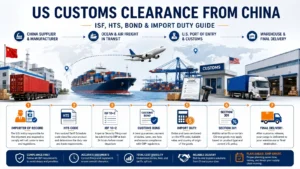
U.S. Customs Clearance for LCL Shipments
LCL cargo entering the United States is subject to U.S. import requirements just like FCL cargo.
Common information includes:
- Commercial invoice
- Packing list
- Bill of lading
- HTS classification
- Country of origin
- Importer information
- Customs value
LCL does not mean simplified customs simply because the cargo shares a container.
ISF 10+2 for China-to-USA LCL Ocean Cargo
Ocean imports to the U.S. require careful ISF planning.
U.S. Customs and Border Protection states that the Importer Security Filing is generally required no later than 24 hours before cargo is loaded aboard the vessel destined for the United States. CBP also warns that inaccurate, incomplete or late filings can lead to liquidated damages.
LCL cargo therefore still needs correct shipping data before consolidation and vessel loading.
Typical ISF data includes information relating to:
- Seller
- Buyer
- Importer of Record
- Consignee
- Manufacturer / supplier
- Ship-to party
- Country of origin
- HTS classification
Does an LCL Importer Need a Customs Bond?
For formal U.S. imports, a customs bond may be required depending on the entry.
CBP explains that importers can use:
Single-Entry Bond
for individual shipments,
or:
Continuous Bond
for recurring imports.
CBP currently states that the minimum continuous bond is generally USD 50,000 or 10% of duties, taxes and fees paid during the previous 12 months, whichever is greater.
Your customs broker should confirm the correct structure for the shipment.
Import Duty and Section 301
LCL freight cost does not include U.S. import duty unless the quote specifically states otherwise.
Duty depends on:
- HTS code
- Country of origin
- Product
- Customs value
- Additional trade measures
Some China-origin goods can also be subject to Section 301 additional duties.
CBP confirms that goods covered by Section 301 remain subject to the applicable additional duty based on their tariff classification and entry conditions.
Therefore:
Product Classification Can Matter More Than the Freight Rate.
LCL Port-to-Port vs Door-to-Door
Port / CFS-to-CFS
This may mainly cover:
China CFS
↓
U.S. CFS
The importer may still need to arrange:
- Customs broker
- Cargo release
- Destination handling
- Truck delivery
Door-to-Door LCL
A more complete route can be:
China Factory
↓
Pickup
↓
China Consolidation
↓
Export Customs
↓
Ocean Freight
↓
U.S. CFS
↓
Customs
↓
Final Delivery
For many small and medium-sized importers, this makes budgeting easier.
LCL Door Delivery in the United States
BRF SHIPPING can coordinate final delivery to suitable commercial destinations.
Examples include:
- Los Angeles
- Ontario, California
- Dallas
- Houston
- Chicago
- Atlanta
- Savannah-area warehouses
- New York / New Jersey
- Commercial distribution centers
The final cost depends heavily on:
ZIP Code
because U.S. inland transportation can exceed the base ocean-freight component for some shipments.
LCL Shipping to Amazon FBA
LCL can be useful for Amazon sellers importing:
- Trial inventory
- Small batches
- Seasonal stock
- Multi-SKU shipments
However, the freight forwarder needs to know whether the final destination is:
- Amazon fulfillment center
- Prep warehouse
- 3PL warehouse
because appointment, labeling and delivery requirements differ.
For many sellers:
China Factory → U.S. 3PL → Amazon
is easier to manage than attempting direct delivery before all receiving requirements are confirmed.
DDP LCL Shipping from China to USA
Some buyers prefer an integrated DDP-style quotation.
Possible workflow:
China Supplier
↓
Pickup
↓
LCL Consolidation
↓
Ocean Freight
↓
U.S. Import Process
↓
Door Delivery
However, DDP does not remove U.S. customs obligations.
The shipment still requires a legally workable structure involving:
- Importer of Record
- HTS classification
- Customs bond
- Duty
- Section 301 where applicable
- Product compliance
BRF SHIPPING’s dedicated DDP China–USA page should remain the main resource for these issues rather than duplicating the full DDP explanation here.
Which Cargo Is Best for LCL?
LCL works especially well for:
Machinery Components
Small replacement parts and production equipment components.
Hardware
Moderate-volume commercial orders.
Furniture Samples
Before committing to a 40HQ order.
Aluminum Components
Smaller quantities of profiles, fittings and accessories.
Fitness Equipment Parts
Components or limited trial inventory.
General Commercial Goods
When volume does not justify a full container.
Cargo That Needs Additional Review
Tell BRF SHIPPING before booking if cargo includes:
- Batteries
- Liquids
- Chemicals
- Powders
- Dangerous goods
- Oversized crates
- Heavy machinery
- Food
- Regulated products
Such cargo can require special packing, documentation, CFS acceptance or carrier approval.
Oversized LCL Cargo
LCL does not automatically mean small physical packages.
A shipment may have only:
3 CBM
but consist of one extremely long crate.
For example:
4.5 m × 0.8 m × 0.8 m
Although the cubic volume is relatively small, the package may require:
- Oversize handling
- Special forklift
- Special CFS acceptance
- Additional charges
Always provide individual package dimensions.
How to Reduce LCL Shipping Cost from China to USA
1. Reduce Packaging Volume
Every unnecessary cubic meter can directly increase freight and handling.
2. Consolidate Suppliers
Combine multiple Chinese orders where practical.
3. Select the Correct China CFS
A Shandong supplier should not automatically truck cargo to Shenzhen.
Origin inland costs matter.
4. Compare U.S. Coasts
For a New Jersey importer:
China → New York
may cost more at sea than:
China → Los Angeles
but save significantly on inland transportation.
5. Compare LCL vs 20GP Before Booking
Especially once cargo approaches approximately:
12–15 CBM
6. Prepare ISF Early
Avoid compliance problems before vessel loading.
7. Provide the Final ZIP Code
Never compare only CFS-to-CFS freight if you actually need warehouse delivery.
LCL Shipping Cost Example: China to Los Angeles Door Delivery
Assume:
Cargo:
5 CBM
Gross weight:
900 kg
Product:
General commercial cargo
China origin:
Qingdao
U.S. arrival:
Los Angeles
A simplified cost structure might include:
| Cost Item | Calculation |
|---|---|
| China Pickup | Based on supplier address |
| China CFS | Per shipment / CBM |
| Ocean Freight | Approx. 5 CBM × current rate |
| U.S. CFS | Per shipment / CBM |
| Customs Broker | Based on entry |
| Customs Bond | If required |
| Duty / Section 301 | Product dependent |
| Final Delivery | Based on ZIP code |
This is a more accurate way to calculate LCL than simply asking:
“What is your price per CBM?”
What Information Is Needed for an LCL Quote?
Send BRF SHIPPING:
China Supplier Information
- Factory city
- Pickup address
Cargo Information
- Product name
- Number of cartons / pallets
- Dimensions
- Gross weight
- Total CBM
- HS / HTS code if known
- Cargo value
U.S. Information
- Destination ZIP code
- Commercial / warehouse address
- Importer details
- Customs-broker requirement
- Delivery requirements
Timing
- Cargo-ready date
With these details, BRF SHIPPING can compare:
LCL
against:
20GP FCL
and recommend the more practical route.
Why Choose BRF SHIPPING for China-to-USA LCL?
BRF SHIPPING can coordinate:
- China supplier pickup
- Multi-supplier consolidation
- China warehouse receiving
- Export customs
- LCL booking
- AMS / ISF data coordination
- U.S. customs-broker coordination
- CFS cargo release
- Truck / LTL delivery
- Warehouse delivery
- DAP / DDP planning
The objective is not simply to find the lowest advertised CBM rate.
It is to design the lowest practical:
Total Delivered Logistics Cost
for your shipment.
LCL Shipping Cost from China to USA FAQ
How much does LCL shipping from China to USA cost per CBM?
Current September 2026 market data shows approximately USD 137.22/CBM for one selected general China–USA market reference. Broader 2026 ranges are around USD 80–160/CBM to the West Coast, USD 90–170/CBM to Houston, and USD 100–180/CBM to New York/New Jersey, depending on origin and service scope.
Is $100 per CBM the final LCL cost?
Usually not. A basic ocean rate may exclude China pickup, CFS handling, destination deconsolidation, customs and truck delivery.
Is LCL cheaper than a 20ft container?
For smaller shipments, usually. Once cargo approaches roughly 12–15 CBM, comparing a complete 20GP FCL quote becomes increasingly important.
How long does LCL shipping from China to Los Angeles take?
Depending on what the quoted transit period includes, market references range from about 18–28 days port-level to roughly 28–38 days including additional CFS handling. Always confirm whether the quote is port-to-port, CFS-to-CFS or door-to-door.
How long does China-to-New-York LCL take?
A practical planning range is approximately 30–45 days depending on sailing, consolidation, port conditions and how transit is measured.
Is ISF required for LCL shipments?
For applicable U.S.-bound vessel cargo, CBP requires the Importer Security Filing generally no later than 24 hours before the cargo is loaded aboard the vessel.
Does LCL include customs duty?
Not automatically. Duty depends on the HTS classification, value, origin and applicable U.S. tariff measures.
Can Section 301 apply to an LCL shipment?
Yes. Whether cargo is LCL or FCL does not determine Section 301 treatment. The product classification and origin do.
Can BRF SHIPPING collect cargo from several Chinese suppliers?
Yes. Multi-supplier pickup and consolidation can be coordinated where practical.
Can LCL be delivered directly to my U.S. warehouse?
Yes. Final truck or LTL delivery can be coordinated subject to cargo, customs release and destination conditions.
Get an LCL Shipping Quote from China to USA
For an accurate LCL shipping cost from China to USA, send BRF SHIPPING:
China Supplier Address
Product
Number of Packages
Package Dimensions
Gross Weight
Total CBM
Cargo Value / HTS Code
U.S. Destination ZIP Code
Cargo-Ready Date
BRF SHIPPING can compare:
LCL
vs
20GP FCL
and calculate the route based on:
China Pickup → Consolidation → Ocean Freight → U.S. Customs → CFS Release → Door Delivery
BRF SHIPPING
LCL Shipping from China to USA
Supplier Pickup | Consolidation | CBM Sea Freight | U.S. Customs | Door Delivery